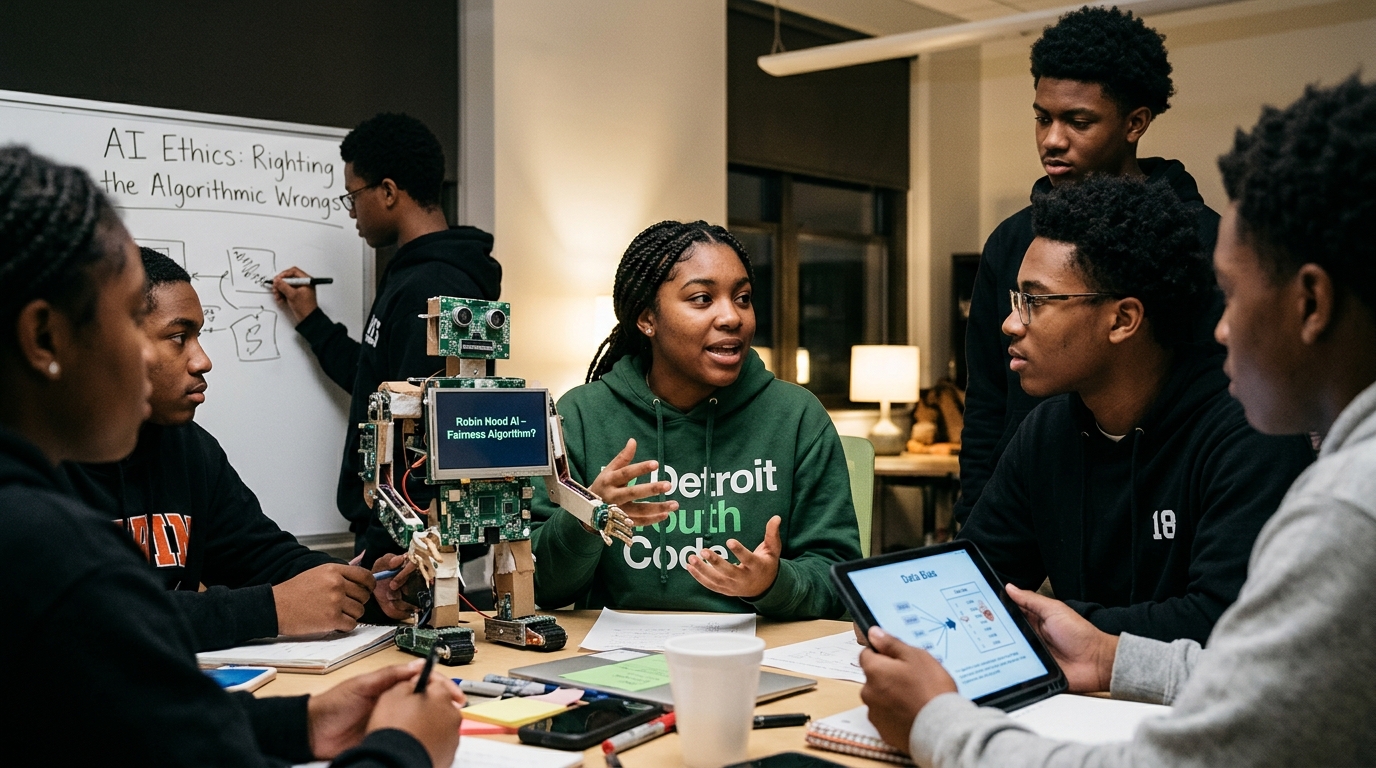
In the heart of Detroit, a city historically perched at the intersection of industrial innovation and social struggle, a new generation of "outlaws" is emerging. They aren't wielding bows and arrows, but rather code, critical thinking, and a profound understanding of the social implications of technology. A recent initiative, highlighted by The Detroit News, brings the city's youth face-to-face with the legend of Robin Hood—not as a simple story of the past, but as a lens through which to analyze the modern challenges of Artificial Intelligence (AI) and social justice.
The Legend as an Analytical Tool
The choice of Robin Hood is far from accidental. The central motif—stealing from the rich to give to the poor—takes on a new, digital dimension in the context of the data economy. Students in Detroit are asked to reflect: Who is the modern-day "Sheriff of Nottingham"? Is it the Big Tech corporations harvesting data without meaningful consent? Is it the governments using algorithms to disproportionately police marginalized communities? And most importantly, what would a digital "Robin Hood" look like today?
This program goes beyond basic coding education. While many STEM programs focus exclusively on technical skills, this initiative centers on "algorithmic literacy." Participants learn how algorithms can embed and amplify existing societal biases. For instance, they discuss how facial recognition systems—which have been extensively used in Detroit through "Project Green Light"—have higher error rates for people with darker skin tones, leading to wrongful arrests and systemic harassment.
From Surveillance to Empowerment
Detroit serves as a living laboratory for these discussions. The city has been at the epicenter of national controversies regarding police surveillance and technology. By using the Robin Hood framework, youth explore the concept of "data redistribution." Instead of data being a source of profit for the few, how could it be used to serve the public good? Perhaps a modern Robin Hood wouldn't steal gold, but would instead "liberate" algorithms, making them transparent and accountable to the community.
- Algorithmic Bias: Understanding how training data can lead to racist or classist outcomes in automated decision-making.
- Digital Privacy: The importance of protecting personal information as an act of political and social resistance.
- Community-Led Tech: Creating AI tools designed by and for the community itself, rather than being imposed from the outside.
Ethics and the Future
The significance of this program lies in changing the narrative. Often, technology is presented as something neutral or inevitable. By teaching youth to question the power structures behind the screen, they are empowered to become not just consumers or tech sector employees, but active citizens demanding justice. Ethical questions regarding labor automation and the concentration of wealth through AI are brought to the table, with students proposing solutions rooted in solidarity and equity.
"We aren't just learning how AI works. We are learning how to make it work for us, instead of let them use it against us," says one of the program participants.
In an era where Artificial Intelligence threatens to widen the gap between those who control technology and those who are controlled by it, the "Robin Hoods" of Detroit remind us that justice is not something granted by the powerful, but something reclaimed through knowledge, imagination, and collective action. Reimagining folklore proves to be the most potent tool for understanding a future that is already here.