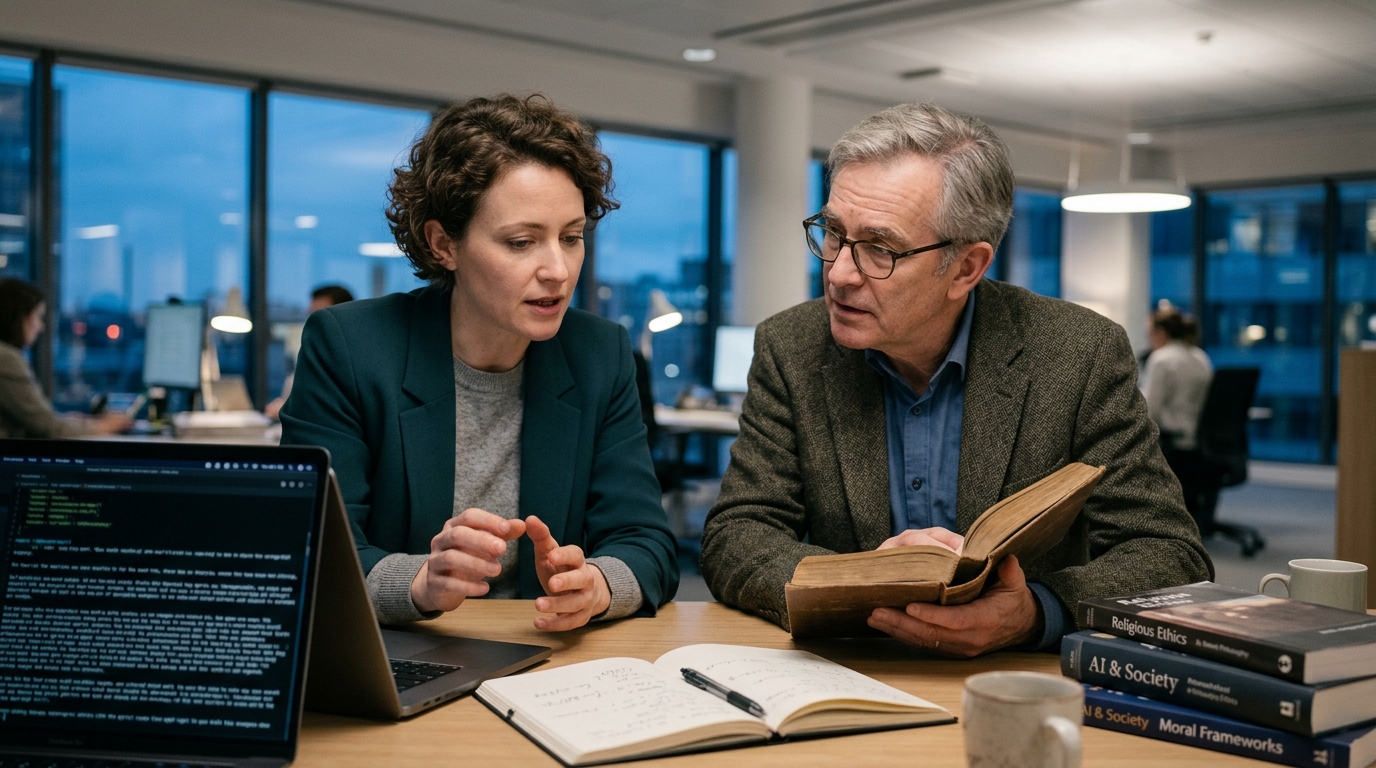
In the heart of Silicon Valley, one of the world's most influential AI labs, Anthropic, is attempting something that once belonged to the realm of theology or political philosophy: the codification of global morality. The recent revelation that the company has integrated teachings from several major religions into the "Constitution" of its flagship model, Claude, marks a new chapter in the quest for AI alignment. This is no longer just about filtering out toxic content; it is an active effort to weave millennia of human wisdom and doctrine into the core of the machine's decision-making process.
The Framework of Constitutional AI
To grasp the weight of this development, one must understand Anthropic's signature approach: Constitutional AI. Unlike the Reinforcement Learning from Human Feedback (RLHF) method popularized by OpenAI—which relies on vast teams of humans ranking responses—Anthropic trains its models to self-correct based on a written set of principles. This "Constitution" initially drew from the UN Declaration of Human Rights and Apple's terms of service, creating a baseline of liberal democratic values.
However, the critique that such documents are overly Western-centric and secular led Anthropic to broaden its horizons. By incorporating religious texts from Christianity, Islam, Judaism, Buddhism, and Hinduism, the company aims to provide a moral compass that resonates with the billions of people living outside the Western secular bubble. The goal is not to make Claude a proselytizer, but to give it a sophisticated understanding of the ethical frameworks that govern human behavior globally.
The Dilemma of Contradiction and Interpretation
Embedding religious mandates into an algorithm raises profound questions. Who chooses which verses are selected? How does an AI handle the inherent contradictions between different faiths or even within a single religion? For instance, the concept of justice can vary wildly between a strict interpretation of Sharia law and the Buddhist principle of ahimsa (non-violence).
Anthropic argues that its focus is on "convergent morality." They seek the universal constants—such as compassion, honesty, and the sanctity of life—that appear across all major spiritual systems. Yet, the risk of "moral blandness" is real. An AI trying to satisfy every religious sensibility might end up with a sanitized, performative ethics that avoids difficult truths to avoid offending any specific group. Furthermore, there is the persistent danger of inheriting historical biases regarding gender, hierarchy, and social structure present in ancient texts.
Cultural Inclusion or Digital Colonialism?
This move can be viewed through two distinct lenses. On one hand, it is a sincere attempt to de-center the American perspective in AI development. As Claude is deployed globally, from Riyadh to Tokyo, it must navigate diverse moral landscapes. Including religious frameworks allows the model to understand the nuance and context of queries from users whose primary moral compass is spiritual rather than legalistic.
On the other hand, there is a growing concern about a private corporation in California acting as the supreme arbiter of global ethics. When Anthropic decides which parts of the Quran or the Bible are "appropriate" for its AI, it exercises a form of spiritual power. This "digital dogma" could shape the worldviews of future generations, as people increasingly turn to AI for advice, companionship, and ethical guidance. We are witnessing the birth of a new kind of authority—one that is opaque, algorithmic, and corporate.
The Future of Machine Ethics
Anthropic’s initiative forces us to confront an uncomfortable truth: there is no such thing as a "neutral" AI. Every line of code and every weight in a neural network carries latent values. By moving away from the pretense of mathematical objectivity, Anthropic’s researchers are acknowledging that ethics is a human construct and must, therefore, be drawn from the sources that have historically shaped human civilization.
In the future, we may see the emergence of "moral profiles" for AI, where users can toggle between Catholic, secular-humanist, or Stoic frameworks depending on their personal beliefs. For now, Anthropic is attempting to synthesize these disparate voices into a single, cohesive identity. Whether this results in a wiser machine or a moral muddle remains to be seen. What is certain is that the bridge between faith and silicon has been crossed, and the implications for our digital and spiritual lives are immense.