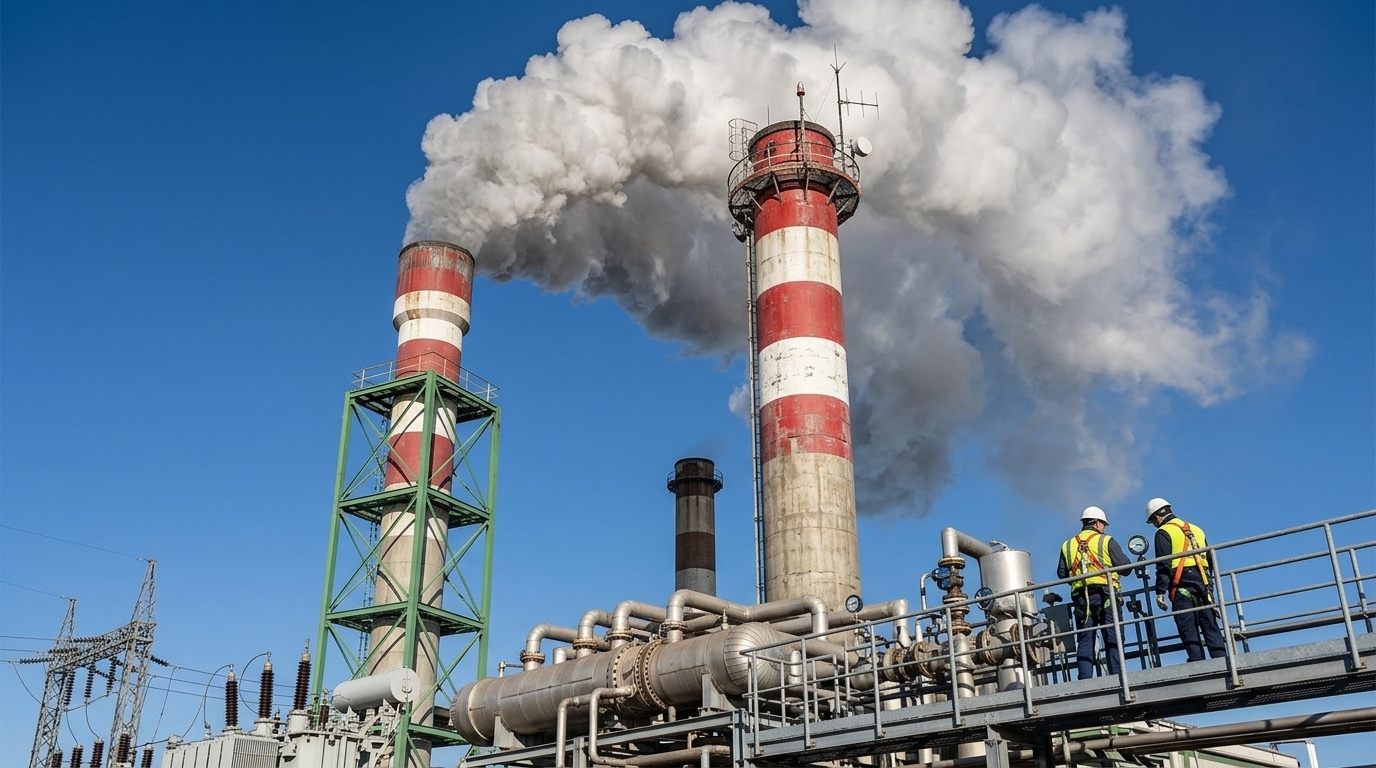
The global community stands at a critical juncture where the promise of technological progress is violently clashing with the urgent necessity of environmental sustainability. According to recent analyses and data highlighted by Fortune, the United States finds itself at the center of a disturbing statistic: it is responsible for nearly half of the increase in global carbon dioxide emissions over the past year. The culprit is not traditional heavy industry, but the "invisible" infrastructure of the digital age: the massive data centers powering the Artificial Intelligence (AI) revolution.
The Insatiable Hunger of Artificial Intelligence
Training a single Large Language Model (LLM) requires staggering amounts of electricity, not only to run thousands of GPU processors but also for the sophisticated cooling systems needed to prevent facilities from overheating. As companies like Microsoft, Google, and Amazon engage in a frantic race for AI dominance, power demand in the U.S. has surged to levels unforeseen just five years ago. The irony is palpable: while these tech giants lead global investments in renewable energy, the sheer pace of AI development is outstripping the power grid's ability to integrate clean energy.
The result is the life extension of coal-fired power plants and an increased reliance on natural gas to provide baseline load. In the U.S., regions like Northern Virginia—the world's "data center capital"—are seeing energy needs double, forcing utilities to revert to carbon-heavy solutions to avoid blackouts. This dynamic effectively cancels out much of the progress made through decarbonization efforts in other sectors of the economy.
The Big Tech Dilemma and Climate Goals
Tech titans are now facing an existential crisis of both public relations and substance. On one hand, they have committed to "net-zero" footprints by 2030 or 2040. On the other, their emissions are rising instead of falling. Google recently admitted that its emissions have increased by nearly 50% compared to 2019, primarily due to the energy consumption of its data centers. Microsoft faces a similar challenge, with its footprint expanding as it integrates ChatGPT into every facet of its services.
Analysis shows that the emission spike in the U.S. is not merely a local issue but a factor affecting the total global effort to limit planetary warming. When the world's largest economy and innovation leader burns more carbon to train algorithms, the message sent to developing nations is discouraging. The ethical dimension of using so much energy to generate content or automate tasks while the planet faces extreme climate events is becoming a subject of intense political debate.
Seeking Solutions: Nuclear Energy and Efficiency
The solution to the problem does not seem to be slowing down AI—something no company or government appears willing to do for reasons of national security and economic competition—but rather a radical shift in how energy is produced. Already, we are seeing a pivot toward nuclear power. Microsoft recently signed a deal to help reopen the Three Mile Island plant, while Amazon and Google are investing in Small Modular Reactors (SMRs). Nuclear energy provides the 24/7 stability that data centers require, something wind and solar cannot guarantee without massive storage infrastructure.
Simultaneously, there is growing pressure to develop "greener" algorithms. Research is now focusing on "computational energy efficiency," attempting to reduce the flops (floating point operations) required for the same quality of output. However, Jevons' Paradox looms: as a technology becomes more efficient, we tend to use it more, ultimately leading to higher total consumption.
Conclusion: A Political and Technological Challenge
The rise in emissions due to AI in the U.S. underscores the need for a new national energy strategy that aligns with digital strategy. It is not enough to be the leader in AI if the price is environmental collapse. The international community will be watching closely to see how Washington manages this contradiction, as decisions made today in Big Tech boardrooms and energy regulatory offices will determine the planet's climate for decades to come. AI promises to solve the climate crisis through resource optimization, but for now, it remains a significant part of the problem.