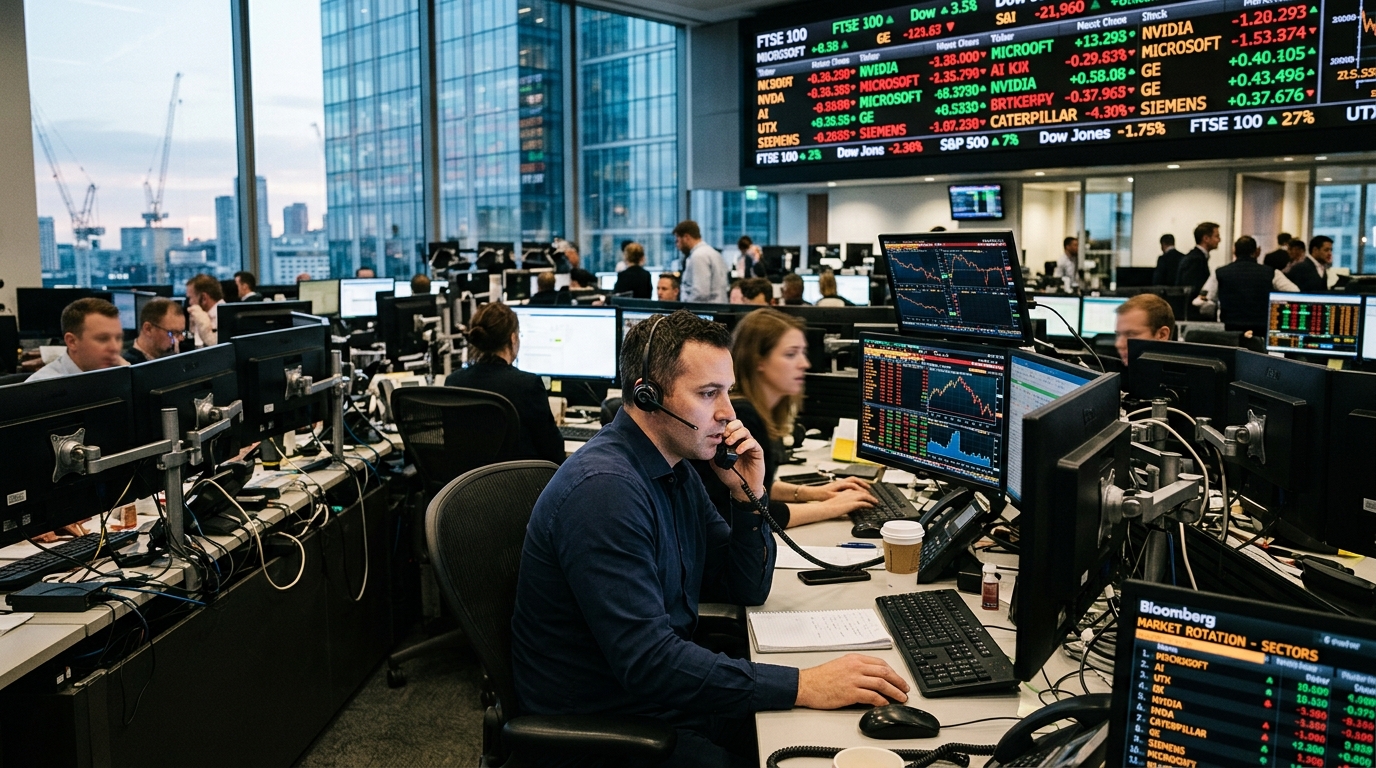
The history of technological revolutions almost always follows a predictable pattern: first comes the invention, then the tool, and finally the infrastructure that enables broad scale. In the case of Artificial Intelligence (AI), 2023 and 2024 were the years of the "tool" — the GPU processor. However, as we approach the second half of 2026, the investment narrative is shifting dramatically. The market is realizing that no matter how powerful a chip is, it cannot function without power, cooling, and a robust energy distribution network. This "great rotation" marks the transition from silicon to steel and copper.
The Saturated Semiconductor Market and the Search for New Value
For nearly three years, Nvidia and its rivals, such as AMD, were the absolute masters of the stock market rally. But their valuations have reached levels that induce vertigo, forcing institutional investors to look for the next phase of growth. The logic is simple: demand for AI computing power is now so massive that the bottleneck is no longer the availability of chips, but the capacity of data centers to house and power them.
Next-generation chips, like Nvidia's Blackwell architecture, require enormous amounts of energy and generate heat that traditional air-cooling methods simply cannot manage. This is where infrastructure companies step in, transforming from "boring" industrial stocks into high-tech protagonists.
Vertiv and Eaton: The Unsung Heroes of AI
Two companies have stood out in this market pivot: Vertiv Holdings (VRT) and Eaton Corporation (ETN). Vertiv specializes in thermal management systems and digital infrastructure. As data centers transition to liquid cooling to withstand the load of LLMs (Large Language Models), Vertiv is seeing its order books swell to record levels. Its expertise in precision cooling makes it an indispensable partner for every new Google or Microsoft data center.
On the other hand, Eaton focuses on electrical infrastructure. The transformers, switchgear, and uninterruptible power supply (UPS) systems it manufactures are the "arteries" carrying the lifeblood of AI — electricity. With the global power grid under strain, Eaton isn't just selling equipment; it's selling the very survival of the digital ecosystem. Its strategic position in the energy supply chain gives it both defensive and offensive investment value.
The Energy Paradox and the Geopolitics of Infrastructure
The shift toward infrastructure also highlights a critical political and social issue: the energy crisis caused by AI. While governments push for a "green transition," the massive energy consumption of AI models often necessitates a return to traditional sources or the rapid development of small modular reactors (SMRs). Infrastructure companies are at the center of this conflict between technological progress and sustainability.
Furthermore, infrastructure is local. While a chip can be designed in California and manufactured in Taiwan, a data center must be built on specific land, with specific permits and access to the local grid. This provides companies in the sector with a geopolitical stability that semiconductor manufacturers, caught in the US-China trade war, often lack.
Conclusion: The Maturation of the AI Trade
The investment rotation we are witnessing in 2026 is not a move away from AI, but a sign of market maturation. Investors are stopping to look only at the "brain" of the machine and are starting to pay attention to its "body." Vertiv and Eaton represent only the tip of the iceberg in a sector expected to attract trillions of dollars in capital expenditures over the next decade. For the savvy investor, the opportunity no longer lies in the speed of the processor, but in the reliability of the transformer.