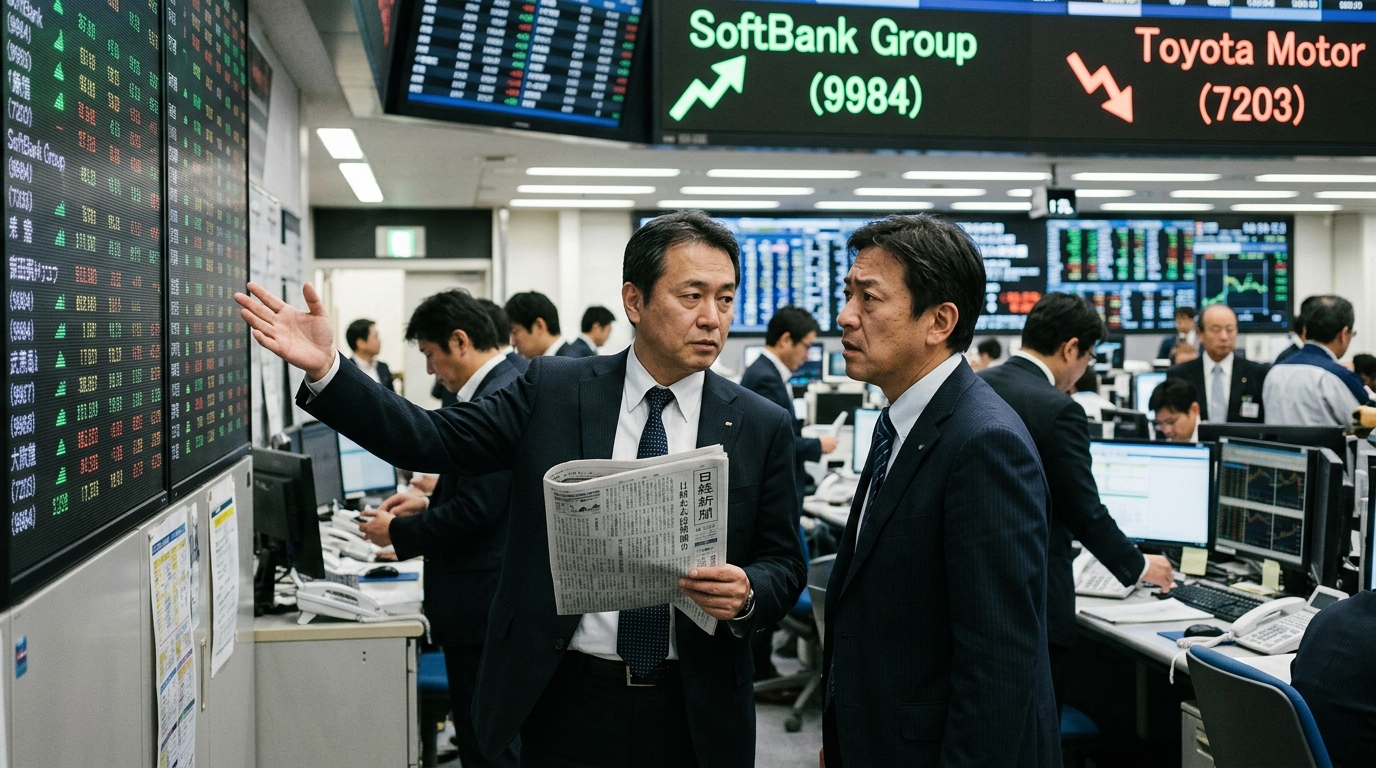
In the heart of Tokyo, a silent yet cataclysmic shift is taking place within the corridors of the Stock Exchange. For decades, Toyota Motor Corp. stood as the undisputed symbol of Japan’s economic miracle and industrial prowess. However, as of June 1, 2026, the status quo has been shattered. SoftBank Group Corp., led by the visionary and often controversial Masayoshi Son, is now on track to dethrone the automotive giant as the nation’s most valuable company. This development is not merely a change in rankings; it is the official validation of Japan’s transition from the age of atoms to the age of bits.
The Redemption of Masayoshi Son and the Arm Catalyst
SoftBank’s ascent was neither easy nor expected just a few years ago. Following the collapse of WeWork and staggering losses within the Vision Fund, many analysts had written off the end of Son’s empire. Yet, his strategic obsession with Artificial Intelligence (AI) has paid off in the most spectacular fashion. The linchpin of this success is Arm Holdings. The semiconductor design firm, in which SoftBank maintains a majority stake, has become the backbone of global AI infrastructure.
As demand for specialized chips capable of handling Large Language Models (LLMs) skyrocketed through 2025 and into 2026, Arm’s valuation followed a parabolic trajectory reminiscent of Nvidia’s. SoftBank, now operating more as an investment arm for AI than a traditional telecom firm, capitalized on this explosion. Son, who recently stated that his life’s purpose is the realization of Artificial General Intelligence (AGI), now sees the market aligning with his long-held predictions. The "Vision" is finally manifesting in the balance sheet.
Toyota and the Challenge of the New Paradigm
Conversely, Toyota represents the traditional model of Japanese success: stability, quality, and physical production. Despite its efforts to lead the hybrid market and its delayed but forceful entry into electric vehicles (EVs) with solid-state batteries, its market capitalization appears to have hit a plateau. Investors in 2026 are no longer solely seeking dividends and steady sales; they are hunting for the exponential growth promised by AI integration.
Toyota also faces mounting pressure from China and emerging tech firms that view the car as a "computer on wheels." While Toyota remains profitable and operationally superb, the market is penalizing it for the lack of a compelling "AI-first" narrative. The contrast is stark: SoftBank is selling the future of intelligence, while Toyota is selling the present of mobility. In the current economic climate, the former is valued at a significant premium. The industrial logic of the 20th century is being replaced by the computational logic of the 21st.
Geopolitical and Social Implications
The changing of the guard at the top of Japanese business has profound implications for the country’s national strategy. The government in Tokyo has invested billions to transform Japan into a global semiconductor hub, attempting to reclaim the glory of the 1980s. SoftBank’s success bolsters this narrative but also raises concerns. Japan’s economy is becoming increasingly dependent on the volatility of the tech sector and the decisions of a single individual, Masayoshi Son.
Furthermore, there is the issue of employment. Toyota and its vast supply chain employ millions of people across Japan. SoftBank, as an investment group, has a much smaller physical footprint. If the Japanese economy shifts too heavily toward capital and technology while neglecting manufacturing, social balances may be disrupted. The question now circulating in economic circles is whether this AI boom has solid foundations or if Japan is abandoning the safe harbor of industry for an uncertain digital frontier.
- SoftBank's market cap is driven largely by its 90% stake in Arm.
- Toyota's valuation remains tied to physical manufacturing cycles.
- The Nikkei 225 is becoming increasingly tech-heavy, mimicking the Nasdaq.
Ultimately, SoftBank’s rise to the top marks the milestone of a new era. Japan in 2026 is no longer the land of transistors and cars, but a nation aspiring to control the intelligence of tomorrow. Whether Son will be fully vindicated or if Toyota will launch a successful counter-offensive remains to be seen, but the map of power has already been redrawn.