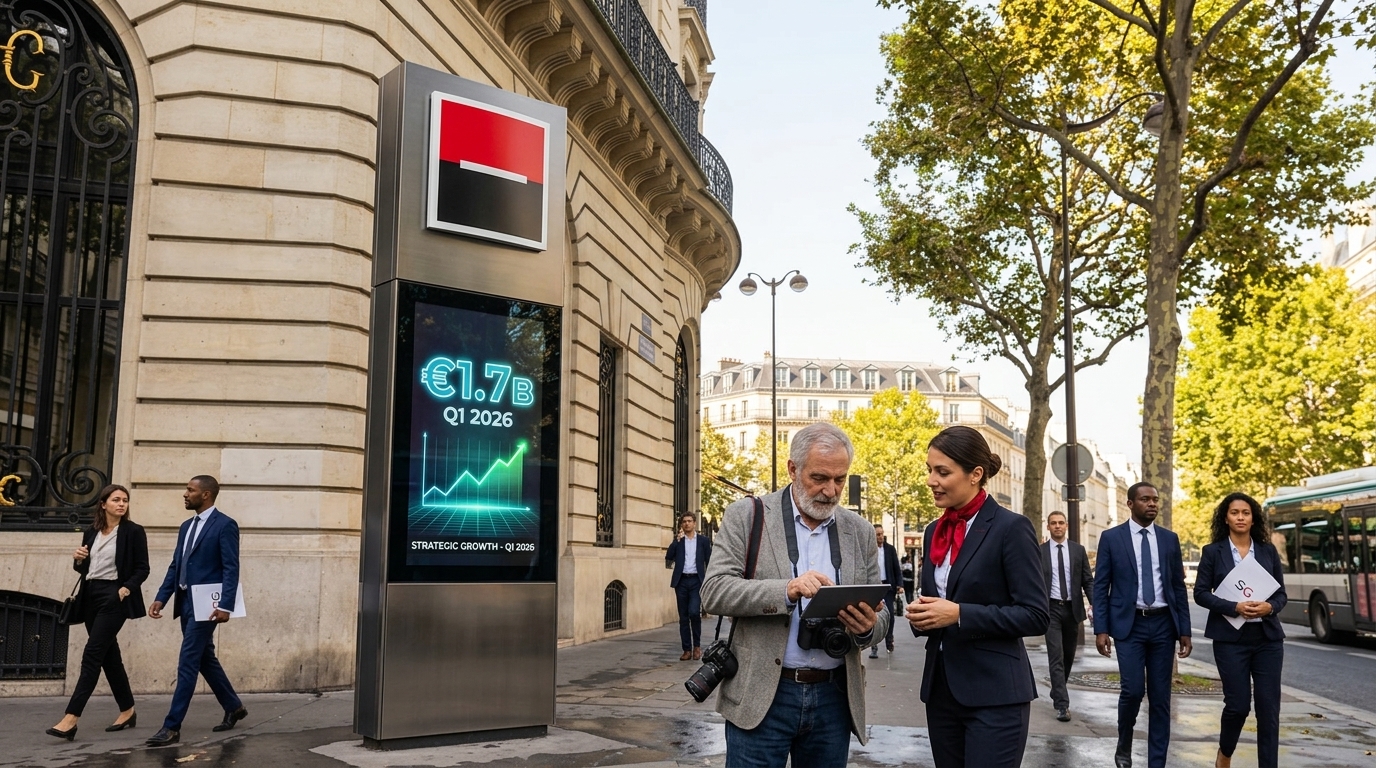
At a time when the European banking system is seeking stability amidst a shifting macroeconomic landscape, Societe Generale has presented results suggesting that the period of uncertainty may finally be a thing of the past. With net profits of €1.7 billion for the first quarter of 2026, France’s third-largest listed bank appears to be validating the choices made by its CEO, Slawomir Krupa, who took the helm promising a "new era" of discipline and efficiency.
The Krupa Strategy and Cost Discipline
When Slawomir Krupa unveiled his "Vision 2026" strategic plan two years ago, markets were skeptical. The commitment to drastic cost reduction and simplifying the group's structure was seen by many as a difficult balancing act. However, the Q1 2026 results show that the bank is moving with precision toward its targets. The reduction in operating expenses was not merely a result of cuts but the product of a deep structural transformation involving the digitalization of internal processes and the consolidation of previously autonomous departments.
Krupa emphasized that "revenue momentum" was combined with an "improvement in operating leverage," which in banking parlance means the bank managed to grow its business without a proportional increase in costs. This strategy has made Societe Generale more agile in the face of interest rate fluctuations, which in 2026 are showing signs of stabilizing after the continuous hikes of previous years.
The Power of Global Markets and Ayvens
One of the key pillars of profitability was the Global Banking & Investor Solutions sector. Performance in capital markets was particularly strong, capitalizing on increased volatility and demand for hedging products. Meanwhile, Ayvens (the entity formed from the merger of ALD Automotive and LeasePlan) has begun to deliver the expected economies of scale, significantly boosting revenue from mobility services.
- Net banking income increased by 4.5% year-on-year.
- Common Equity Tier 1 (CET1) ratio at 13.4%, providing a significant capital buffer.
- Cost-to-income ratio reduced below 65%.
BoursoBank, the group’s digital subsidiary, continued its impressive trajectory, consolidating its position as a leader in the French online banking market. The strategy of attracting customers at a low cost and providing a full range of financial products via mobile devices seems to be paying off, turning a cost center into a steady source of future profit.
Technological Transformation and Artificial Intelligence
One cannot analyze Societe Generale’s success in 2026 without mentioning the integration of Artificial Intelligence. The bank has invested billions in developing proprietary AI models for risk analysis and customer service. According to bank executives, the use of Generative AI in the back-office has reduced request processing times by 30%, contributing decisively to the operational cost reductions cited by Krupa.
"Technology is no longer a supporting tool, but the central axis of our profitability," Krupa stated during the results presentation.
Challenges and the Future of the European Banking Sector
Despite the euphoria, challenges remain. The geopolitical environment remains fragile, and the possibility of an economic slowdown in the Eurozone could increase provisions for bad loans. Furthermore, competition from FinTech companies and Big Tech firms entering financial services forces traditional banks to remain constantly vigilant.
Societe Generale, however, seems to have found its stride. With the completion of its exit from non-strategic markets and a focus on Europe and international corporate banking services, the group appears more fortified than ever. The challenge for the remainder of 2026 will be maintaining this discipline, as the sirens of expansion may reappear as the market recovers.