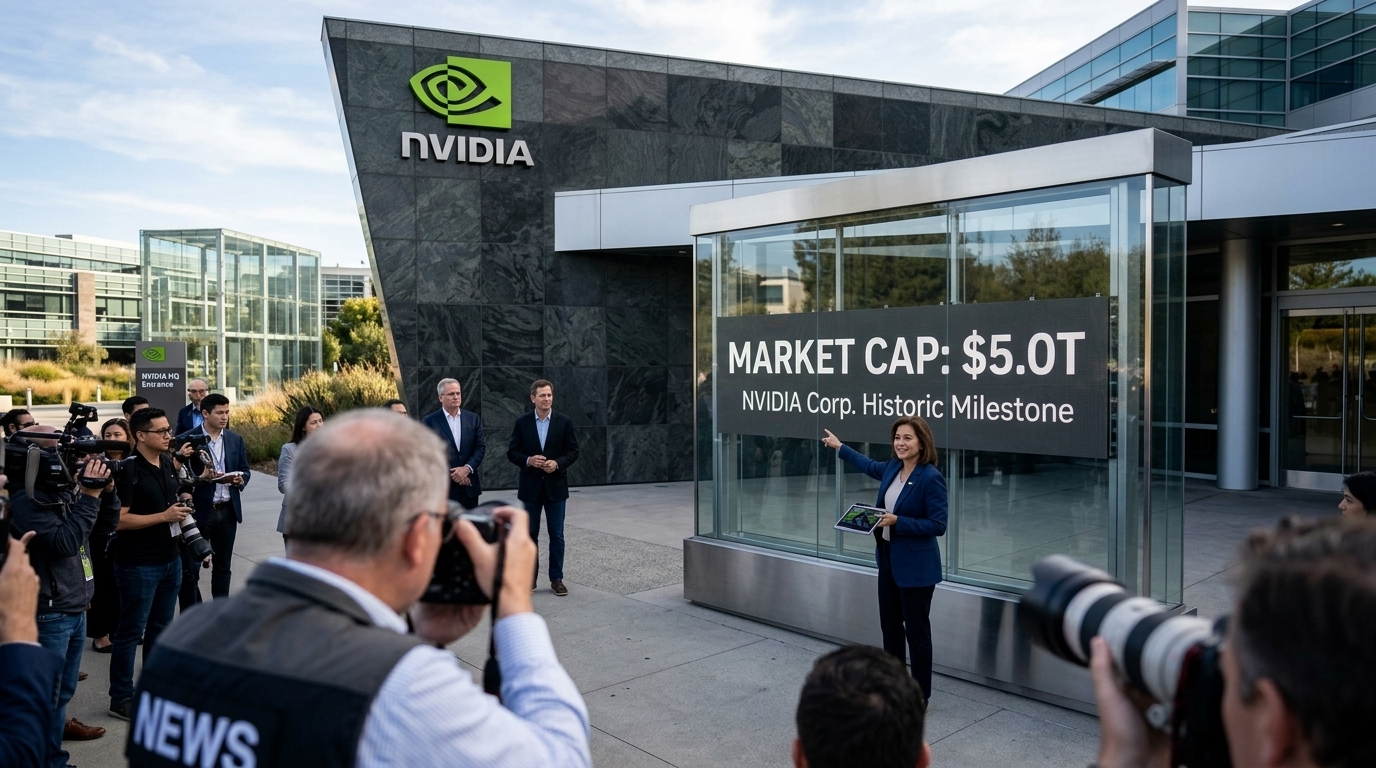
In a historic moment for the global economy and the technology industry, Nvidia Corp. has breached the $5 trillion market capitalization threshold. This milestone, achieved on Friday, April 24, 2026, is not merely a number on a trading floor but the hallmark of a new era where computational power is the most valuable commodity on the planet. The company's stock surged, driven by relentless demand for its next-generation Blackwell chips and the expansion of Artificial Intelligence (AI) infrastructure at the state level.
The Architecture of Dominance: From H100 to Blackwell
Nvidia's ascent from a niche graphics card manufacturer for gamers to a global economic titan is a phenomenon that will be studied in business schools for decades. The driving force behind this latest rally is the Blackwell architecture. While its predecessors, the H100 and H200 units, laid the groundwork for Generative AI, the Blackwell series promises a tenfold increase in performance with significantly lower power consumption. This technological chasm between Nvidia and its competitors, such as AMD and Intel, has created a competitive moat that appears nearly impenetrable.
Major Cloud Service Providers (CSPs), including Microsoft, Amazon, and Google, continue to commit billions of dollars to Nvidia hardware. However, the new trend propelling the valuation is the rise of "Sovereign AI." Nations like Saudi Arabia, the UAE, and various EU member states are now investing directly in national data centers, seeking to secure their digital sovereignty. Nvidia is no longer just selling chips; it is selling the entire infrastructure of modern intelligence.
Economic Bubble or New Reality?
With market capitalization hitting $5 trillion, voices warning of a "bubble" reminiscent of the dot-com crash of 2000 are growing louder. However, Wall Street analysts point to a fundamental difference: earnings. Unlike the companies of 2000 that relied on promises and eyeballs, Nvidia boasts profit margins nearing 75% and cash flows that rival those of oil giants. Demand continues to outstrip supply, with waiting lists for the new Blackwell processors extending well into 2027.
"We are not just in a bull market. We are in the midst of the largest reallocation of capital in human history, moving from traditional infrastructure to intelligence infrastructure," stated a leading investment strategist.
Furthermore, Nvidia's CUDA software remains its "secret weapon." Millions of developers worldwide have built their applications on this framework, making a switch to competing platforms extremely difficult and costly. Nvidia is no longer a semiconductor company; it is the platform upon which the future global economy is being constructed.
Geopolitical Risks and the Supply Chain Challenge
Despite the triumph, the road to $6 trillion is not without obstacles. Nvidia's heavy reliance on TSMC (Taiwan Semiconductor Manufacturing Company) for chip production remains its Achilles' heel. Geopolitical tensions between the US and China regarding Taiwan represent the single largest systemic risk. Any disruption in the Taiwan Strait could erase trillions of dollars in market value within hours.
Simultaneously, regulators in the US and the EU are closely monitoring the company for potential monopolistic practices. As Nvidia expands into software and cloud services, the risk of being deemed "too powerful" increases. Jensen Huang's ability to navigate these political waters will be just as critical as his company's technological innovation in the years to come.
- Nvidia's market cap now exceeds the GDP of most G7 nations, excluding the US and Japan.
- AI investments now account for approximately 40% of total capital expenditures by Big Tech firms.
- The energy crisis remains a looming challenge, as data centers require massive amounts of electricity to operate.