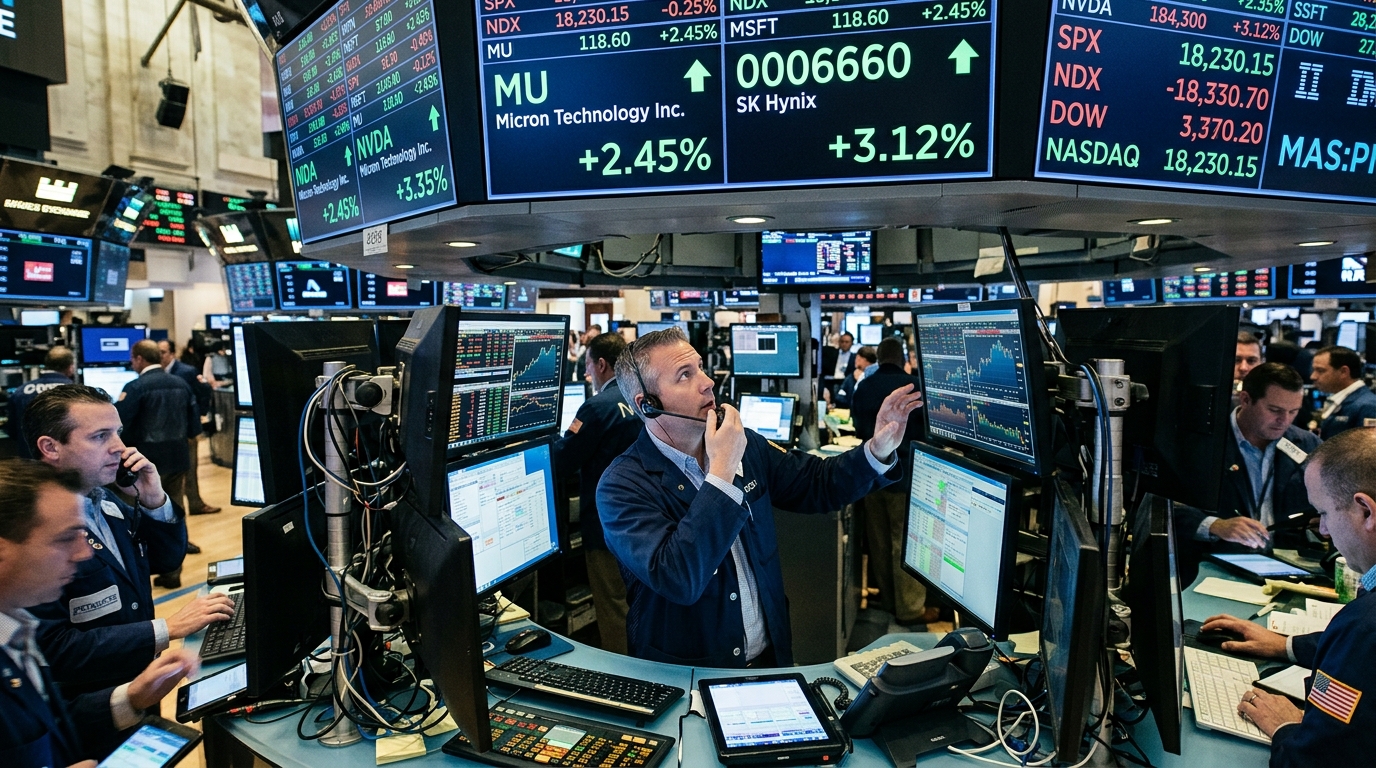
As we enter June 2026, the global semiconductor market bears little resemblance to the landscape of just two years ago. While Nvidia remains the undisputed king of GPUs, the focus of investors and tech giants has shifted to a critical, yet often overlooked, component of AI infrastructure: High Bandwidth Memory (HBM). The recent news that two major players in the memory chip sector, Micron Technology and SK Hynix, have solidified their position within a sector valuation context approaching the $1 trillion mark highlights a pivotal moment for the global economy.
The End of the Bottleneck: Why Memory is the New Gold
For years, DRAM memory was considered a commodity with low margins and high cyclicality. However, the advent of Large Language Models (LLMs) changed everything. An AI processor is only as powerful as its ability to access data quickly. HBM3e and the forthcoming HBM4, developed by Micron and SK Hynix, provide the solution to what engineers call the "memory wall." Without these chips, the high-powered processors from Nvidia and AMD would be like race cars stuck in city traffic.
SK Hynix, the South Korean giant, was the first to bet heavily on HBM technology, securing a privileged partnership with Nvidia. On the other hand, US-based Micron made a stunning technological leap, skipping development generations to offer chips with lower power consumption—a critical advantage for data centers struggling with energy costs. The market capitalization of these companies now reflects not just their current sales, but their role as gatekeepers to the next phase of digital intelligence.
The $60 Strategy: Democratizing Tech Investment
One of the most compelling aspects of the current market is accessibility. While individual shares of Micron or other giants might seem expensive for the average retail investor, the use of Exchange Traded Funds (ETFs) such as the Invesco PHLX Semiconductor ETF (SOXQ) allows entry into the sector at a fraction of the cost. For approximately $60, an investor can gain exposure to a diversified portfolio that includes both of these memory leaders.
- Diversification: ETFs reduce the risk associated with the volatility of a single company.
- Low Cost: With expense ratios often below 0.20%, the investment is highly cost-efficient.
- Growth Participation: As demand for AI servers is projected to grow by 30% annually through 2028, semiconductor exposure is now considered a core component of a modern portfolio.
"Memory is no longer the secondary component of the computer. In the age of AI, memory is the brain itself in operation," a prominent Wall Street analyst noted.
Geopolitics and Future Challenges
Despite the optimism, the path forward is not without hurdles. SK Hynix finds itself at the center of the US-China competition, trying to balance its production facilities in mainland China with Washington's demands for export restrictions on cutting-edge technology. Meanwhile, Micron is benefiting from CHIPS Act subsidies in the US, building new plants in Idaho and New York, but faces the massive capital expenditure required to scale production.
The question is no longer whether AI is a bubble, but who will control its infrastructure. With SK Hynix and Micron leading the charge, the memory market has transformed from a low-margin sector into a battlefield of geopolitical and economic power. For the $60 investor, this battle offers a unique opportunity to participate in an industrial revolution that is only just beginning.