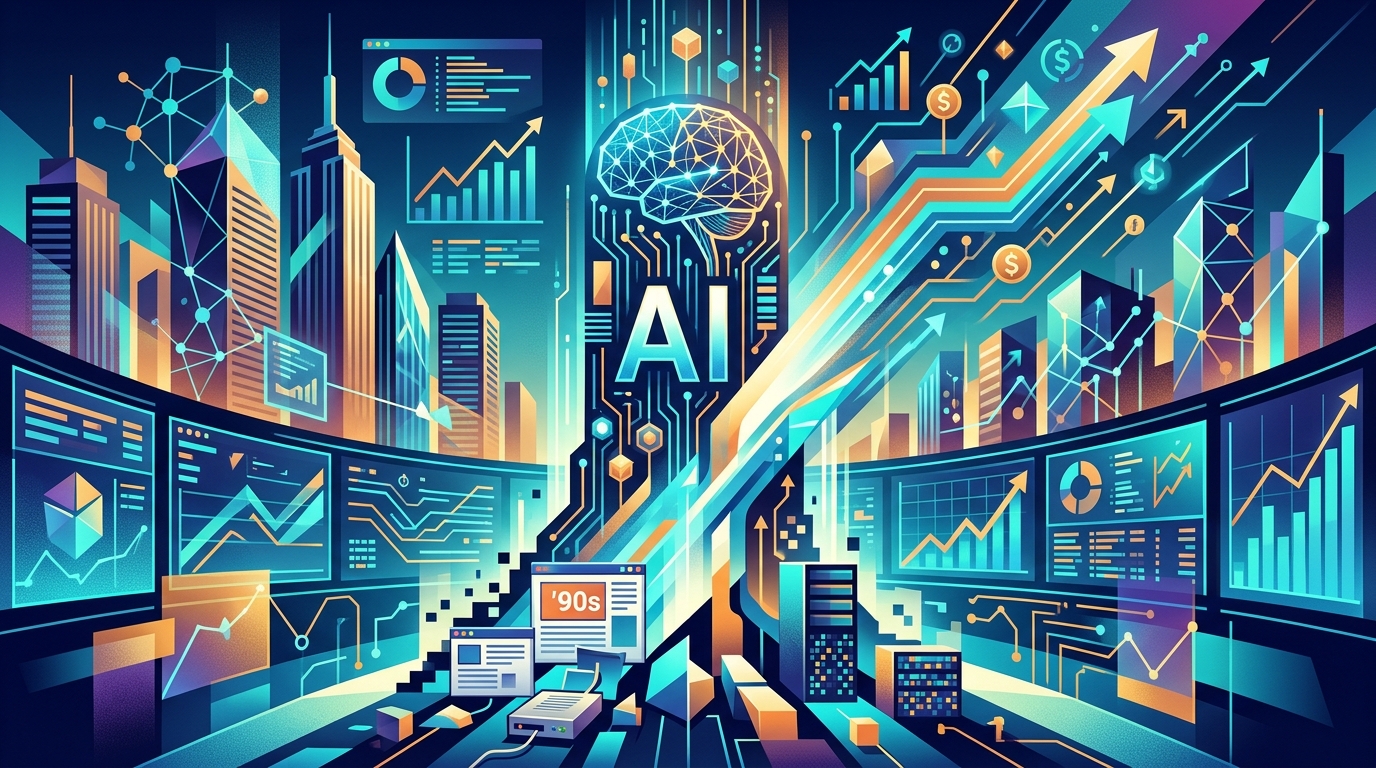
At SoftBank’s latest annual general meeting, Masayoshi Son, the man who has become synonymous with bold (and often controversial) tech investments, presented a vision that many would describe as audacious and others as perilously optimistic. According to Son, the Artificial Intelligence (AI) revolution is not just another technological trend but a tectonic shift that will make the internet explosion of the late 1990s—the famous Dot-Com boom—look like a minor historical footnote.
The Transition from Information to Superintelligence
Son did not limit himself to generalities. His analysis is rooted in the distinction between Artificial General Intelligence (AGI) and Artificial Superintelligence (ASI). While AGI refers to systems that can match human intelligence across all domains, ASI represents the stage where machines will be thousands of times smarter than any human. The SoftBank founder predicted that ASI will become a reality within the next ten years, fundamentally altering the structure of the global economy and society itself.
For Son, the internet changed how we exchange information and consume goods. AI, however, is set to change how we solve problems, create value, and perceive reality. The comparison to the Dot-Com boom is deliberate: back then, investors chased the promise of connectivity. Today, they are chasing the promise of infinite cognitive power. Son argues that the market capitalization of companies leading in AI will reach levels currently considered unthinkable, as the productivity unlocked will be exponential.
The ARM Bet and Future Infrastructure
Central to Son’s vision is ARM, the semiconductor design firm majority-owned by SoftBank. Son views ARM as the "brain" of the AI revolution. As AI models become increasingly demanding, the need for energy-efficient and ultra-powerful processors is becoming the new "oil" of the global economy. SoftBank’s strategy is shifting from mere software application investments (as seen with the Vision Fund) to building a comprehensive ecosystem that includes hardware, data centers, and energy.
- ARM’s dominance in low-power chips is key to bringing AI to mobile devices.
- Investment in energy infrastructure is essential to power massive data centers.
- Synergy between SoftBank portfolio companies aims for a vertical integration of AI.
Son admitted his past has had its ups and downs—obliquely referencing failures like WeWork—but emphasized that his faith in AI is unshakable. "I was not born to lose money; I was born to help humanity evolve," he stated, highlighting that SoftBank is now in "offense mode," ready to funnel billions of dollars into the next phase of the technological race.
Economic Implications and the Risk of a Bubble
Despite the enthusiasm, analysts remains divided. The comparison to the Dot-Com boom inevitably brings to mind the crash that followed in 2000. Many wonder if current valuations of companies like Nvidia or ARM are based on real earnings or excessive future expectations. Son, however, counters these fears by claiming that AI is already producing tangible value, unlike many 1999-era companies that lacked even a basic business model.
"The difference is that AI is not just a communication tool. It is an accelerator of intelligence. When intelligence becomes cheap and abundant, every industry—from medicine to manufacturing—is radically transformed."
In conclusion, Masayoshi Son is not just selling shares; he is selling a future where biological intelligence is complemented and eventually surpassed by synthetic intelligence. Whether this is the most accurate prediction of the century or another investment overreach, SoftBank’s influence ensures that this bet will define market trajectories for the next decade. Humanity stands at the threshold of an era where wealth will be measured not by resources, but by information processing capacity.