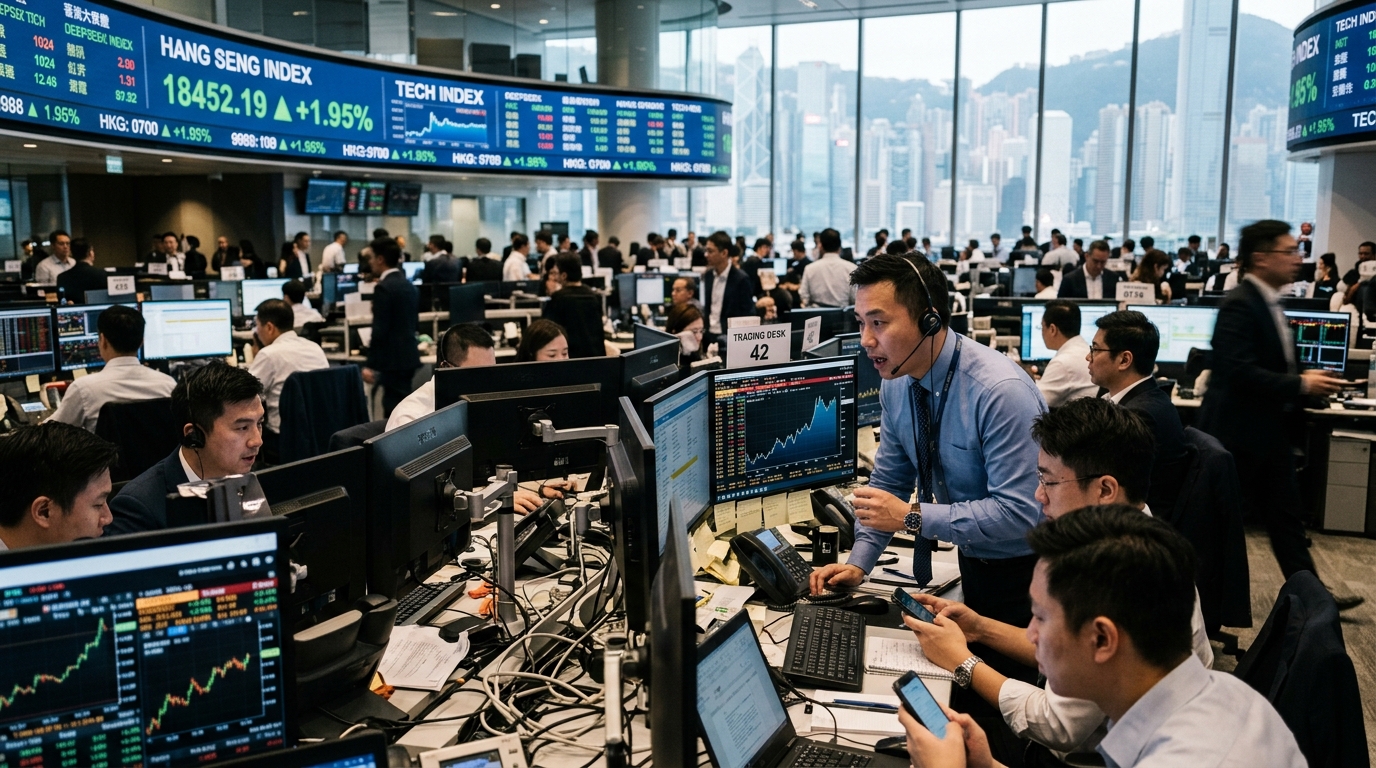
The global technology market is undergoing a seismic shift as the gravity of Artificial Intelligence (AI) investment moves from raw computational power to practical, industry-specific applications. At the heart of this transformation lies the Hong Kong Stock Exchange, which has recently resembled a digital gold rush. The spectacular surge in AI application stocks, led by Qunhe Technology (also known as Manycore) skyrocketing by over 50%, is no isolated incident. It represents the culmination of several key developments, most notably the buzz surrounding DeepSeek, the Chinese startup that has managed to challenge Silicon Valley’s dominance at a fraction of the cost.
The DeepSeek Phenomenon and the Death of 'Scaling Laws'
For years, the dominant narrative in AI has been the 'Scaling Law': the more data and the more processing power (GPUs) you throw at a problem, the better your model will be. DeepSeek, with the recent announcement of its first external financing round, has proven that there is another path. The company, which originated as an internal project of the quantitative hedge fund High-Flyer Quant, has managed to build models that rival OpenAI’s GPT-4o while utilizing significantly fewer resources.
The news that DeepSeek is opening up to external investors has sparked a frenzy. Investors no longer see AI as merely a game for Big Tech companies with bottomless pockets, but as a field where algorithmic ingenuity and optimization can outmaneuver the 'brute force' approach of massive chip clusters. This sentiment immediately spilled over into Hong Kong-listed companies, where the market is scouting for the 'next DeepSeek' among firms developing specialized applications (Vertical AI).
Qunhe Technology: Revolutionizing 3D Design
Qunhe Technology’s case is emblematic of this new trend. As a leader in 3D interior design and cloud-based planning, Qunhe integrated generative AI that allows users to transform simple sketches into fully photorealistic environments in seconds. The 50% stock price explosion reflects analyst conviction that the ultimate value of AI will be captured by those who own industry-specific data and the interfaces used by end-consumers.
According to reports from Futu Niuniu, the Hong Kong market is serving as both a 'safe haven' and a springboard for Chinese tech, especially at a time when US export restrictions on semiconductors are forcing Chinese firms to become more creative. The rally wasn't limited to Qunhe; SaaS software, digital marketing, and data analytics firms saw double-digit gains as the AI application ecosystem in China matures faster than anticipated.
"We are no longer in the phase of promises, but in the phase of execution. Companies that can demonstrate real revenue from AI are the ones that will dominate the stock markets in 2025," noted a market analyst in the South China Morning Post.
Geopolitical and Economic Convergence
This dynamic cannot be viewed in isolation from the geopolitical landscape. While Washington attempts to throttle China’s access to high-end Nvidia chips, Beijing is investing heavily in domestic innovation and algorithmic efficiency. DeepSeek has become the 'poster child' of this effort: if you can reach the top with fewer chips, sanctions lose their bite.
Furthermore, the liquidity flowing into the Hong Kong Stock Exchange suggests a return of institutional investor confidence in Chinese tech after a prolonged period of regulatory uncertainty. AI appears to be the catalyst bridging the gap between the old economy and the digital frontier. Investors are betting that China, due to its massive user base and industrial prowess, will be the first to implement AI at scale in manufacturing, logistics, and design.
Conclusion: The Era of Specialization
The rally in Hong Kong is a wake-up call for global markets. The era when AI was synonymous only with Microsoft, Google, and Nvidia is ending. The new era belongs to applications. Whether it is DeepSeek redefining the cost of intelligence or Qunhe changing how we design our physical world, AI is becoming 'invisible' and utilitarian. For investors, the challenge is no longer finding who makes the best chips, but who uses AI to solve real-world problems in the most efficient manner possible.