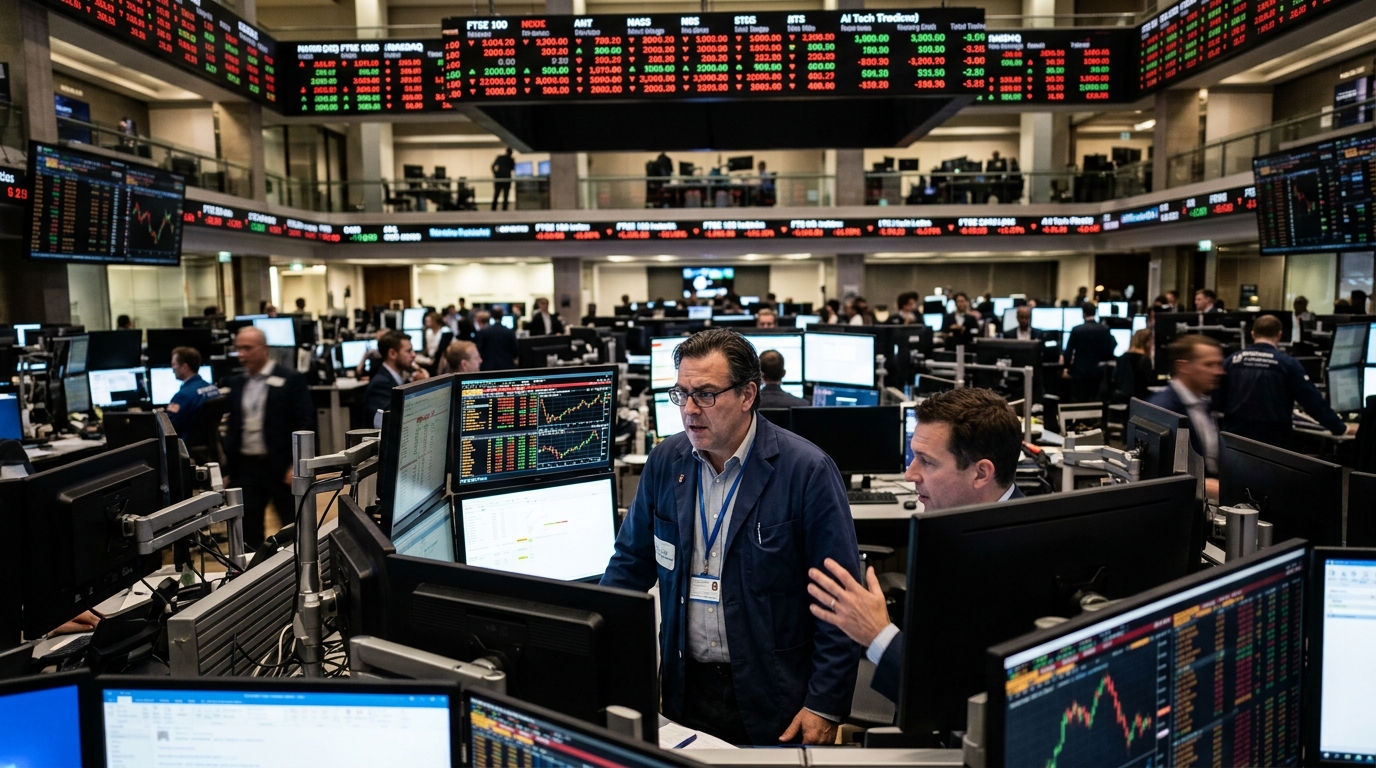
For decades, the dream of an "automated wealth machine" has haunted the halls of Wall Street and the City of London. With the advent of Large Language Models (LLMs) and advanced Artificial Intelligence, many believed the moment when algorithms would definitively surpass human intuition had arrived. However, recent data from trading contests, as reported by Bloomberg, reveals a different, more humbling reality: AI models are losing money where traditional strategies—or even simple luck—often prevail.
The Trap of Overfitting
The most fundamental problem AI developers face in financial markets is the phenomenon of overfitting. Models are trained on massive volumes of historical data, learning to recognize patterns that led to profits in the past. But the market is not a closed system like chess or Go; it is a chaotic environment where history rarely repeats itself in exactly the same way.
When a model "learns" the past too well, it tends to mistake random data noise for a significant signal. In recent contests, we saw AI models execute trades based on correlations that had no logical basis in the present, resulting in rapid capital depletion. The inability to distinguish between causality and mere coincidence remains the Achilles' heel of machine learning in finance.
Inability to Adapt to "Black Swans"
The markets of 2024 and 2025 have been characterized by intense geopolitical uncertainty, sharp shifts in central bank policies, and unpredictable events that economists call "Black Swans." AI, by its nature, is statistical: it predicts the most likely next step based on what has already happened. But when something unprecedented occurs, the AI freezes or, worse, reacts based on outdated scenarios.
- Geopolitical Tensions: Models struggle to quantify the impact of a diplomatic crisis or a military conflict.
- Mass Psychology: AI fails to understand the "irrationality" of investors driven by fear or excitement on social media.
- Regime Change: When the market shifts from a period of low volatility to a crisis period, algorithms often take too long to "realize" that the old rules no longer apply.
Competition and the Erosion of Alpha
Another critical factor is the proliferation of the technology itself. In the past, if a firm possessed a powerful algorithm, it held a massive advantage. Today, nearly every hedge fund and institutional investor uses similar AI models. This leads to the erosion of "Alpha" (returns above the market average). When all algorithms attempt to exploit the same small market inefficiency simultaneously, that opportunity vanishes in fractions of a second, and transaction costs devour any potential gains.
"Artificial Intelligence is excellent at solving problems with fixed rules. However, markets change their rules every time someone thinks they've learned them," notes a Wall Street analyst.
In conclusion, the failure of AI models in recent trading contests does not signal the end of the technology, but rather the beginning of a more mature phase. Blind trust in the "black boxes" of algorithms is giving way to hybrid models, where human judgment sets the boundaries and technology executes the strategy. The road to algorithmic profitability is proving to be much more arduous than the brochures of fintech companies promised.