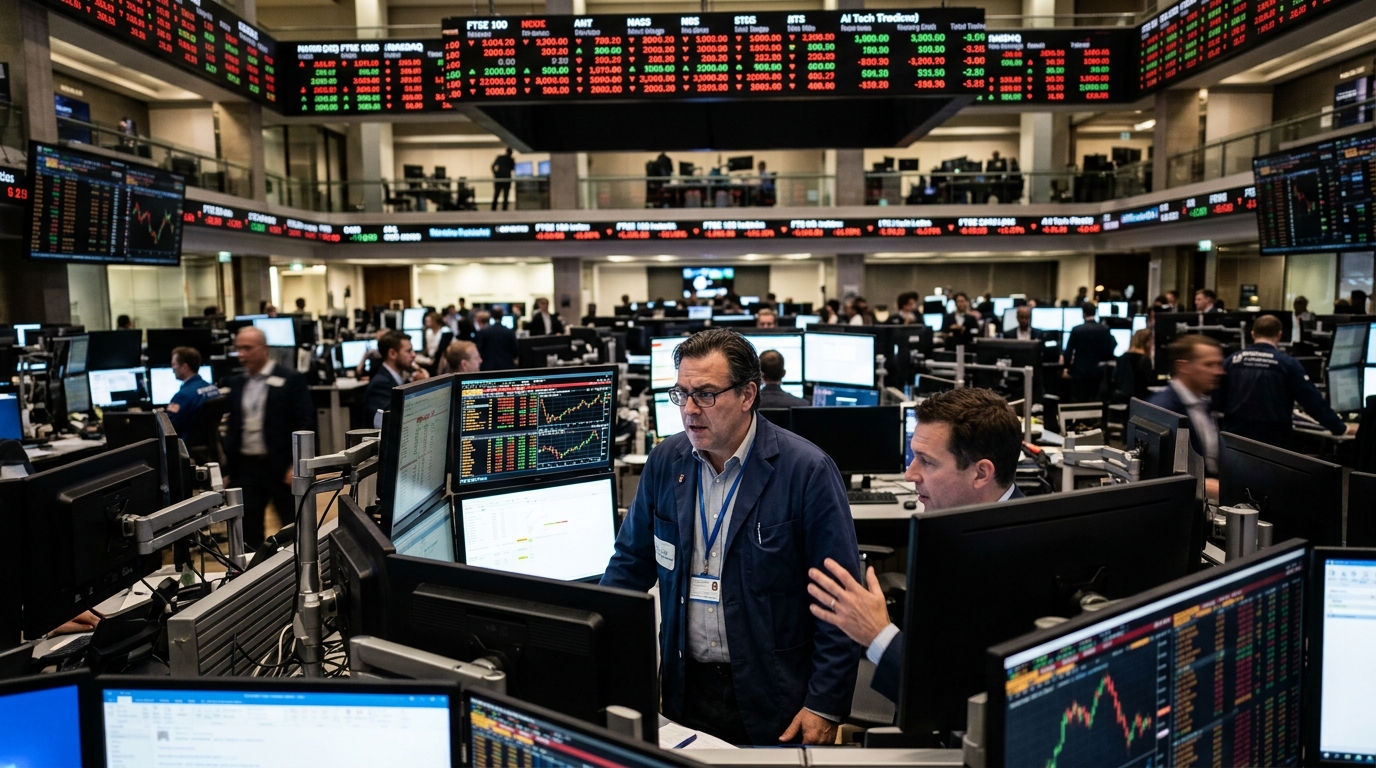
On April 26, 2026, the Artificial Intelligence investment landscape looks nothing like the 'Wild West' of 2023. The era of promises has passed, giving way to the era of performance and earnings. Investors are no longer satisfied with the mere mention of 'AI' in earnings calls; they demand tangible proof of productivity gains and revenue scaling. MarketBeat highlights that the current market is characterized by a shift toward specialization and infrastructure, with energy emerging as the year's unexpected protagonist.
Hardware Dominance and the Energy Challenge
Despite predictions of saturation, NVIDIA remains the undisputed leader, having evolved from a chip designer to a comprehensive data center ecosystem provider. However, in 2026, attention has shifted to 'Sovereign AI,' with nations like France, Saudi Arabia, and Japan investing billions in domestic infrastructure. This has boosted companies like ASML and TSMC, which serve as the gatekeepers of manufacturing technology.
The most interesting element of this year is the emergence of utility and energy stocks as 'proxy' AI plays. Energy consumption from next-generation models has exceeded all forecasts. Companies specializing in small modular reactors (SMRs) and renewables with grid-scale storage are seeing their valuations soar, as Big Tech (Microsoft, Google, Amazon) sign multi-decade contracts to secure power for their massive data centers.
Software and Applications: The Moment of Truth
On the software front, hype has been replaced by rigorous ROI analysis. Companies that successfully integrated AI into daily workflows, such as Salesforce and Adobe, are showing steady growth. However, 2026 is the year of 'Edge AI.' With the release of devices featuring integrated Neural Processing Units (NPUs) capable of running large language models locally, Apple and Qualcomm have returned strongly to the spotlight. The ability to process data on-device, without cloud reliance, solves major privacy issues and drastically reduces operational costs.
- NVIDIA (NVDA): Still the gold standard, but carries higher valuation risk.
- Microsoft (MSFT): Its cloud leadership and OpenAI partnership make it the 'safest' bet.
- Vertiv Holdings (VRT): The hidden winner in data center cooling and infrastructure.
- Palantir (PLTR): Its dominance in defense AI systems makes it a geopolitical powerhouse.
Geopolitics and the Regulatory Framework
We cannot ignore the role of the European Union and the AI Act, which is now fully implemented. Companies that comply quickly gain an advantage in the European market, while those that relied on questionable training data face massive fines. For the global investor, diversification remains key. The market is no longer moving in unison; we are seeing a decoupling where winners are separated from the 'AI-washers' who failed to deliver real value.
"Artificial Intelligence is no longer a sector of technology; it is the operating system of the global economy," a MarketBeat analyst noted.
In conclusion, April 26, 2026, finds the market in a phase of mature growth. Opportunities remain abundant but require a deep understanding of the tech stack and the physical constraints of energy and hardware. Investors must look beyond the obvious names and seek out the companies solving the structural problems of the AI era.