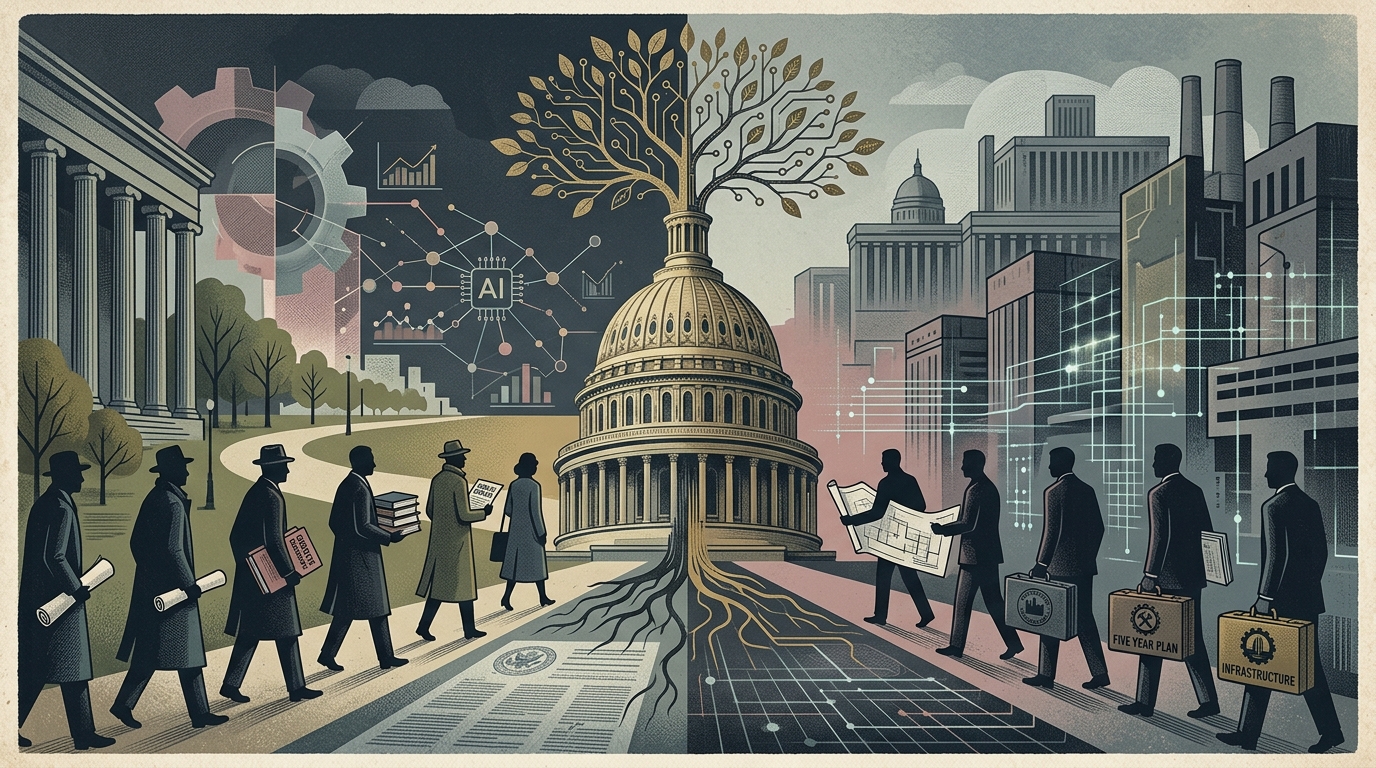
In the labyrinth of technological evolution in 2026, a new line of confrontation has been drawn across the Pacific. On one side, Silicon Valley continues its frantic race toward Artificial General Intelligence (AGI), with Large Language Models (LLMs) becoming increasingly abstract. On the other, Tokyo, led by giants like SoftBank and Toyota, is carving a different path: that of "useful" or "embodied" artificial intelligence (Embodied AI). This is not merely a difference in philosophy, but a geopolitical and economic clash that will determine who controls production in the physical world.
The Philosophy of Practicality: Why Tokyo Differs
For decades, Japan was seen as the "sleeping giant" of technology, trapped in bureaucratic structures and an obsession with hardware that seemed outdated in the software era. However, the advent of AI changed the game. Japanese strategists quickly realized that while ChatGPT can write a poem, it cannot assemble a car or care for the elderly. This is where the concept of "useful" AI lies.
The Japanese approach focuses on integrating intelligence into physical objects. Sony, Panasonic, and Mitsubishi are investing billions in developing sensors that "think" and robots that can navigate unstructured environments. In Japan, AI is not a digital assistant on a screen, but the connective tissue between code and matter. This shift is strongly supported by the government in Tokyo, which views technology as the only solution to the country's acute demographic crisis.
The Masayoshi Son Factor and SoftBank's Renaissance
One cannot discuss the Japanese counter-offensive without mentioning Masayoshi Son. The founder of SoftBank, after some turbulent years, has returned stronger, stating that his mission is to achieve Artificial Superintelligence (ASI). However, his plan, codenamed "Izanagi," differs from those of OpenAI or Google. Son aims to create an ecosystem where ARM semiconductors (of which SoftBank holds a majority stake) will power robotic systems performing all kinds of manual labor.
"AI that cannot touch the world is merely an illusion," a SoftBank executive recently stated at a conference in Tokyo. "The power lies in movement, not just in thought."
This strategy places Japan in a vantage position. While Silicon Valley struggles with copyrights and the ethics of content generation, Tokyo focuses on supply chain efficiency and factory automation. The battle for AI chip dominance also plays a decisive role, with Japan attracting TSMC to build plants on its soil, securing the necessary infrastructure.
Demographic Pressure: The Mother of Japanese Innovation
Unlike the US, where AI is often met with fear regarding job loss, in Japan, the reception is almost messianic. With a rapidly shrinking and aging population, the country does not have the luxury of fearing automation. It desperately needs "hands"—even if they are metallic.
- Elderly Care: Development of robots with empathy and precision of movement.
- Construction: Autonomous machinery operating on construction sites without human supervision.
- Agriculture: AI systems managing crops with minimal resources.
This social necessity gives Tokyo a moral and practical edge. Real-world testing occurs faster, as the regulatory framework is friendlier toward the application of robotics in daily life. Silicon Valley may own the internet's data, but Japan is collecting the data of the physical world.
Conclusion: A Complementary or Conflictual Relationship?
The question posed in 2026 is whether these two worlds will collide head-on or end up in a necessary symbiosis. It is possible that Silicon Valley will remain the "brain" of AI, providing the large reasoning models, while Tokyo becomes the "body," providing the technology that transforms logic into action. However, with geopolitical tensions rising, control over "useful" AI is turning into a matter of national security. Japan no longer wishes to be just a component supplier; it wants to be the architect of the new industrial reality.