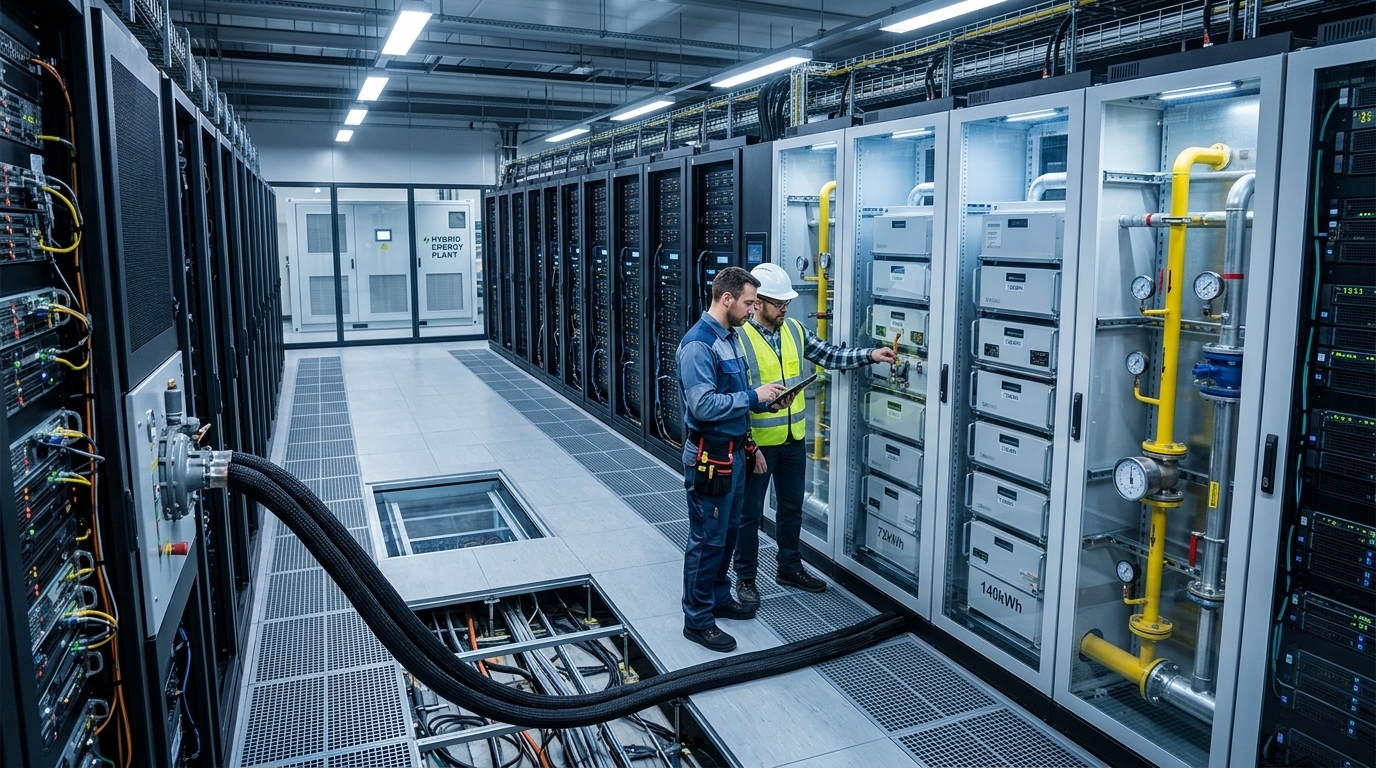
As we navigate the second quarter of 2026, the global AI industry faces a paradox that threatens to derail its momentum: the inability of existing electrical grids to power the gargantuan data centers required for next-generation models. The solution now favored by Silicon Valley giants is not exclusively "green," but a hybrid combination of large-scale battery storage and natural gas generation units. This shift marks a new era in energy planning, where reliability of supply takes precedence over absolute climate pledges.
The Energy "Black Hole" of Artificial Intelligence
The demand for computing power has skyrocketed to levels no one predicted three years ago. Data centers housing the latest GPUs now consume energy comparable to that of mid-sized European nations. The problem is not just quantity, but stability. AI doesn't "sleep"; it requires a continuous flow of energy (baseload) 24/7, 365 days a year. Renewable energy sources (RES), such as wind and solar, despite massive progress, remain intermittent. When the sun sets or the wind dies down, the gap must be filled instantaneously.
This is precisely where the new model enters: data centers are being transformed into autonomous energy islands. Instead of relying solely on the public grid—which in many parts of the US and Europe is saturated—companies are installing their own generation and storage systems. The combination of lithium-ion battery energy storage systems (BESS) and natural gas turbines provides the necessary flexibility. Batteries absorb excess energy from renewables and discharge it during peak periods, while natural gas acts as the ultimate safety net, ensuring the system never fails.
Natural Gas: A Bridge or a Permanent Fixture?
The use of natural gas is sparking intense backlash from environmental groups, as Big Tech had previously promised full decarbonization by 2030. However, market reality is harsh. Without natural gas, AI expansion would have to grind to a halt. The new gas units being built alongside data centers are highly efficient and can be activated within minutes, complementing battery storage.
- Immediacy: Gas generators can be deployed much faster than high-voltage transmission lines.
- Cost-Effectiveness: Despite price volatility, natural gas remains an economically viable solution for covering baseload requirements.
- Stability: Battery technology, while evolving, cannot yet store energy for weeks of low wind or cloud cover.
In regions like the Mediterranean, this discussion is particularly relevant. Countries aiming to become data center hubs find themselves in a strategic position, having access to gas pipelines and high renewable potential. Yet, the challenge remains: how to reconcile this need with EU Net Zero targets? The "hybrid" approach seems to be the only pragmatic path forward for the next decade.
Economic Implications and Market Impact
The investments required for this energy infrastructure are colossal. We are no longer talking just about the cost of servers, but capital expenditures (CAPEX) involving entire power plants. This is changing the profile of tech companies, which are increasingly resembling utilities. Shareholders are closely monitoring these costs, as energy autonomy is necessary for operations but weighs heavily on balance sheets.
"Energy is no longer an operating expense for AI; it is the limiting factor of its very existence," Wall Street analysts note.
In the future, Small Modular Reactors (SMRs) are expected to enter the fray, but until that technology matures, the "marriage" of batteries and natural gas will remain the dominant rule. The industry must prove it can innovate not only in algorithms but also in managing the planet's resources, balancing digital progress with environmental responsibility. The stakes are high: the winner of the AI race will be the one who secures the most stable and scalable power source.