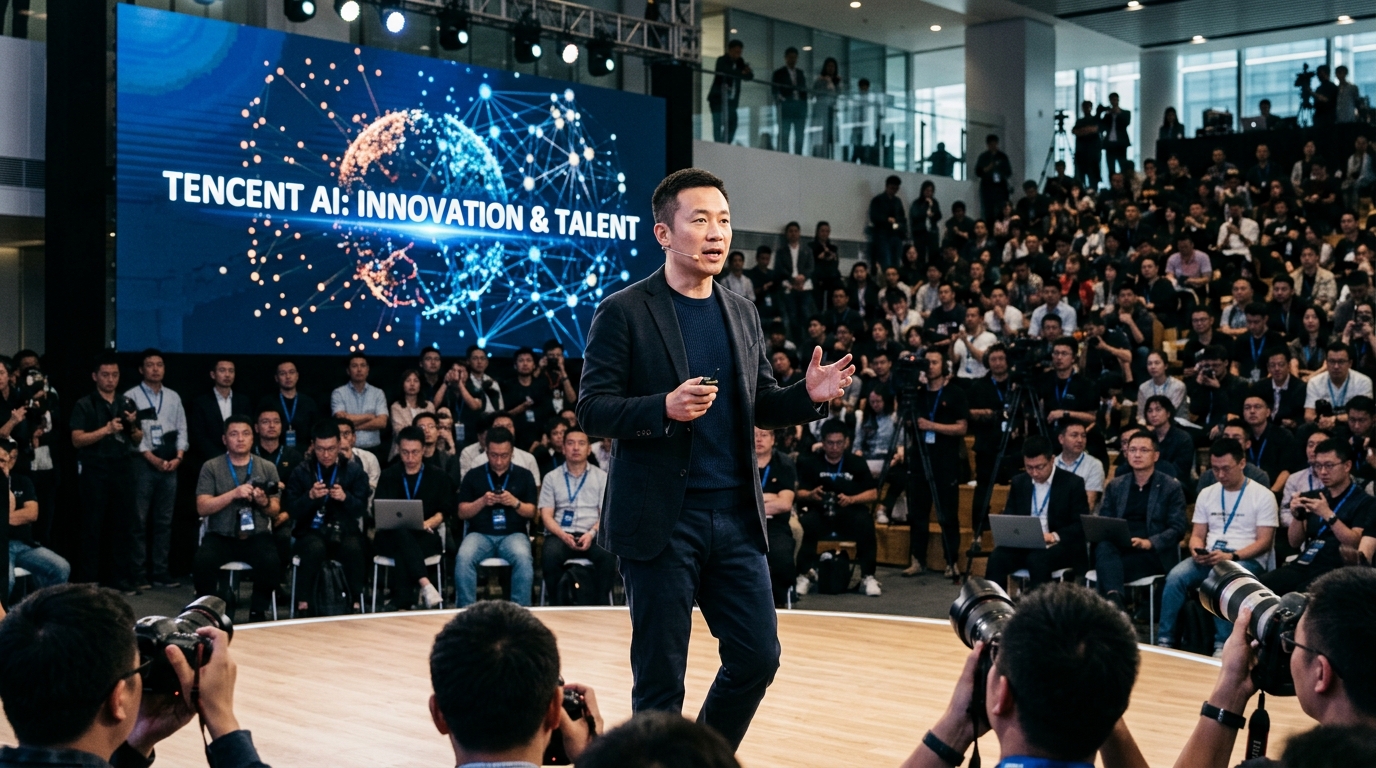
In the high-tech corridors of Shenzhen, where China’s digital titans grapple with the mounting pressure of U.S. export restrictions, Tencent has made a move that market observers describe as a strategic masterstroke. The unveiling of its latest large language model (LLM) is more than a mere technical iteration; it represents the culmination of an aggressive talent acquisition strategy aimed directly at the heart of Silicon Valley: OpenAI.
The Talent Bridge: From San Francisco to Shenzhen
Tencent’s decision to place former OpenAI engineers at the helm of its AI development is a high-stakes gamble on the portability of innovation. The new model, a significant evolution of the Hunyuan series, is designed to challenge the benchmarks set by GPT-4o while operating within the unique constraints of the Chinese digital ecosystem. The core challenge for these high-profile hires was to adapt the scaling laws and training methodologies perfected in the U.S. to a landscape where high-end Nvidia hardware is increasingly scarce.
Insiders suggest that the new architecture utilizes a sophisticated Mixture-of-Experts (MoE) framework. This approach allows the model to activate only a fraction of its parameters for any given task, drastically improving inference efficiency. For a conglomerate like Tencent, which operates at a scale of billions of transactions, such efficiency is not just a technical preference but a financial necessity. The goal is to democratize high-order AI across its massive cloud infrastructure and consumer-facing apps.
Geopolitics and the Quest for Sovereign AI
This development does not exist in a vacuum. China is currently engaged in a frantic race for "AI sovereignty," seeking to decouple its technological future from Western supply chains. The recruitment of OpenAI veterans is seen by many as a form of strategic intelligence transfer, where the methodologies developed in the West are being repurposed to fortify China's domestic capabilities.
"It is no longer about who has the most raw data, but who can achieve cognitive reasoning with the highest compute-efficiency," notes a senior analyst covering the Asian tech sector.
However, the path forward is fraught with complexity. Chinese regulators maintain a strict oversight regime, requiring AI outputs to strictly adhere to state-mandated ideological guidelines. This presents a unique challenge for engineers used to the relatively unconstrained research environment of the West: building a system that is cognitively superior yet ideologically compliant. Tencent is betting that its new talent can navigate this paradox through advanced alignment and safety layer techniques.
Commercial Integration: The WeChat Advantage
Domestically, Tencent is locked in a fierce battle with rivals Baidu and Alibaba. While Baidu’s Ernie Bot had a head start, Tencent holds a unique trump card: the WeChat ecosystem. With over 1.3 billion monthly active users, WeChat provides an unparalleled dataset of social and commercial interactions. The new AI model is expected to turn WeChat into a hyper-intelligent operating system, capable of handling everything from complex financial advisory to automated customer service within its 'Mini-Programs'.
- Deep integration into WeChat for seamless B2C interactions.
- AI-driven content creation tools for Tencent’s burgeoning short-video platforms.
- Advanced coding assistants tailored for the company’s global gaming empire.
Ultimately, Tencent’s new model is a statement of intent. By importing the 'DNA' of OpenAI’s success, the company is attempting to leapfrog the hardware limitations imposed by trade wars. If this high-stakes test succeeds, it will prove that in the age of AI, talent and architectural ingenuity can potentially outweigh the raw power of silicon, potentially shifting the center of gravity in the global tech race toward the East.