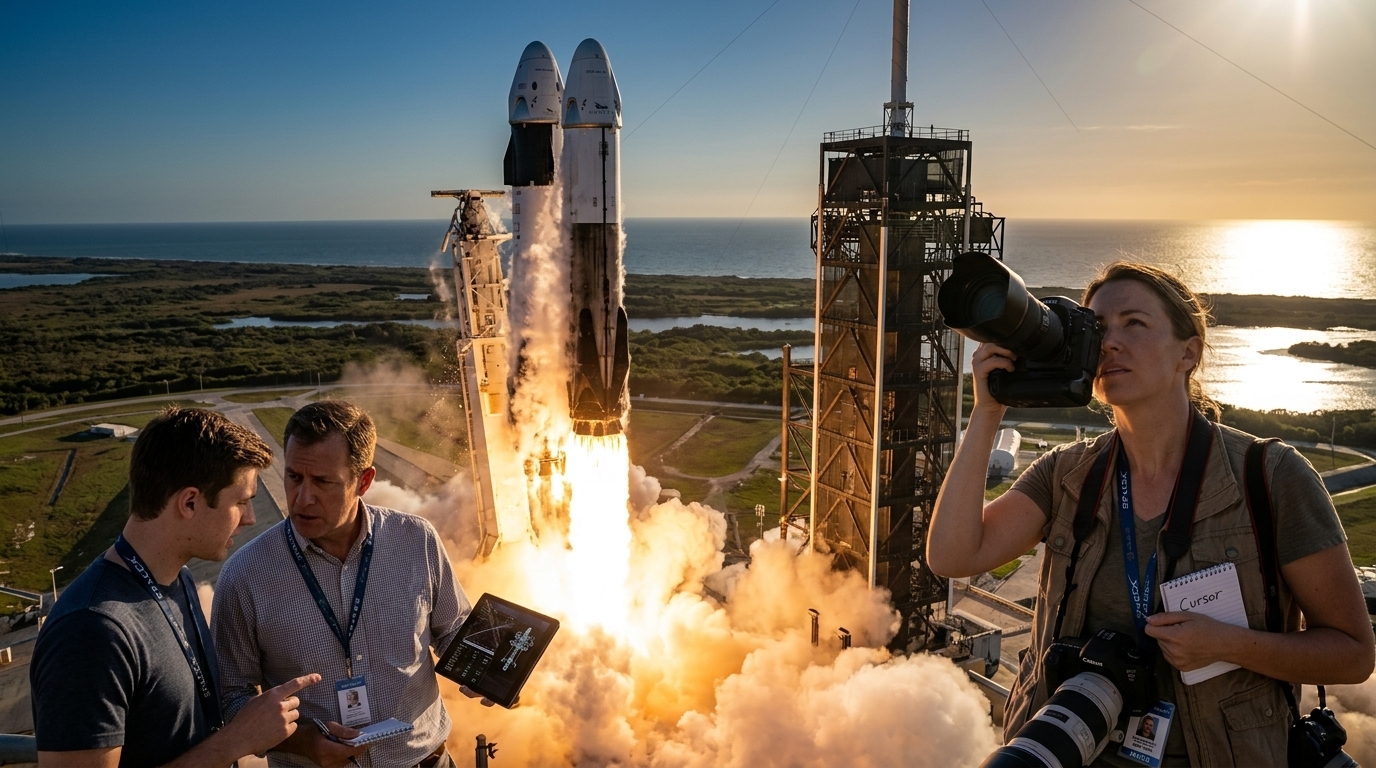
In a move that has sent shockwaves through Silicon Valley and the global aerospace sector, Elon Musk’s SpaceX has announced an unprecedented financial arrangement to acquire Cursor, the world’s leading AI-powered coding platform. The deal, which values the startup at a staggering $60 billion, includes a unique $10 billion break-up fee, signaling Musk’s aggressive push to consolidate the tools that will build the future of software engineering.
The Convergence of AI and Deep Tech
To the casual observer, the acquisition of a code editor by a rocket company might seem disjointed. However, as of April 2026, the lines between hardware and software have blurred into oblivion. SpaceX’s Starlink fleet and the upcoming Starship Mars missions rely on millions of lines of mission-critical code that must be updated, debugged, and optimized in real-time. Human engineers alone can no longer keep pace with the complexity of these multi-planetary systems. Cursor, which began as an AI-enhanced fork of VS Code, has become the de facto environment where AI doesn’t just assist the developer—it often leads the architectural design.
By integrating Cursor into the SpaceX and xAI ecosystem, Musk aims to create a closed-loop feedback system. xAI’s Grok models will provide the underlying intelligence, Cursor will provide the interface for implementation, and SpaceX’s hardware will serve as the ultimate testing ground. This vertical integration is reminiscent of the early days of computing, where companies owned everything from the silicon to the compiler.
Financial Engineering and the IPO Horizon
The deal’s structure—pay $60 billion to own it or $10 billion just for the option—suggests a complex strategic play. Analysts believe this is a foundational step toward a massive IPO involving a combined entity of SpaceX, xAI, and X. By securing Cursor, Musk is effectively building a “moat” around his software development pipeline.
- Total control over the software production lifecycle.
- Exclusive access to proprietary coding models that competitors like Blue Origin or Boeing will lack.
- The ability to train xAI’s future models on the vast telemetry and engineering data generated within the Cursor environment.
However, the $60 billion price tag has raised eyebrows. While Cursor’s growth has been exponential, its revenue metrics do not typically support such a valuation. Skeptics argue this might be an exercise in “valuation padding,” aimed at inflating the overall net worth of the Musk empire ahead of a public listing. If software is the most valuable part of a rocket, then the tool that writes the software must be the most valuable tool in the world.
The Impact on the Global Developer Community
The announcement has been met with a mix of awe and anxiety by developers worldwide. Cursor achieved its status by being an open, highly efficient tool that integrated seamlessly with various LLMs like Claude and GPT-4. The prospect of it becoming a proprietary tool for the Musk conglomerate raises concerns about the future of the platform’s neutrality. Will Cursor remain the best IDE for a developer in Berlin or Athens, or will it be optimized solely for the xAI tech stack?
“Coding is the language of the universe, and whoever controls the translator controls the future,” a SpaceX spokesperson noted during the press briefing.
The broader implications for the AI industry are significant. If SpaceX successfully absorbs Cursor, it sets a precedent for “Deep Tech” companies to acquire the very tools used to build them, potentially leading to a fragmented landscape where different tech giants own their own specialized versions of reality-building software.
Conclusion: A High-Stakes Bet on Autonomy
SpaceX’s bid for Cursor is more than a simple acquisition; it is a declaration of intent. Musk is betting that the future of engineering is not just automated, but autonomous. By owning the interface where humans and AI collaborate to write code, SpaceX secures its position at the top of the technological food chain. Whether this $60 billion gamble pays off or becomes a $10 billion cautionary tale remains to be seen, but one thing is certain: the era of the independent AI coding tool is facing its greatest challenge yet.