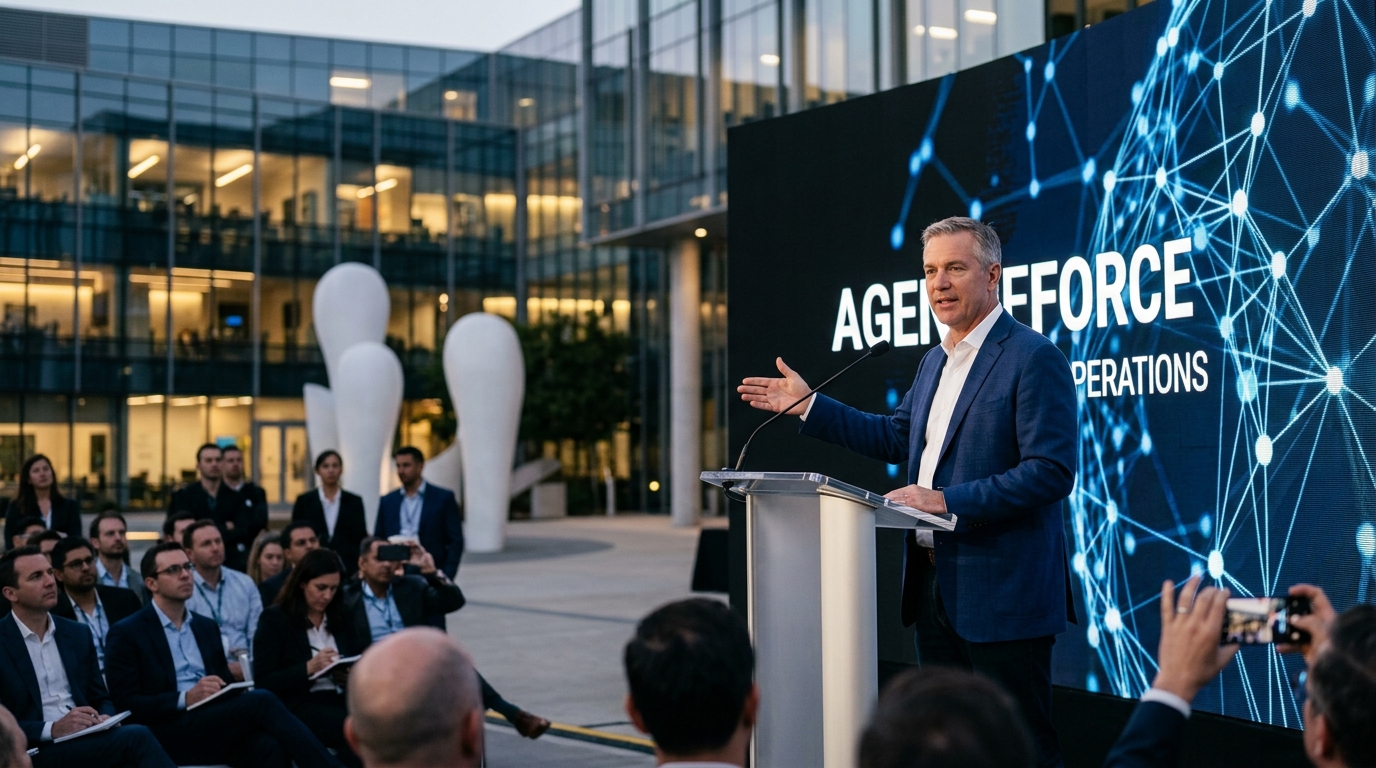
The era of large language model (LLM) hype is gradually giving way to a stark reality: artificial intelligence is only as good as the infrastructure supporting it. As enterprises attempt to move from simple chatbots to autonomous agents capable of executing complex tasks, they are hitting a formidable wall. Existing workflows, designed for human interaction or rigid legacy automation, are fracturing under the weight of AI’s probabilistic nature. Recognizing this gap, Salesforce has announced Agentforce Operations, a new architectural layer designed to serve as the 'operating system' for enterprise AI.
The Problem of Broken Workflows
For decades, enterprise architecture has been built on linear processes: if X happens, then do Y. However, AI agents operate on reasoning and probability. When an agent attempts to interact with a legacy ERP system or a CRM that hasn't been optimized for agentic workflows, connections often fail. APIs may not respond as expected, access permissions block progress, and a lack of visibility makes it impossible to pinpoint exactly where a process stalled. This has led to what industry experts call 'agentic friction'—a state where AI, instead of solving problems, creates new management burdens.
Agentforce Operations acts as a centralized control room. It provides developers and system administrators with the tools to monitor, test, and debug agents in real-time. This is not merely a monitoring tool; it is a governance infrastructure ensuring that AI remains within the boundaries of corporate policy and operational efficiency. By addressing the 'plumbing' of AI, Salesforce is targeting the most significant bottleneck in the current technology cycle.
The Shift Toward Agent Orchestration
The core philosophy behind Salesforce's new move is orchestration. In this new paradigm, an AI agent is not an isolated entity. It must collaborate with other agents, request human intervention when necessary, and access data across multiple silos via Data Cloud. Agentforce Operations introduces 'Agent Lifecycle Management,' allowing teams to simulate agent behavior before deploying them into production environments.
- Diagnostic Tools: The ability to identify the exact step where an agent became 'confused' or failed to execute a command.
- Policy Management: Setting strict guardrails on what an agent can and cannot do, preventing costly errors or security breaches.
- Human-in-the-loop (HITL): Creating checkpoints where AI must receive approval from a human employee before completing a high-stakes transaction.
This approach shifts the narrative from 'AI replacing workers' to 'AI requiring a new form of management.' Organizations that adopt these technologies will see a difference not in the speed of text generation, but in the reliability of back-office automation. The goal is to move from experimental pilots to mission-critical deployments that don't require constant human babysitting.
Strategic Implications for the AI Market
With Agentforce Operations, Salesforce is positioning itself as the indispensable partner for the agentic era, competing head-on with rivals like Microsoft and ServiceNow. The stakes are immense: if Salesforce can convince enterprises that its platform is the only one capable of guaranteeing safe and effective agent operations, it will secure its market dominance for the next decade. However, the challenge remains complexity. Adding another layer of management software could be seen as a solution, but it risks introducing new tiers of digital bureaucracy if not implemented with simplicity for the end-user.
"The success of enterprise AI will not be judged by the intelligence of the models, but by the robustness of the workflows," industry analysts suggest.
In conclusion, Agentforce Operations is an admission that AI requires stewardship. As we move toward 2027, a company’s ability to manage its fleet of digital agents will become its primary competitive advantage. Salesforce has just handed its customers the steering wheel for that journey, but the road ahead remains complex and unmapped.