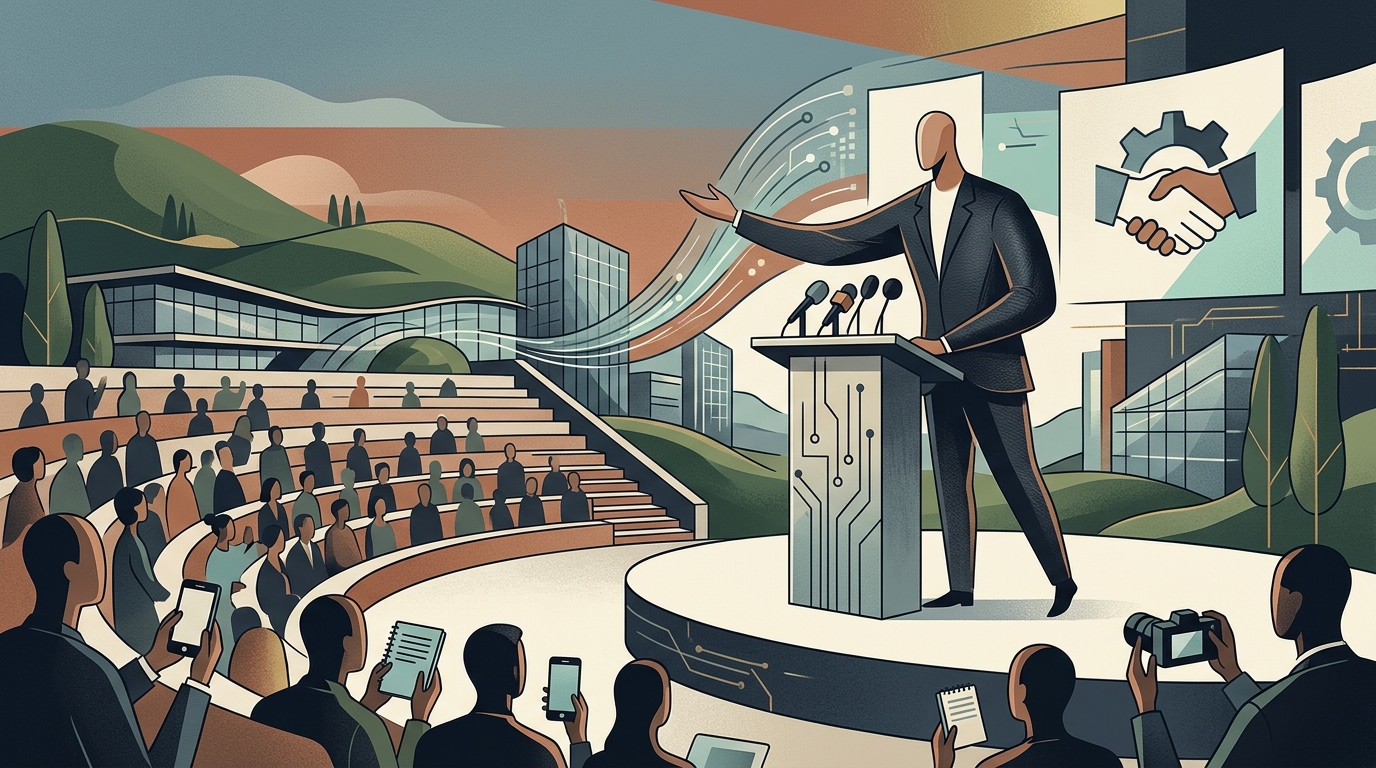
In a provocative intervention set to ignite intense debate across tech and political circles, Nvidia CEO Jensen Huang has dismissed concerns regarding mass unemployment caused by Artificial Intelligence as “complete nonsense.” Speaking to Bloomberg Tech on June 1, 2026, Huang presented a vision that sharply contrasts with the gloomy forecasts of many analysts, arguing that we are on the cusp of a new era of corporate expansion that will demand more, not fewer, workers.
The Rise of Agentic AI
Huang’s central argument is not based on the traditional Generative AI we’ve come to know, but on its evolution: Agentic AI. These are systems that don't just answer prompts but can plan, make decisions, and execute complex tasks autonomously. According to Huang, these “digital agents” will act as power multipliers for businesses.
“When a company becomes more productive, it doesn't fire people; it expands,” Huang stated. “The ability to produce more software, more products, and better services with the help of AI means companies will be able to tackle problems that were previously economically unfeasible. This requires more software engineers to oversee, direct, and evolve these systems.”
The Productivity Paradox and Employment
The history of technology, Huang argued, supports his position. He pointed to the introduction of spreadsheets in the 1980s. At the time, many predicted the end of the accounting profession. Instead, the ease of calculation led to an explosion in demand for financial analysis, creating millions of new roles that didn't exist before.
Today, Nvidia sees a similar trend in the software sector. Despite AI’s ability to write code, the demand for skilled engineers is increasing. Companies don't just want to maintain existing systems at a lower cost; they want to build new, more complex ecosystems that AI makes possible. “The world has an infinite need for software,” Huang noted, highlighting that AI simply lowers the barrier to entry for creation while increasing the total volume of work to be done.
The Social Dimension and Market Reality
However, Huang’s optimism is not universally shared. While Big Tech companies are indeed hiring engineers to develop AI tools, many lower-skilled industries are seeing their roles shrink. The transition Huang describes requires a radical retraining of the workforce, something that doesn't always happen at the pace technology dictates.
Huang admitted that the nature of work will change, but insisted that human judgment, strategic thinking, and creativity remains irreplaceable. “AI won't take your job. A person using AI will take your job,” he repeated, using a phrase that has become the mantra of the new digital economy.
Nvidia as the Architect of the Future
It must be noted that Nvidia has every reason to promote this narrative. With its market capitalization breaking records, the company depends on the continuous adoption of AI by businesses worldwide. If AI is seen as a threat to social stability, regulators may intervene. By framing AI as a “hiring engine,” Huang is attempting to preempt political backlash and solidify his technology as a positive social tool.
In any case, Huang’s dismissal of concerns as “nonsense” sets the stage for a major confrontation in 2026: Is AI the liberator of human creativity or the accelerator of economic inequality? The answer likely lies somewhere in the middle, but for Huang, the future is already here, and it is full of opportunity.