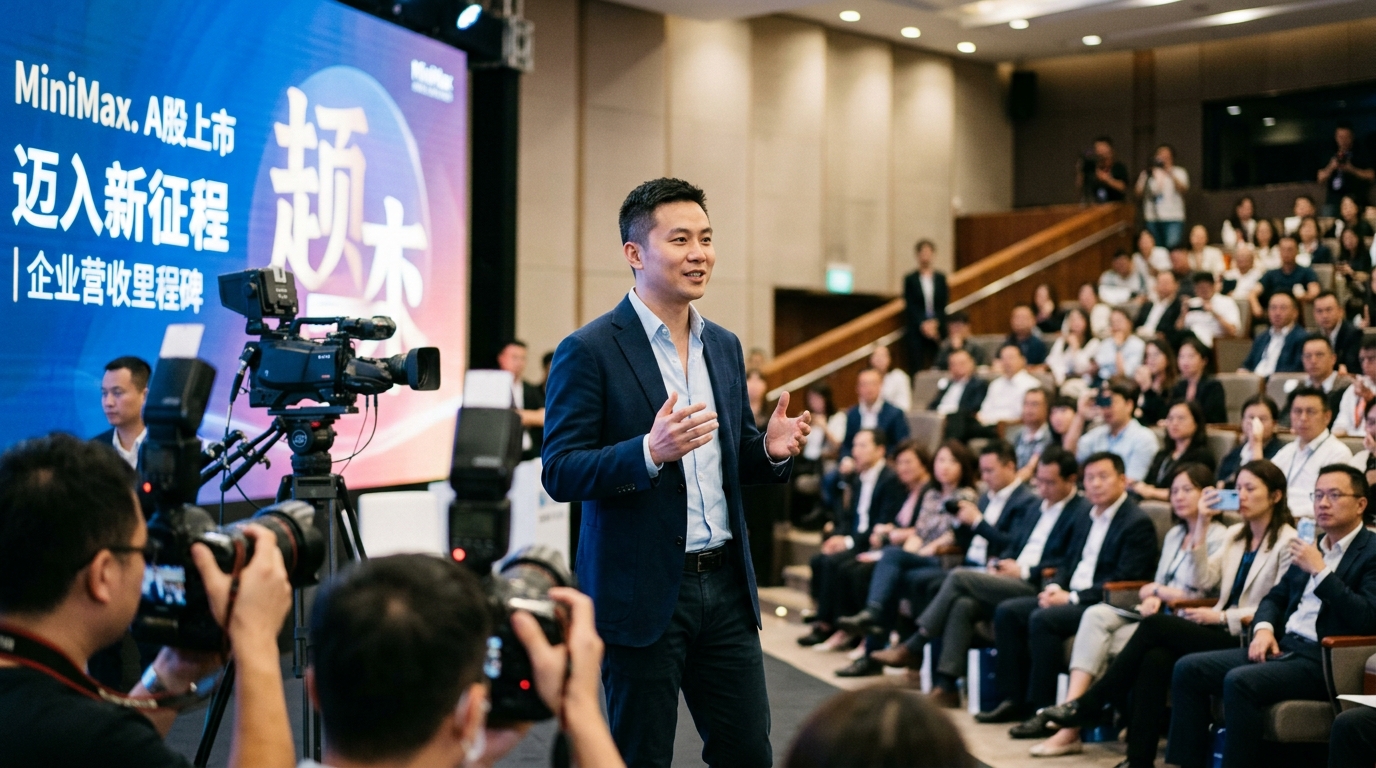
In a global AI landscape that is increasingly demanding proof of monetization over mere technological promises, China’s MiniMax is making a definitive statement. The news that the startup has officially filed for an initial public offering (IPO) on China’s A-share market—coupled with the revelation that its Annual Recurring Revenue (ARR) has eclipsed the $300 million mark—marks a pivotal moment for the industry. This is no longer just about potential; it is about a scalable, revenue-generating reality that challenges the dominance of Silicon Valley’s elite.
Founded in late 2021 by Yan Junjie, a visionary former vice president at SenseTime, MiniMax has rapidly ascended to become one of the so-called 'Six Little Dragons' of Chinese AI. These companies are viewed as China’s primary answer to OpenAI, and MiniMax’s trajectory suggests it may be leading the pack in terms of commercial viability. While many high-profile AI startups in the West are still burning through venture capital with limited returns, MiniMax has managed to build a product ecosystem that users are actually paying for.
The Revenue Engine: Talkie and the Global Reach
The $300 million ARR figure is a staggering achievement for a company of its age. To put this in perspective, reaching $100 million ARR is often considered the 'gold standard' for successful SaaS and tech companies. MiniMax has tripled that, largely on the back of its flagship consumer application, Talkie. Known as 'Xingye' in China, the international version, Talkie, has become a sensation in markets like the United States, Southeast Asia, and Japan.
Talkie utilizes the company's proprietary 'abab' series of large language models to allow users to interact with AI-driven personas. The platform’s success lies in its sophisticated blend of emotional intelligence and gamification. Users don't just chat; they collect 'cards' of characters and engage in complex role-playing scenarios. This high level of engagement has translated directly into a robust subscription model and in-app purchases, proving that consumer-facing AI can be a massive cash cow if executed with a focus on user experience.
"MiniMax has cracked the code of AI engagement. They aren't just selling a tool; they are selling a digital companion infrastructure that scales globally," notes a senior tech analyst.
The Strategic Shift to A-Shares
Choosing to list on the domestic A-share market (likely in Shanghai or Shenzhen) rather than seeking a high-profile listing in Hong Kong or New York is a calculated strategic move. In the context of the escalating tech 'cold war' between Washington and Beijing, a domestic IPO offers MiniMax a degree of protection from geopolitical volatility. It aligns the company with Beijing’s national goal of achieving technological self-reliance and ensures that its capital structure remains within the reach of Chinese regulators and investors.
However, the A-share market is known for its rigorous listing requirements and the recent tightening of oversight by the China Securities Regulatory Commission (CSRC). By moving forward now, MiniMax is signaling that its financial health is robust enough to withstand intense scrutiny. The capital raised from this IPO will be critical for the company to secure its future, particularly as it seeks to navigate the challenges of US-led export restrictions on high-end AI chips like Nvidia’s H100s.
Navigating the Chip Gap and Competitive Pressures
The primary hurdle for MiniMax—and indeed all Chinese AI firms—is the 'compute gap.' Without access to the latest Western hardware, these companies must rely on algorithmic ingenuity. MiniMax has been a vocal proponent of 'efficiency-first' development, optimizing its models to perform at state-of-the-art levels while consuming fewer resources. This focus on efficiency is not just a technical choice; it is a survival strategy in a resource-constrained environment.
Furthermore, the competition within China is fierce. Startups like Zhipu AI and Moonshot AI are also vying for dominance, often backed by the same tech giants like Alibaba and Tencent. MiniMax’s move toward an IPO may be an attempt to secure a 'first-mover advantage' in the public markets, providing it with the liquidity needed to outpace its domestic rivals in talent acquisition and infrastructure investment.
Conclusion: A New Chapter for Generative AI
MiniMax’s IPO filing represents a transition from the 'hype phase' of generative AI to the 'industrialization phase.' When a company can show $300 million in recurring revenue, the conversation shifts from 'what if' to 'what's next.' For the global market, MiniMax serves as a reminder that the AI revolution is not a mono-polar event centered in California. As it prepares to go public, all eyes will be on how it balances its international consumer success with the regulatory and geopolitical realities of being a Chinese tech champion.