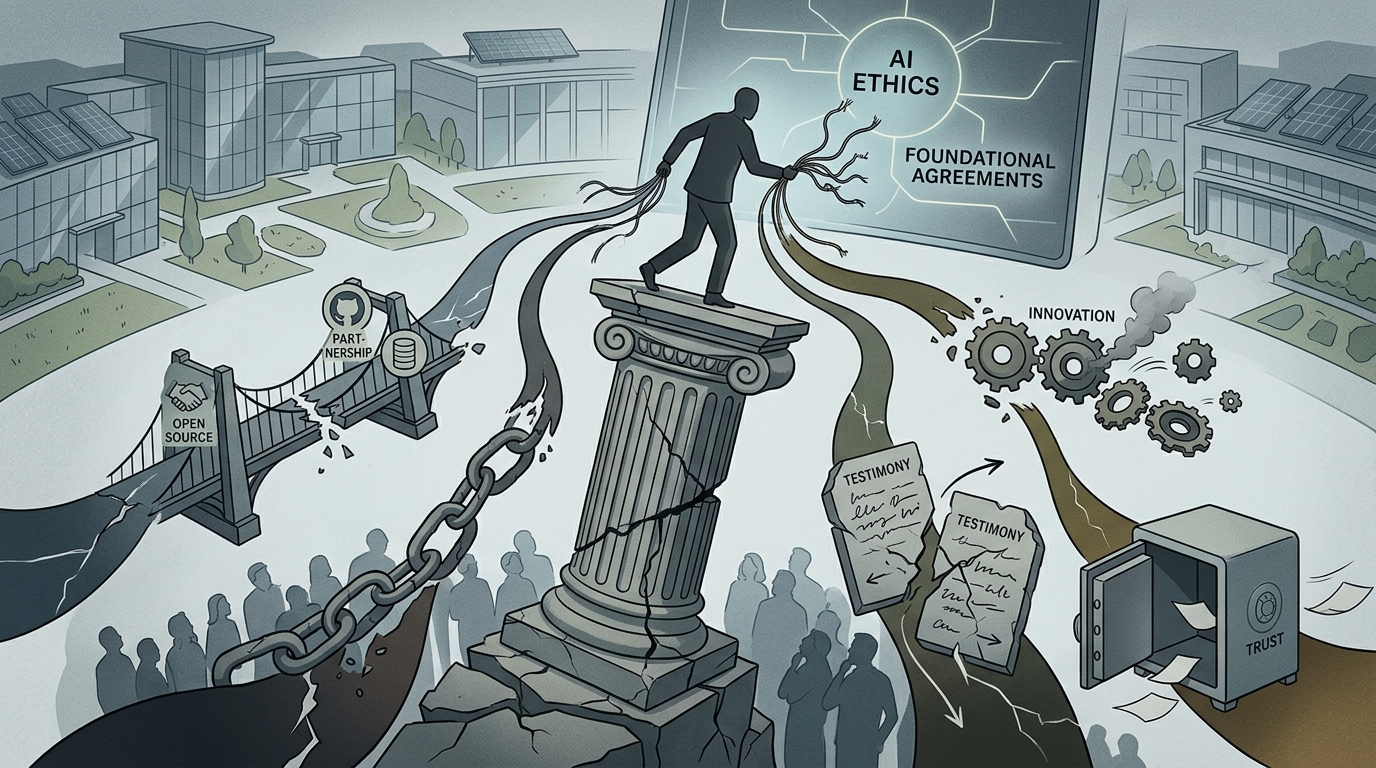
The San Francisco courtroom was transformed last week into a theater where ideology clashed with corporate reality. Elon Musk, the man who once helped birth OpenAI as a counterweight to Google's dominance, spent three full days on the witness stand. While his lawsuit is built on the premise that OpenAI was meant to remain a non-profit, open-source organization for the benefit of humanity, cross-examination by lawyers for OpenAI and Microsoft revealed a much more complex and, many argue, contradictory picture.
1. The 2018 Tesla Merger Proposal
Musk's most significant stumble occurred when he was confronted with his own emails from 2018. While he currently accuses Sam Altman of commercializing OpenAI, documents showed that Musk himself had proposed placing OpenAI under Tesla's full control. The revelation that Musk wanted to become CEO and use OpenAI’s resources to power Tesla’s autonomous driving program undermines his argument that his motives are purely altruistic. When asked why "saving humanity" required his own absolute control, his answer was vague, drawing skepticism from the court.
2. Ambiguity Surrounding "Open Source"
Musk has repeatedly argued that the "Open" in OpenAI necessarily meant open source. However, defense attorneys presented correspondence in which Musk agreed with Ilya Sutskever that, as AI approaches AGI (Artificial General Intelligence), making the code public would be dangerous. Musk’s admission on the stand that "sometimes safety comes before transparency" seemed to negate the central pillar of his lawsuit, leaving the impression that his current stance is a retrospective construct.
3. The Paradox of xAI and Grok
Perhaps the most ironic moment of the testimony was when Musk was asked to explain why his own new AI company, xAI, operates with models that are largely proprietary. The defense pressed him on how he could sue OpenAI for a lack of transparency while following the exact same business strategy with Grok. Musk argued that xAI is a "necessary evil" to compete with "woke" AI, but the legal impact of this admission was negative, painting the plaintiff as a hypocrite in the eyes of the court.
4. Failure to Prove a "Binding Contract"
Legally, Musk’s case hinges on the existence of a "founding agreement." During his testimony, however, he admitted there is no signed document explicitly stating that OpenAI would never become for-profit or partner with entities like Microsoft. His attempt to present verbal assurances and informal emails as legally binding contracts met with strong resistance from the judge, who noted that entrepreneurs of Musk's stature typically do not rely on "handshakes" for multi-million dollar investments.
5. Personal Animus as a Driver
In a particularly charged moment, Musk was asked if he would have filed this lawsuit had he remained on the OpenAI board. His difficulty in providing a clear "yes" reinforced the theory that the trial is less about the future of humanity and more about his personal bitterness over Sam Altman's success. The revelation that Musk had attempted to recruit top OpenAI engineers for Tesla immediately after his departure showed a systematic effort to weaken the organization he now claims to want to protect.
6. Technical Inconsistencies and AGI Definitions
Musk often portrays himself as a deep technical expert, but on the stand, he struggled to provide a consistent definition of what constitutes AGI—the critical threshold that, according to OpenAI’s charter, terminates Microsoft’s exclusive license. OpenAI’s lawyers used his own past statements to show that his definition changes depending on what serves his interests at any given time, rendering him an unreliable witness on technical matters.
7. The Funding Narrative
Finally, Musk claimed that OpenAI would not exist without his funds. However, the defense presented evidence that his contribution, while significant (approximately $44 million), was much less than the $100 million he initially promised, and that OpenAI managed to survive and thrive primarily due to the investments secured by Altman and others after Musk’s departure. This debunking of his role as the "sole benefactor" appeared to be the final blow to the credibility of his testimony.