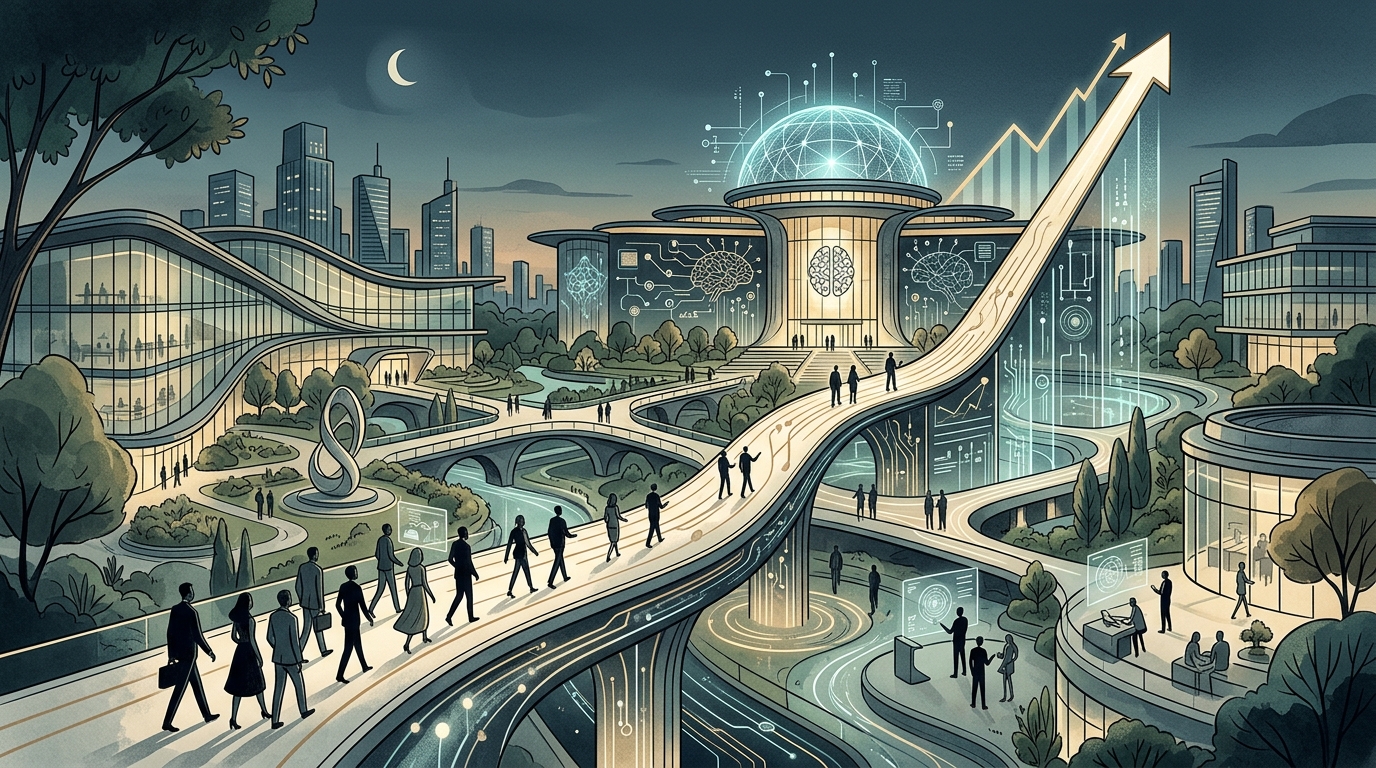
The recent stock market explosion of Dell Technologies, which saw its shares leap by a staggering 38%, is not merely a favorable moment for its shareholders. It is the confirmation of a profound strategic shift. The company once identified exclusively with personal computers (PCs) has now become one of the central pillars of the infrastructure supporting the global Artificial Intelligence (AI) revolution.
The Explosion in Demand for AI Servers
The financial results announced by Dell exceeded all analyst expectations, primarily due to the massive demand for AI-optimized servers. The order backlog for these specialized servers reached $2.9 billion, highlighting the hunger of large enterprises and cloud providers for computational power. Investors now see Dell as the essential partner to Nvidia, as Michael Dell's company is the one tasked with "packaging" the power of H100 and H200 chips into ready-to-use solutions for the enterprise segment.
The strategic importance of this growth lies in the fact that Dell is not just selling hardware. It is selling the "AI Factory," as Nvidia's Jensen Huang famously put it. This pivot allows the company to differentiate itself from the traditional PC cycle, which has shown signs of fatigue in recent years, and enter a market with much higher profit margins and long-term prospects.
The Alliance with Nvidia and Michael Dell's Role
One of the key factors driving the stock surge was public support from Nvidia. The close collaboration between the two giants ensures Dell has privileged access to coveted GPUs, which remains the biggest hurdle for its competitors. Michael Dell, with the foresight that has characterized him for decades, has managed to position his company at the center of the AI supply chain, transforming Dell from a PC assembler into a digital infrastructure architect.
- Privileged access to Nvidia's Blackwell architecture.
- Development of integrated cooling solutions for high-density data centers.
- Strategic focus on "Edge AI," bringing artificial intelligence closer to the source of data.
Challenges and the Future of AI PCs
Despite the excitement, Dell faces challenges. The traditional PC market remains sluggish, though there are hopes for a recovery through "AI PCs" — computers with built-in processing power for local execution of AI models. Dell is betting heavily on this new category, which is expected to drive a new hardware refresh cycle for businesses in 2025 and 2026. Furthermore, competition from Super Micro Computer and HP Enterprise remains fierce, forcing Dell to constantly innovate in energy efficiency and thermal management for its systems.
"We are at the beginning of a massive opportunity, and Dell is uniquely positioned to capitalize on it," a company executive stated during the earnings call.
In conclusion, the 38% rise is not just a number on a ticker. It is the recognition that Dell has become an integral part of the new computing paradigm. As AI moves from the experimentation stage to full production application, the need for robust, scalable, and efficient infrastructure will continue to fuel the growth of companies like Dell that dared to invest early in the future.