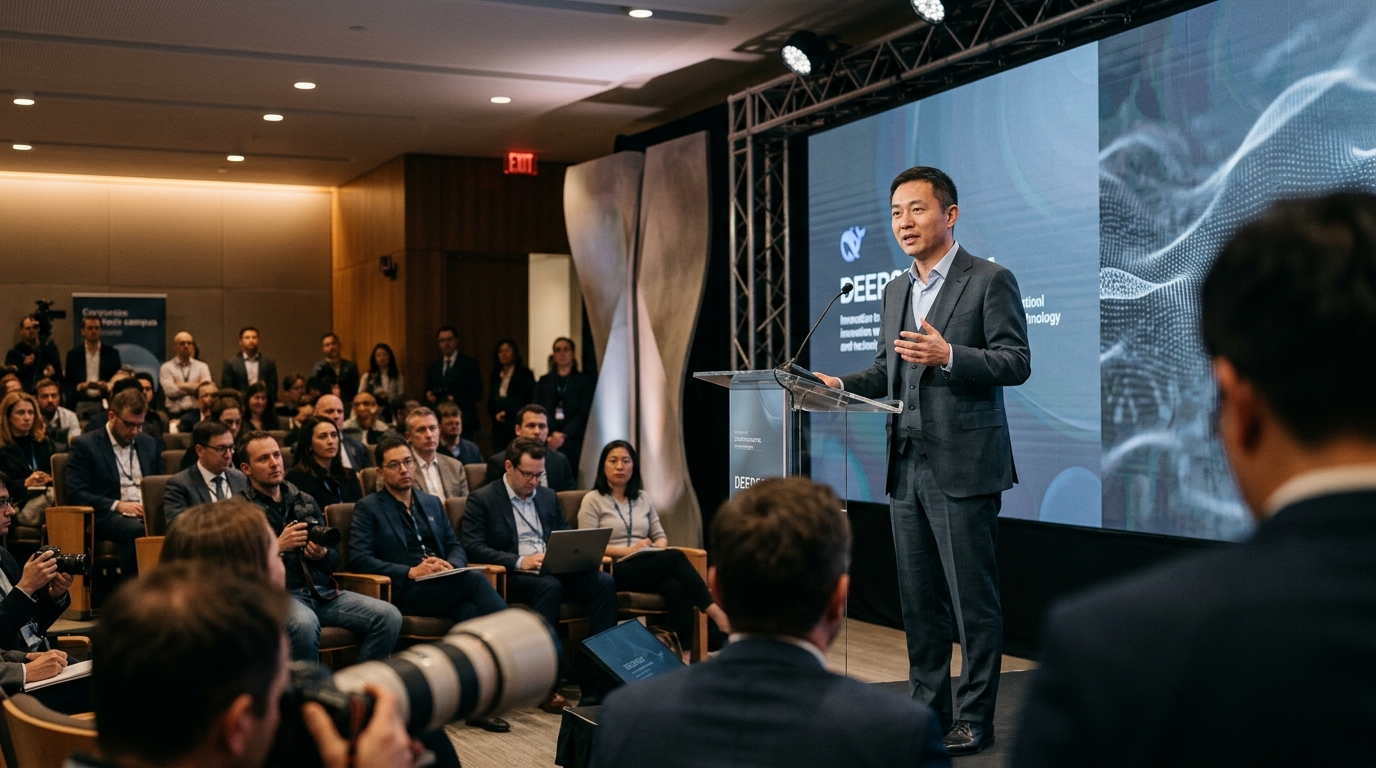
DeepSeek is no longer just a player in the AI arena; it is the symbol of a new era where efficiency triumphs over brute force. Following the thunderous success of the V3 and R1 models, which proved that China can produce cutting-edge technology at a fraction of the cost of American giants, anticipation for DeepSeek V4 had reached a fever pitch. However, recent reports of a delay in its launch have sent ripples through tech and geopolitical circles.
The Compute Wall and Software Alchemy
The first and most obvious cause of the delay lies in hardware constraints. U.S. sanctions on the export of advanced semiconductors, such as Nvidia’s H100s and B200s, have created a suffocating environment for Chinese labs. DeepSeek, although it has shown a unique ability to squeeze every drop of performance out of older GPUs through innovative Mixture-of-Experts (MoE) architectures, seems to be hitting a physical limit.
For V4, the training requirements are exponentially higher. The company is attempting to develop new algorithms that will allow for the training of GPT-5-level models on domestic chips or limited stocks of Western technology. This "software alchemy" takes time and countless iterations, as DeepSeek refuses to settle for anything less than the top of the benchmarks.
The Reasoning Challenge and R1 Integration
DeepSeek V4 is not intended to be just a larger language model; the goal is the full integration of the reasoning capabilities seen in the R1 model directly into the base architecture. The process of Reinforcement Learning (RL) at scale is notoriously unstable. Balancing creative writing, coding precision, and deep mathematical reasoning requires a fine-tuning process that the company’s engineers appear to be re-evaluating.
- Optimization of Multi-head Latent Attention (MLA) to reduce memory footprint.
- Ensuring the model does not "hallucinate" in complex logical problems.
- Enhancing multimodality for simultaneous processing of images, video, and code.
According to sources close to the company, the delay is partly due to a decision to retrain certain segments of the model from scratch to ensure that V4’s behavior is more consistent than its predecessors.
The Political Minefield and Regulatory Compliance
We cannot ignore the political context in which DeepSeek operates. The Chinese government has tightened rules for AI models facing the public, requiring strict alignment with national values and social stability. Creating a model that is both a global leader in free-form reasoning and compliant with domestic restrictions is a high-wire balancing act.
"DeepSeek is not just competing with OpenAI; it is competing with time, politics, and the laws of physics," says an industry analyst.
The delay gives the company the chance to "bulletproof" the model against potential political pitfalls that could lead to operational suspensions in China, while maintaining the open-source philosophy that earned it international acclaim.
Economic Implications and Competition
The market reacted with skepticism to the news of the delay. High-Flyer Quant, DeepSeek's parent company, has invested billions. Every month of delay is a month where OpenAI (with GPT-5) and Anthropic (with Claude 4) can widen their lead. However, DeepSeek’s strategy has always been the "quality counter-attack" rather than a rushed release.
In conclusion, the delay of DeepSeek V4 is not a sign of weakness, but rather a strategic pause to regroup. In a world moving at breakneck speed, DeepSeek is betting that quality and efficiency will ultimately be the winners, even if it means V4 reaches our hands a little later than expected.