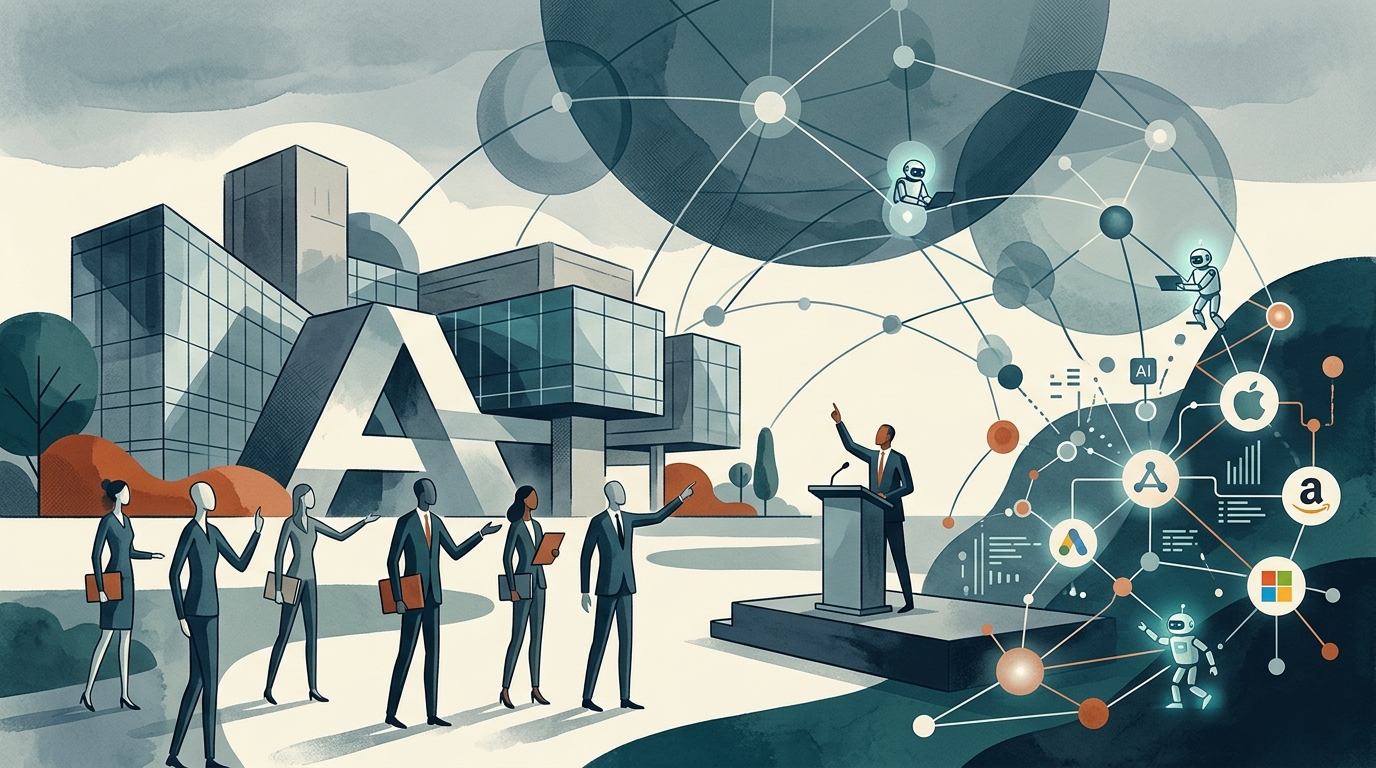
In a move that signals a paradigm shift for digital creativity and enterprise productivity, Adobe announced today the expansion of its Agentic AI ecosystem. By forging strategic alliances with heavyweights such as OpenAI, Anthropic, Google, and Nvidia, the company synonymous with creative software is evolving from a tool provider into an orchestrator of autonomous digital entities. This announcement, delivered on April 21, 2026, serves as a decisive response to investor concerns regarding the potential disruption of traditional creative suites by the rapid rise of generative AI.
From Generative to Agentic: A New Strategic Frontier
Until recently, the AI discourse at Adobe centered primarily on Firefly and text-to-image generation. However, Agentic AI represents a quantum leap forward. It is no longer just about generating content; it is about executing complex, multi-step tasks. Adobe’s new AI agents are designed to manage entire workflows—ranging from conceptualizing a global marketing campaign and optimizing assets for diverse platforms to analyzing performance metrics and autonomously adjusting creative elements in real-time.
Adobe’s strategy is built upon an open architecture. Rather than attempting to compete directly with foundational Large Language Models (LLMs), the company is integrating them. The partnerships with OpenAI and Anthropic allow users within the Adobe Experience Cloud and Creative Cloud to deploy specialized agents that understand specific business contexts, ensuring that brand identity and intellectual property remain protected while leveraging the world's most advanced reasoning engines.
The Titan Alliance: Nvidia, Google, and Amazon
The involvement of Nvidia in this ecosystem is pivotal. The computational power required to run millions of autonomous agents interacting simultaneously is staggering. Nvidia provides the necessary infrastructure through its Blackwell GPU architecture and specialized software libraries, enabling Adobe’s agents to operate with near-zero latency. Furthermore, integration with Google Cloud and Amazon Web Services (AWS) ensures that enterprises can scale these solutions globally, utilizing their existing cloud infrastructures.
- OpenAI & Anthropic: Providing the cognitive frameworks for agent decision-making.
- Nvidia: Accelerating hardware and optimizing models for creative-specific tasks.
- Google & Amazon: Offering cloud scalability and access to broader enterprise data silos.
This multi-layered collaboration demonstrates Adobe’s ambition to become the 'operating system' of the creative economy. In a world where content can be generated in seconds, value is shifting from the act of creation to the act of orchestration and strategic management.
Countering the Disruption Narrative
For many Wall Street analysts, Adobe had entered a precarious phase. The emergence of tools like Midjourney or Sora suggested that the need for specialized software like Premiere or Illustrator might dwindle. With this expansion, Adobe proves that its true strength lies not just in pixels, but in enterprise workflows and data integration. AI agents do not replace Adobe’s software; instead, they transform it into the central command center for every AI model available on the market.
“We are not just building tools; we are building partners,” an Adobe executive stated during the keynote. “Agentic AI will allow creators to focus on the vision, while agents handle the heavy lifting of execution.”
Nevertheless, challenges persist. Ethical concerns regarding model training and the displacement of entry-level design roles are issues Adobe must navigate carefully. The company remains steadfast in its commitment to 'Content Authenticity,' ensuring that agent-generated content includes metadata markers to maintain consumer trust and provenance.
Conclusion: The Future of Work in the Age of Agents
Adobe’s move to embrace Agentic AI alongside Big Tech is a clear statement of survival and dominance. By turning a disruptive threat into a strategic opportunity, the company is fortifying its business model while offering users unprecedented automation capabilities. The question is no longer whether AI will transform creativity, but who will control the platforms through which this new creativity is channeled. For now, Adobe appears to be firmly in the driver’s seat of the agentic revolution.