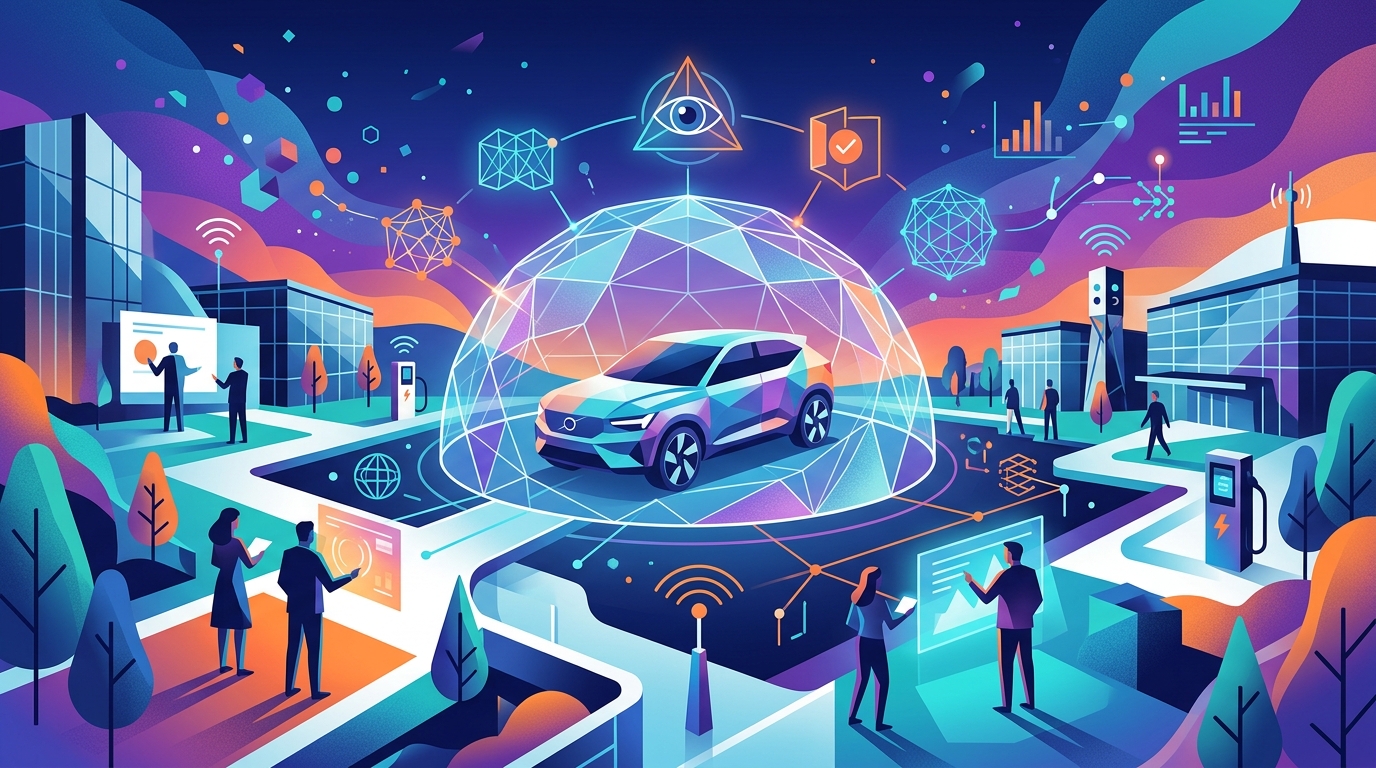
For decades, Volvo’s reputation was built on the strength of its steel—the physical 'crumple zone' designed to protect us when things go wrong. But as I look at their latest technical roadmap for 2026, it's clear that the forge has been replaced by the compiler. We are witnessing the transition from passive safety to what they call the 'Digital Guardian Angel.' As a builder, I find the underlying architecture far more fascinating than the marketing buzzwords.
The Trinity of Sensor Fusion
The heart of this system isn't just a single model; it’s a sophisticated orchestration of sensor fusion. Volvo’s new platform utilizes a high-performance compute core powered by NVIDIA DRIVE Orin, capable of 254 trillion operations per second (TOPS). But raw power is nothing without precision. The 'Guardian Angel' relies on a trinity of inputs:
- Luminar Iris LiDAR: Providing a high-resolution point cloud that doesn't care about lighting conditions.
- 8MP Cameras: Handling semantic segmentation—identifying whether that shape is a pedestrian or a plastic bag.
- Imaging Radar: Measuring velocity and distance with sub-centimeter accuracy.
What impresses me is the perception layer. Unlike older systems that relied on rigid, rule-based heuristics (if distance < x, then brake), the new architecture uses a Transformer-based neural network to predict the intent of other road users. It’s not just seeing; it’s anticipating.
The Challenge of Real-Time Determinism
In engineering, we talk about 'latency' as a nuisance in gaming, but in automotive AI, it is a matter of life and death. Volvo’s challenge was moving from cloud-reliant AI to pure edge computing. The 'Digital Guardian Angel' must operate with deterministic real-time constraints. I’ve examined the middleware layers, and the way they handle priority-based task scheduling ensures that safety-critical inference always takes precedence over infotainment or comfort features.
// Simplified logic for the safety interrupt layer
if (collision_probability > THRESHOLD && latency_budget < 20ms) {
    execute_evasive_maneuver(IMMEDIATE);
    log_telemetry(CRITICAL);
}
Daedalus’ Warning: The Human in the Loop
Like Icarus, there is a danger in over-confidence. As we build these 'angels,' we must ensure they don't lead to driver atrophy. Volvo’s approach includes an interior 'Driver Understanding System.' Using dual-camera infrared sensors, it monitors eye patterns to ensure the human hasn't mentally checked out. It is a pragmatic, layered defense: the AI protects the car, and the car monitors the human. This is responsible engineering—building a safety net, not a replacement for judgment.