
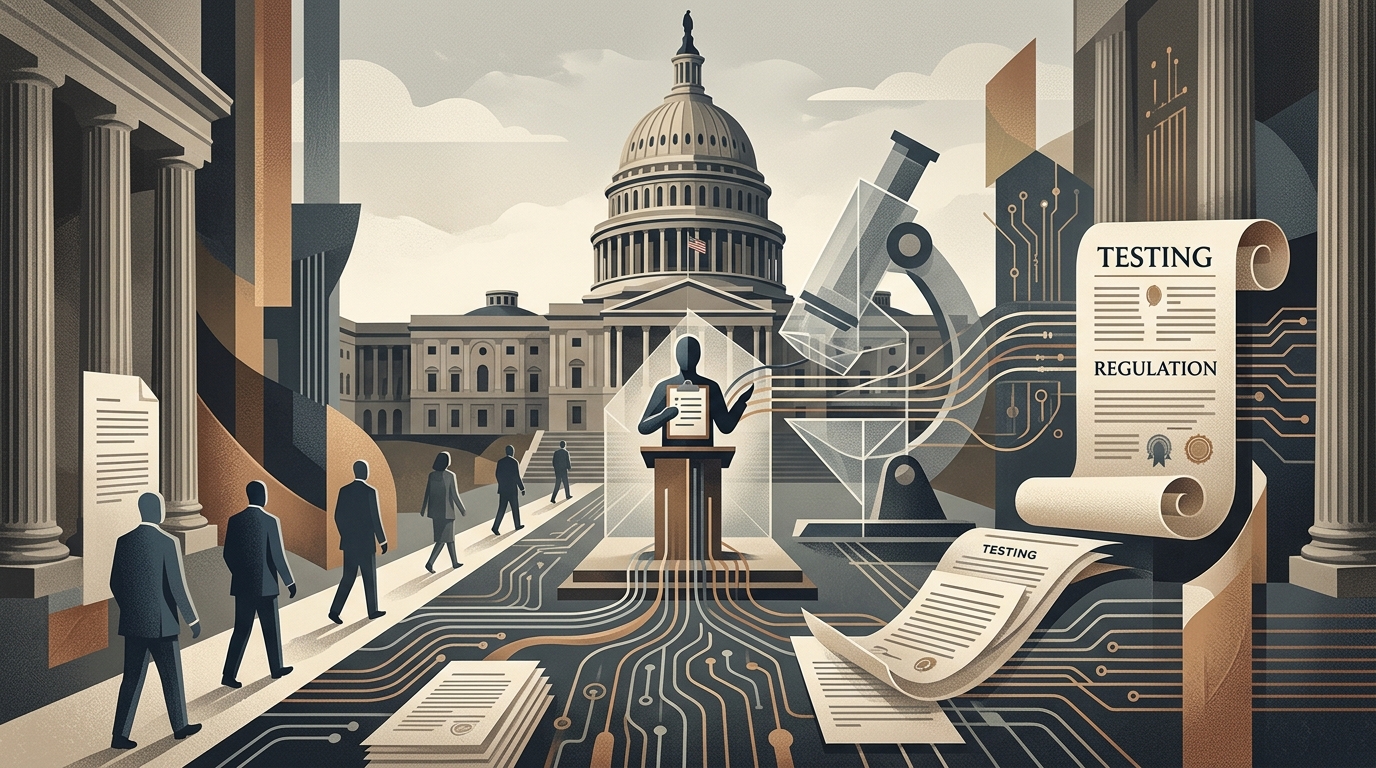
In the history of governance, there are moments when the sheer magnitude of a new power necessitates a fundamental restructuring of the relationship between the state and the private sector. In ancient Athens, my own reforms sought to balance the interests of the powerful few with the stability of the city-state. Today, as we witness the 'Washington Consensus'—where industry giants like Google, Microsoft, and xAI have formally submitted to federal AI safety testing—we are observing a modern iteration of this delicate rebalancing. This is no longer a matter of voluntary 'best practices'; it is the birth of a regulatory architecture for the most transformative technology of our age.
From Voluntary Pledges to Institutional Oversight
For years, the development of Large Language Models (LLMs) and agentic systems operated in a state of 'digital exceptionalism,' where innovation outpaced the slow machinery of legislation. However, the recent submission to federal testing protocols indicates that the era of self-regulation has reached its limits. The complexity of systems like ZAYA1-8B and the risks associated with AI-driven cyber warfare, as highlighted by recent earnings in the cybersecurity sector, have made the 'black box' approach politically untenable. The state is finally asserting its role as the ultimate arbiter of public safety.
The submission to federal testing is not merely a technical hurdle; it is a recognition that the 'Sovereignty of Code' must ultimately answer to the 'Sovereignty of the People.'
This shift is driven by a growing 'Crisis of Truth,' where the public's inability to detect deepfakes threatens the very foundation of democratic discourse. By institutionalizing safety testing, the federal government aims to create a 'seal of trust' that private entities can no longer provide on their own. This mirrors the ancient concept of the Liturgy (λειτουργία), where the most powerful actors in society were expected to contribute directly to the security and well-being of the polis.
The Geopolitical Chessboard and the European Perspective
While the Washington Consensus focuses on domestic stability, its implications are profoundly geopolitical. As American firms align with federal safety standards, they gain a 'diplomatic shield' that may facilitate their expansion into highly regulated markets like the European Union. However, we must be cautious. A 'Washington Consensus' that prioritizes national security over civil liberties could diverge from the EU AI Act’s focus on fundamental rights. The challenge for policymakers in Athens, Brussels, and beyond is to ensure that these safety tests are transparent and not merely a tool for consolidating market power among a few 'compliant' incumbents.
In my analysis, the next step must be the internationalization of these standards. A fragmented regulatory landscape where safety is defined differently in Washington, Beijing, and Brussels will only lead to 'regulatory arbitrage,' where risks are exported to the least-governed jurisdictions. We need a Global Safety Accord that treats AI safety not as a competitive advantage, but as a common good—a koinon agathon—essential for the survival of the democratic experiment in the 21st century.