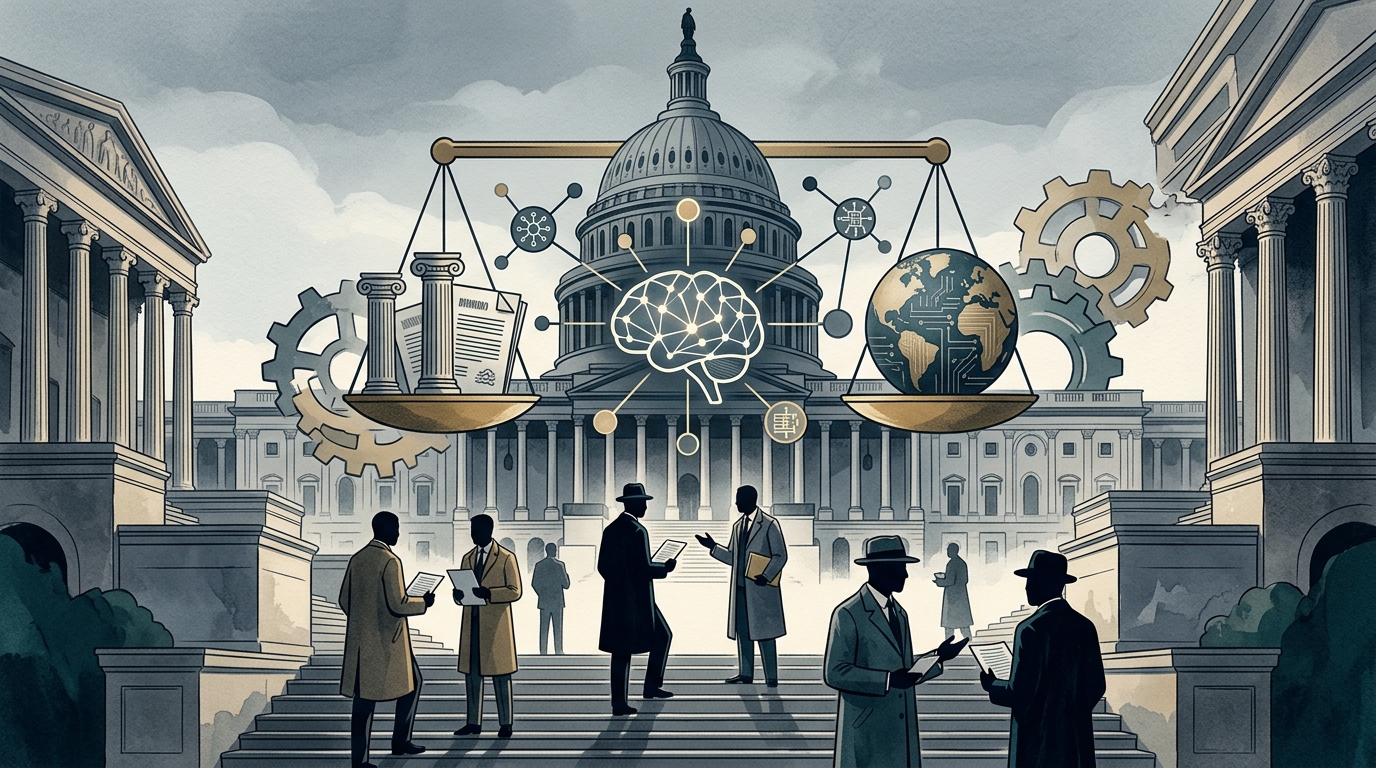

As we cross the midpoint of 2026, the global markets are witnessing what I term 'The Great AI Recalibration.' The era of speculative exuberance, where a mere mention of 'generative AI' could inflate a balance sheet, has concluded. In its place, we find a more rigorous, albeit high-stakes, focus on the physical and financial foundations of the intelligence economy. The primary question facing institutional investors today is whether the $700 billion committed to AI infrastructure—ranging from Meta’s aggressive cloud expansion to the 'AI factories' powering our grids—can deliver the necessary Return on Investment (ROI) before the capital trap closes.
The Infrastructure Paradox and the Margin Crisis
The current market sentiment is defined by a stark divergence. While Allianz’s Ludovic Subran warns of 'irrational exuberance' regarding productivity gains, the capital expenditure (CapEx) of Big Tech continues to accelerate. Meta’s recent pivot to challenge the established cloud titans illustrates a strategic necessity: owning the 'foundry' is now more important than owning the 'app.' However, this pivot comes at a cost. We are seeing a crisis of profit margins among second-tier AI providers who are caught between rising energy costs and the commoditization of basic AI services.
The market is no longer rewarding the promise of intelligence; it is rewarding the ownership of the means of production—power equipment, specialized chips, and high-density data centers.
This shift has created a clear divide in the power equipment market. Companies specializing in electrical grid modernization and cooling systems for AI factories are the new darlings of the industrial index, often outperforming the very software firms they serve. The 'AI Trade' is losing its traditional signals; revenue growth is no longer sufficient if the cost of compute erodes the bottom line.
The Industrial Pivot: Real-World ROI in Greece and Beyond
While the Silicon Valley narrative focuses on LLMs, the most sustainable market movements are occurring in the industrial sector. We are seeing a 'Great AI Pivot' where industrial ROI is beginning to outpace software hype. A prime example is the resurgence of the Greek shipbuilding industry. By integrating AI-driven predictive maintenance and autonomous structural welding, Greek yards are reclaiming competitive advantages that were lost decades ago. This is not 'speculative' AI; it is 'productive' AI with a direct impact on the Hellenic trade balance.
Similarly, the Greek financial sector, led by Eurobank’s billion-euro digital commitment, demonstrates a shift toward high-difficulty autonomous service agents. These are not simple chatbots but systems capable of complex credit risk assessment and cross-border settlement. For the Greek market, the focus remains on 'on-device' AI and retail efficiency—practical applications that insulate local leaders from the volatility of global tech valuations.
Actionable Insights for the Q3 Horizon
- Infrastructure Over Software: Investors should favor companies providing the 'picks and shovels'—specifically power management and cooling—over software firms with unproven monetization models.
- Monitoring CapEx: Watch for the $1 trillion capital trap; if hyperscalers begin to decelerate infrastructure spending, it will signal a broader market correction.
- Greek Industrial Resilience: The digital transformation of Greek heavy industry and banking offers a unique 'value play' within the Eurozone, grounded in tangible productivity gains rather than speculative multiples.