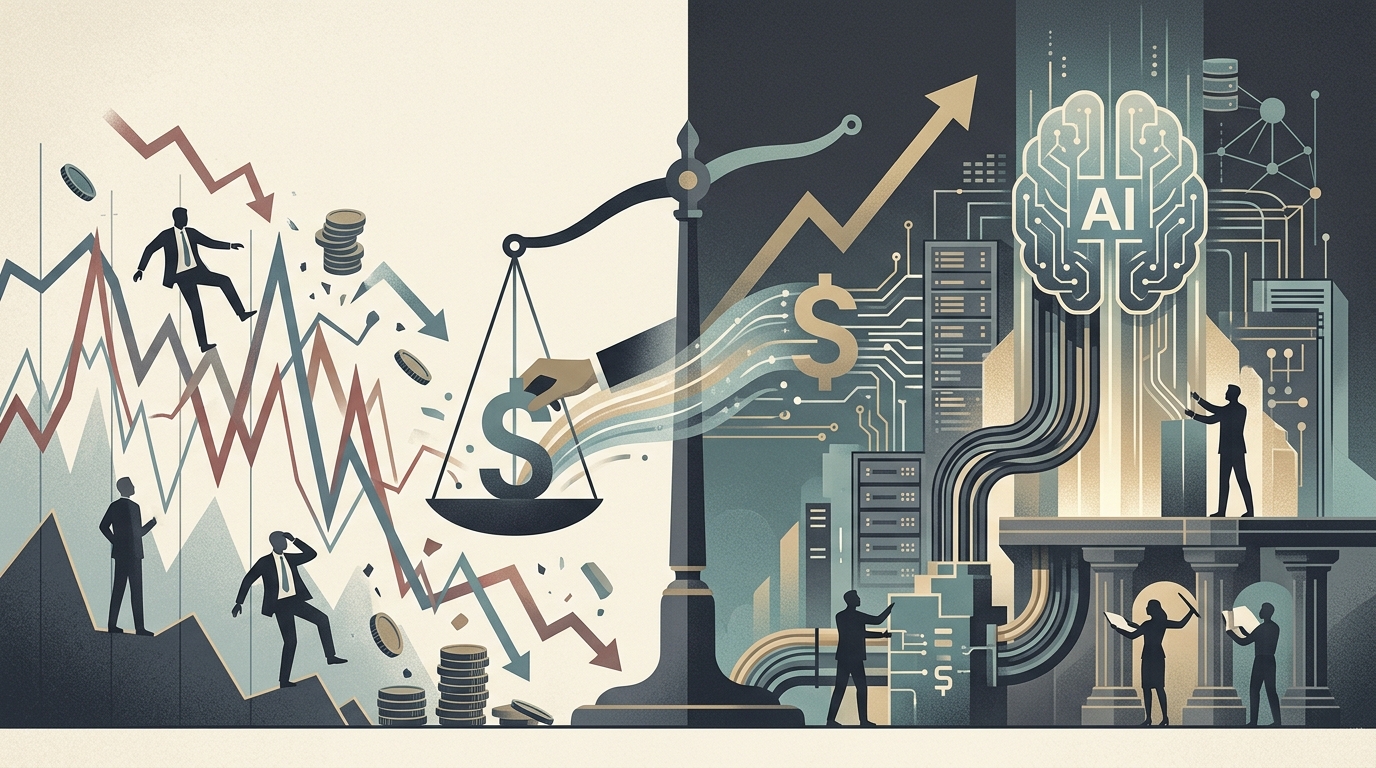

As we enter the second half of 2026, the global financial landscape is witnessing what I term 'The Great AI Recalibration.' The recent 13% dip in AI-heavy indices serves as a necessary stress test, separating speculative 'dumb money' from sustainable enterprise value. In this volatile climate, the Greek market presents a paradox of stability and growth that has caught the attention of institutional giants like Goldman Sachs.
The ASE Paradox: Fragile Growth vs. Institutional Optimism
The latest IOBE report highlights a 'fragile balance' in the Greek economy, noting marginal growth in June. However, this cautious domestic outlook contrasts sharply with Goldman Sachs’ decision to maintain an 'Overweight' rating on the Athens Stock Exchange (ASE). The rationale is clear: while macro-growth may seem incremental, the structural health of Greek listed companies—particularly in the banking and professional services sectors—is improving at a rate that outpaces regional peers.
We are seeing a shift from general economic sentiment to specific sectoral performance. The appointment of four new partners at KPMG Greece and the strategic expansion of Kaizen Gaming demonstrate that the 'human capital' element remains the primary driver of digital transformation. For investors, the takeaway is that the Greek market is no longer a high-beta play on European recovery, but a targeted bet on operational efficiency and professional services modernization.
Infrastructure ROI: The New North Star
The global narrative has shifted from 'software efficiency' to 'infrastructure ROI.' The trillion-dollar capital trap in AI software has led investors back to the basics: who is building the tools and who is using them to generate real cash flow? In Greece, Eurobank’s 'Billion-Euro Bet' on AI rebirth is a lighthouse project. By integrating AI into the core of financial services, the goal is not just automation, but the creation of new revenue streams through hyper-personalized banking.
"The market is no longer rewarding the promise of AI; it is rewarding the deployment of AI that reduces OpEx and enhances customer lifetime value."
This trend is also visible in the retail sector, where on-device AI is becoming the new frontier for Greek market leaders. By processing data at the edge, retailers are bypassing the high costs of cloud-based LLMs, achieving a faster return on investment. This pragmatic approach to technology is exactly what will sustain the ASE's valuation in the face of broader global volatility.
Strategic Implications for H2 2026
For the remainder of the year, market participants should watch the 'Great Decoupling' closely. We are seeing a divergence between companies that over-leveraged on AI hype and those, like JTI Hellas or Eurobank, that are using digital transformation to solve specific labor and operational challenges. The Eurogroup’s focus on a permanent AI agenda, as proposed by the Greek delegation, suggests that the regulatory environment will soon provide more clarity for long-term capital expenditure.
- Banking Sector: Look for margin expansion driven by AI-led operational efficiency rather than just interest rate fluctuations.
- Professional Services: The growth of firms like KPMG indicates a rising demand for high-level consultancy in navigating the AI transition.
- Retail & Logistics: On-device AI and maritime cluster fortifications (as seen in Cyprus) offer defensive growth opportunities.