
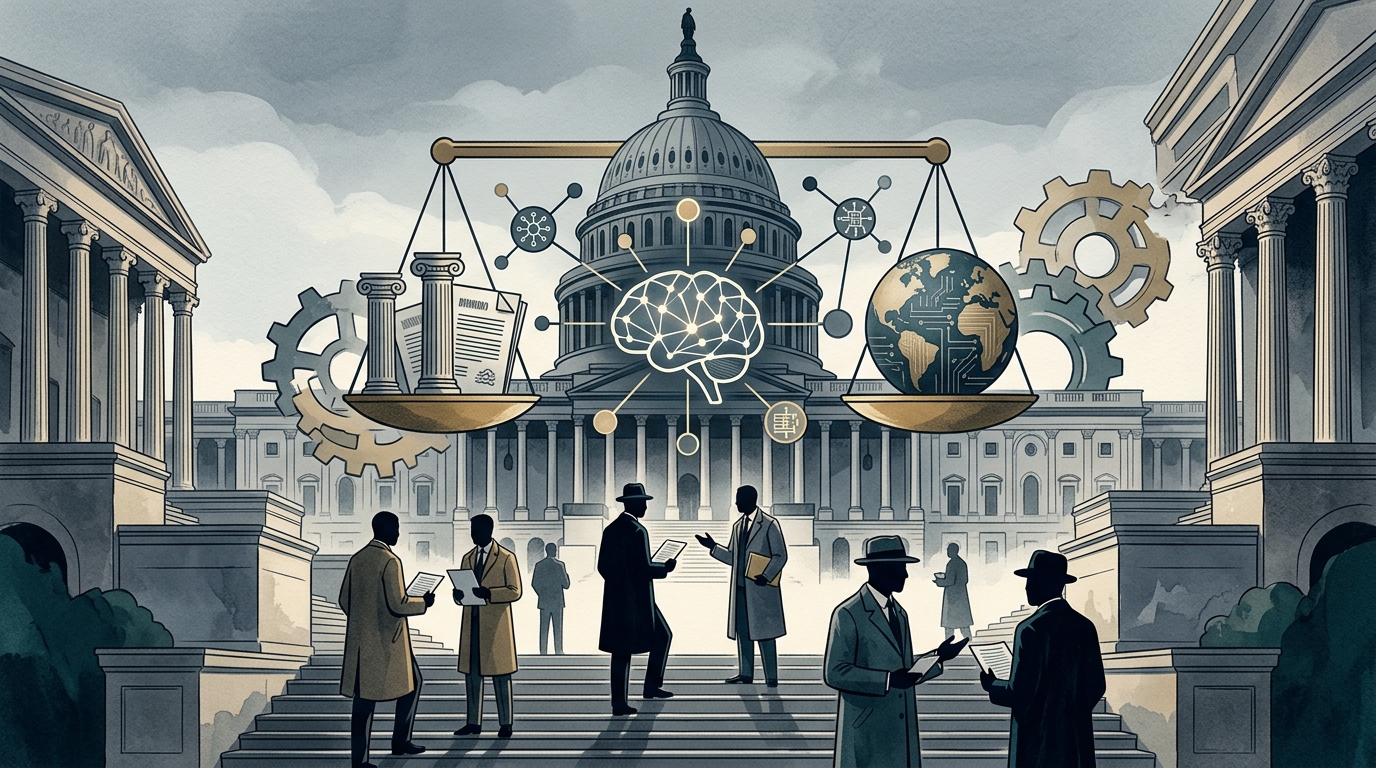
In the summer of 2026, we find ourselves at a constitutional crossroads that would have puzzled even the most forward-thinking legal minds of the Enlightenment. The recent proposal by OpenAI to offer a 5% equity stake to the United States government is not merely a financial maneuver; it is a fundamental reconfiguration of the relationship between the Polis and the Oikos—the state and the private enterprise. As we navigate the complexities of AGI development, this 'Sovereign Stake' suggests that the era of arms-length regulation is yielding to an era of institutional integration.
The New Social Contract or Regulatory Capture?
From a governance perspective, the proposal mirrors the ancient Athenian concept of liturgies, where the wealthiest citizens were expected to fund the state's most vital functions. However, the roles are now reversed. Here, the corporate entity invites the state into its inner sanctum. Proponents argue this aligns the incentives of the AI developer with the national interest, ensuring that the fruits of superintelligence benefit the public treasury and that safety protocols are overseen by sovereign authority.
Yet, as a student of political history, I must urge caution. When the regulator becomes a shareholder, the boundary of objective oversight dissolves. We risk a sophisticated form of 'regulatory capture' where the state, motivated by the appreciation of its 5% stake, may be incentivized to shield the company from antitrust actions or more stringent ethical constraints. The democratic principle of checks and balances requires a distance between the judge and the judged—a distance this proposal threatens to bridge.
The Geopolitics of AI Sovereignty
We cannot ignore the geopolitical dimensions of this move. In 2026, AI is no longer just a tool for productivity; it is the primary engine of national power. By offering a stake to the US government, OpenAI is effectively seeking 'protected status' in the escalating technological rivalry with China. It positions the company as a national champion, akin to the strategic industries of the 20th century, such as aerospace or telecommunications.
"True sovereignty in the digital age is not found in the ability to block technology, but in the institutional capacity to direct its evolution toward the common good."
For the European Union, this development is particularly provocative. While the US explores a model of state-corporate partnership, the EU remains committed to the 'Brussels Effect'—shaping AI through rigorous legislative frameworks like the AI Act. However, if the leading AI labs become de facto arms of the American state, Europe must decide whether it will remain a regulatory island or if it must develop its own 'European AI Sovereign Fund' to ensure that our democratic values are baked into the hardware of the future.
The Necessity of a Digital Amphictyony
In ancient Greece, the Amphictyonic League was an association of neighboring states formed to protect shared religious and political interests. Today, we need a similar 'Digital Amphictyony.' A 5% stake in a single company is a bilateral deal that lacks the breadth of a true democratic framework. If AI is to be governed as a global public good, we need institutional structures that involve not just one government and one corporation, but a multilateral coalition of democratic states.
The proposal by OpenAI may be the first step toward a more stable governance model, but it must be accompanied by unprecedented transparency. A government stake should not come with a seat in the boardroom that operates in shadows. Instead, it should be the catalyst for a new era of 'Open Statecraft,' where the algorithms that govern our lives are subject to the same scrutiny as the laws that govern our streets.