In the early 2020s, the prevailing fear was that Artificial Intelligence (AI) would widen the chasm between the rich and the poor. However, as we progress through the second half of 2026, reality is proving remarkably different. The revolution in medical technology is not just unfolding in the gleaming private hospitals of the West, but also in the rural districts of Vietnam, the townships of Lagos, and the remote villages of the Greek provinces. AI is being transformed from a luxury into a "public utility" infrastructure, offering access to diagnoses and treatments that once required a fortune.
This trend, often described as the "democratization of care," is based on the rapid reduction in the cost of computing power and the maturation of multimodal AI models. Today, a standard smartphone in 2026 possesses enough power to locally run algorithms that analyze skin lesions, interpret ultrasounds in real-time, and monitor chronic diseases with an accuracy that often surpasses the average general practitioner. For low-income individuals, this is not just a technological upgrade; it is the difference between life and death.
Diagnostics at the Edge: Smartphones as Pocket Clinics
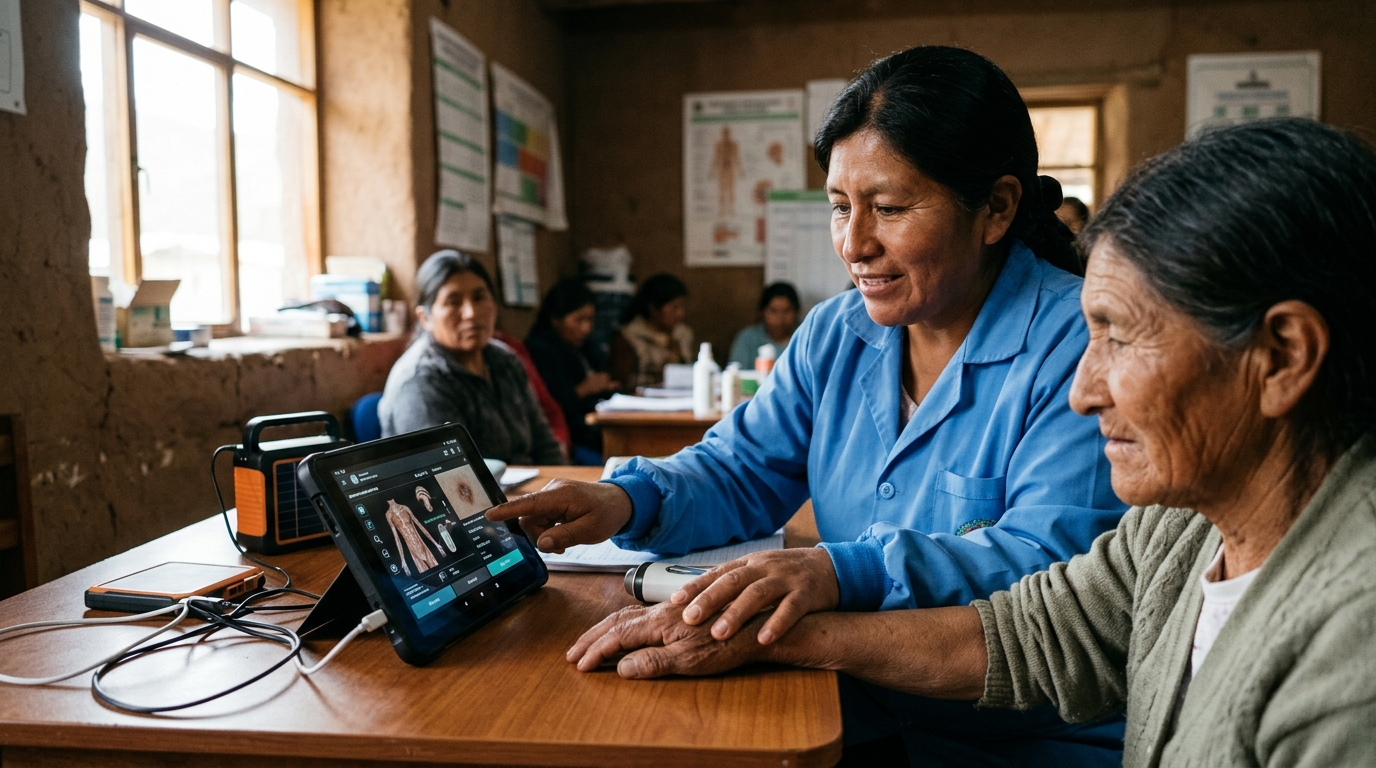
The most significant shift we observe in 2026 is the move of diagnostics from the hospital to the "edge." The use of specialized AI applications, approved by international health organizations, allows non-specialized personnel or even patients themselves to perform preventive screenings. In Vietnam, for instance, government-backed programs utilize AI-vision to detect tuberculosis and lung cancer through simple X-rays digitized by mobile phones.
This "leapfrogging" technology allows developing economies to bypass the need for expensive physical infrastructure and offer high-level primary care. Algorithms are now trained on diverse datasets, reducing the racial and socioeconomic biases that plagued early 2023 models. Consequently, a woman in a mountainous village in Epirus can receive a reliable assessment of her cardiovascular risk without having to travel for hours to the nearest urban center.
Virtual Assistants and the Bridge of Linguistic Inequality
One of the primary barriers to healthcare for low-income populations has always been education and communication. In 2026, virtual health assistants powered by next-generation LLMs speak local dialects fluently and simplify complex medical instructions. These systems do not just act as diagnostic tools; they serve as "health navigators," reminding patients to take their medication and explaining side effects in a way that is understandable for individuals with limited digital or medical literacy.
Furthermore, AI is contributing to the optimization of the pharmaceutical supply chain. Within the framework of new trends, demand-prediction algorithms ensure that essential vaccines and medicines reach where they are needed most, minimizing waste and lowering prices for end consumers. The economic efficiency offered by automation allows public health systems, often buckling under the weight of debt, to breathe and reinvest in human capital.
Ethical Challenges: The Risk of "Two-Tier Healthcare"
Despite the optimism, 2026 brings critical ethical questions. There is a risk that AI might be used as a "cheap substitute" for human care for the poor, while the wealthy continue to enjoy personal contact with top-tier physicians. The international community must ensure that AI remains complementary and not an excuse for the further degradation of public hospitals.
Moreover, data privacy remains a significant concern. Low-income populations are often more vulnerable to predatory data practices in exchange for free services. Ensuring that their health data does not become a commodity in the hands of Big Tech giants is the major political battle of the year. Algorithmic transparency and data sovereignty must be the foundations upon which a new digital social contract for health is built.
Conclusion: Towards a Universal Right to Wellness
The AI revolution in healthcare in 2026 is not just about robotic surgeries or gene therapies. It is about restoring justice to a system that for decades excluded the underprivileged. When a technology manages to make specialized knowledge accessible and affordable, it ceases to be a mere tool and becomes a lever for social progress. The challenge for the remainder of the decade is to maintain this momentum, ensuring that innovation serves humanity, regardless of the size of one's wallet.