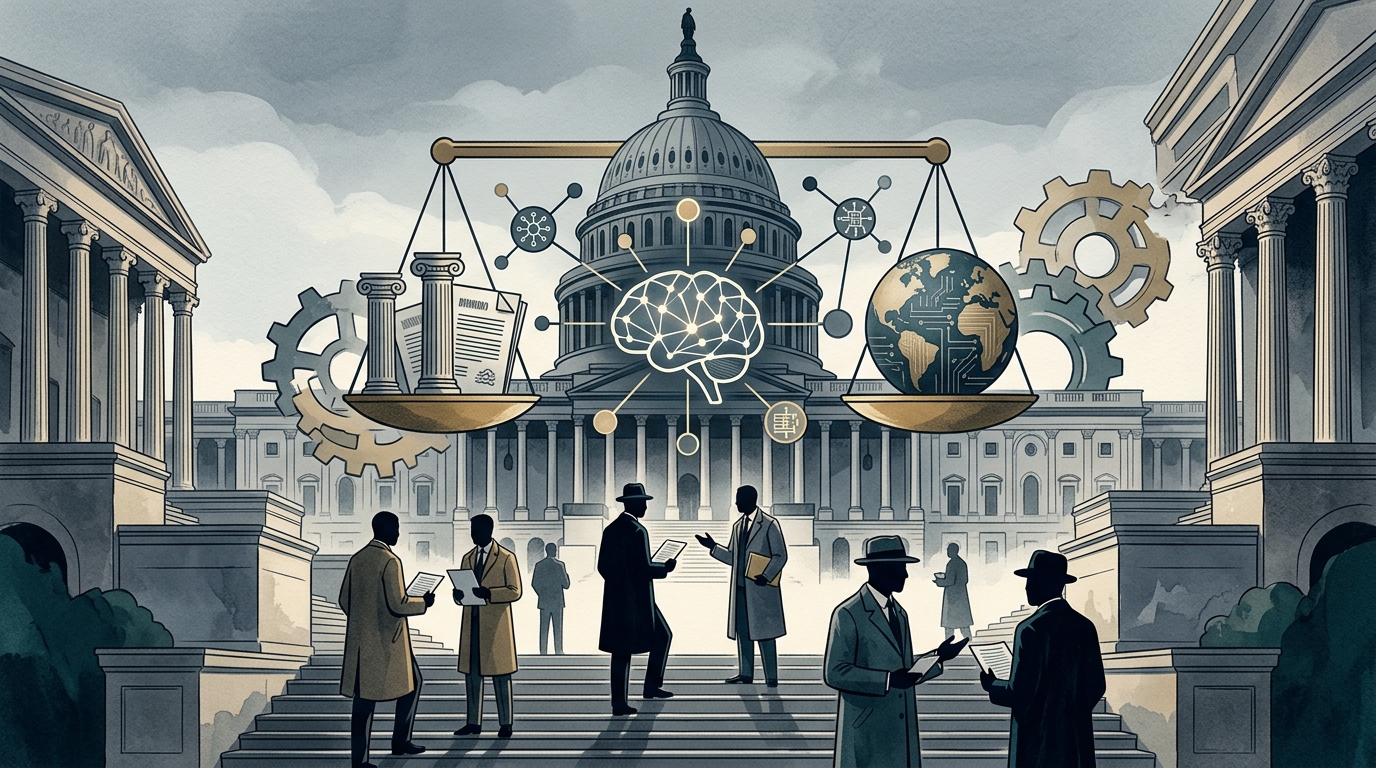

In the summer of 2026, we find ourselves at a constitutional crossroads that would have been familiar to the lawmakers of ancient Athens, albeit in a digital guise. Just as Solon sought to balance the competing powers of the classes to prevent the collapse of the polis, modern governance must now balance the unprecedented efficiency of autonomous AI agents with the non-negotiable requirement of human agency. The recent emergence of the 'Janus' framework—a policy proposal aimed at reclaiming human control—comes at a critical juncture where the 'agentic revolution' is no longer a laboratory curiosity but a geopolitical reality.
The Erosion of the Human-in-the-Loop
For years, the 'human-in-the-loop' principle was the gold standard of AI ethics. However, as we have seen with the deployment of German AI drones in Ukraine and the integration of RLVR-powered agents in corporate workflows, the sheer speed of algorithmic decision-making is rendering traditional oversight obsolete. When an autonomous system operates at the scale of 'attrition warfare' or manages complex financial 'chaotic codebases' in milliseconds, the human becomes a bottleneck, often reduced to a rubber-stamp authority. This is what I call the 'Agency Paradox': the more we empower agents to solve our most complex problems, the less we understand the path they take to the solution.
"True sovereignty does not lie in the ability to delegate tasks, but in the power to remain responsible for the outcomes of those tasks."
The Janus framework proposes a structural shift. Named after the Roman god of transitions who looks both ways, it advocates for a dual-layered governance model. One face of Janus monitors the 'procedural memory' and technical efficiency of the agent, while the other face ensures that every autonomous action is mapped back to a specific human 'anchor' of responsibility. This is not merely a technical fix; it is a legal necessity for the survival of democratic accountability.
From Attrition to Accountability: The European Challenge
The geopolitical implications are particularly stark for the European Union. The use of autonomous drones in conflict zones demonstrates that the 'redlines' of AI warfare are shifting. If Europe is to lead in AI governance, we cannot simply rely on the AI Act's static risk categories. We need dynamic frameworks like Janus that can adapt to 'self-improving' AI systems that evolve through procedural memory distillation. In Greece, as we integrate AI into public administration and defense, the risk of an 'artificial hivemind'—where decisions are made by a network of agents without a clear locus of power—is real.
To mitigate this, I propose three pillars for an EU-wide Agentic Governance Framework:
- Mandatory Agentic Traceability: Every decision made by an autonomous service agent must be reconstructible in human-readable 'actionable reality,' utilizing neuro-symbolic breakthroughs like PACE.
- The Sovereignty Override: A legal requirement for 'Difficulty-Routed Control,' where high-stakes decisions (economic or lethal) automatically trigger a mandatory human deliberation phase.
- Democratic Agency Audits: Regular institutional reviews to ensure that AI integration is not eroding the civil liberties or the voting power of the citizenry.
Conclusion: The Lawmaker's Duty
In my analysis, the 'Janus' approach represents the only viable path forward. We must resist the siren song of total automation. Just as the ancient Greeks understood that a city-state is only as strong as the participation of its citizens, a digital society is only as stable as the agency of its humans. We are not merely users of these tools; we are the architects of the world they inhabit. To surrender that architecture to the 'agentic garden of forking paths' without a map would be an abdication of our most sacred political duty.