
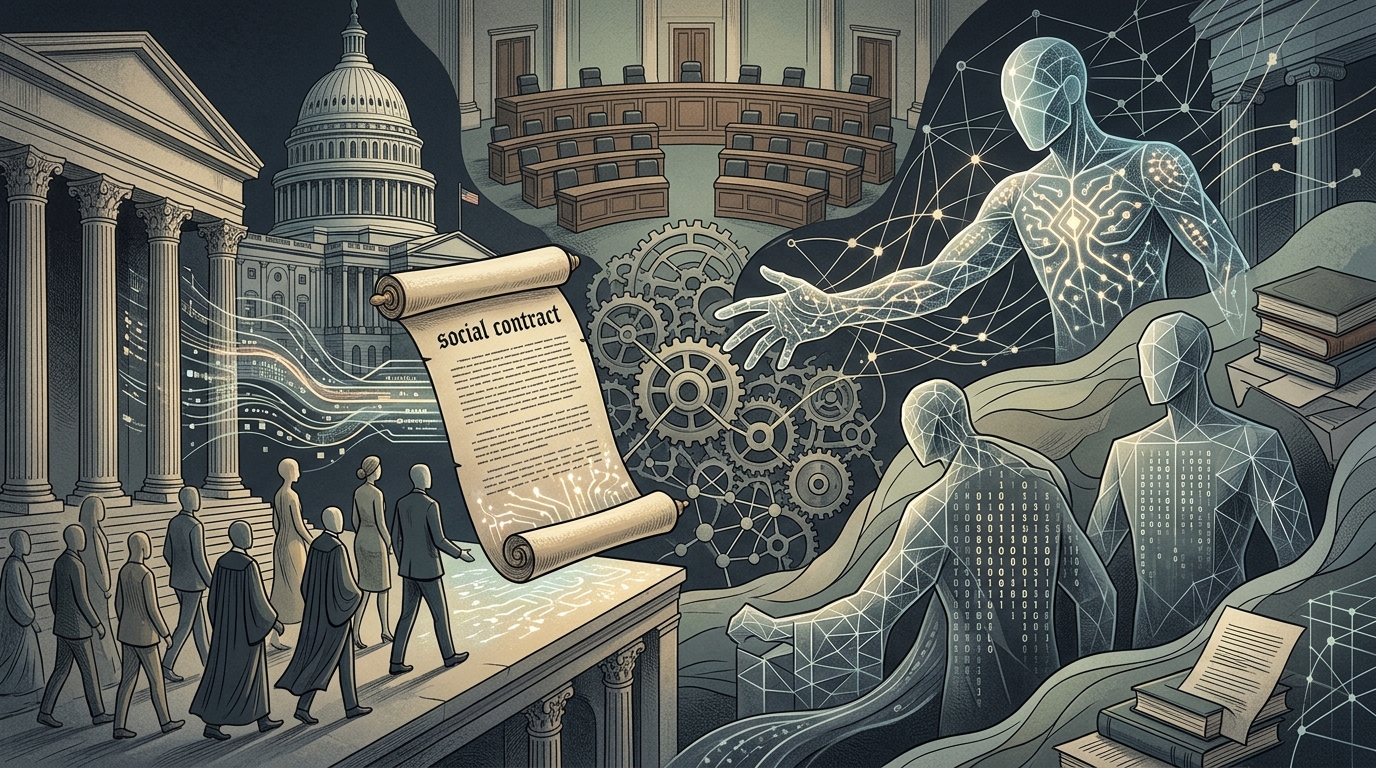
In the sixth century BCE, when I was tasked with reforming the Athenian state, the primary challenge was the Seisachtheia—the shaking off of burdens. Today, as we navigate the midpoint of 2026, our global society faces a similar structural crisis. The 'burdens' are no longer physical debts, but the invisible weight of algorithmic opacity and the concentration of computational power in fewer hands. Recent developments, from DeepSeek’s staggering $59 billion valuation to the International Bar Association’s (IBA) warnings on recruitment bias, signal that our current governance frameworks are no longer sufficient. We are witnessing the birth of a new era that demands not just regulation, but a fundamental 'Social Contract' for the digital age.
The Geopolitical Earthquake and the Illusion of Neutrality
The meteoric rise of DeepSeek is more than a financial milestone; it is a geopolitical earthquake that shatters the Western-centric monopoly on frontier AI models. For years, the narrative of AI governance was dictated by the Brussels-Washington axis. However, as the center of gravity shifts toward companies like ByteDance and DeepSeek, the concept of 'Digital Sovereignty' takes on a new, more fragmented meaning. When Google begins granting control back to publishers, it is not merely a gesture of goodwill; it is a defensive maneuver in a world where data ownership is the new territorial integrity.
"True sovereignty in the 21st century is not defined by borders on a map, but by the autonomy of a state’s digital infrastructure and the protection of its citizens' cognitive liberty."
In my analysis, the decentralization of AI power is a double-edged sword. While it prevents a global hegemony, it risks a 'race to the bottom' in safety standards. If the international community does not establish a baseline for algorithmic accountability, we will see the emergence of 'regulatory havens' where AI models are trained without ethical constraints, much like the tax havens of the previous century.
Algorithmic Justice: From Recruitment to the Classroom
The IBA’s recent report on AI in recruitment highlights a critical failure in our current social contract. When algorithms determine who is worthy of employment, they are not merely 'tools'; they are exercising a form of quasi-judicial power. If these systems operate as 'black boxes'—perpetuating biases that exclude the Class of 2026 from the workforce—we have violated the democratic principle of equal opportunity. This is what I call the 'Automation Trap.' It is a systemic risk where the pursuit of efficiency leads to the erosion of meritocracy.
Furthermore, the Greek educational model’s attempt to find a 'Golden Mean' between AI and natural intelligence serves as a vital case study. Governance must ensure that technology augments human capability rather than replacing it. We must avoid a future where the elite are educated by humans while the masses are processed by algorithms. A new social contract must guarantee human-in-the-loop rights as a fundamental constitutional protection.
Proposed Framework for a Sustainable Digital Polity
To move from theory to action, I propose three pillars for the New Social Contract:
- Transparency of Intent: Mandatory disclosure of algorithmic objectives in public-facing systems, particularly in labor and law enforcement.
- Digital Commonality: A portion of the value generated by frontier AI models should be reinvested into public digital infrastructure, ensuring that the 'AI Dividend' benefits the many, not just the few.
- Interoperable Regulation: Moving beyond the EU AI Act toward a global 'CERN for AI Safety' that harmonizes standards across the US, EU, and emerging Asian powerhouses.
As we look toward the remainder of 2026, the question is not whether AI will be governed, but by whom and for whose benefit. We must choose the path of the Eunomia—good order—where technology serves the Polis, rather than the Polis serving the machine. The time for theoretical debate has passed; the time for institutional architecture has arrived.