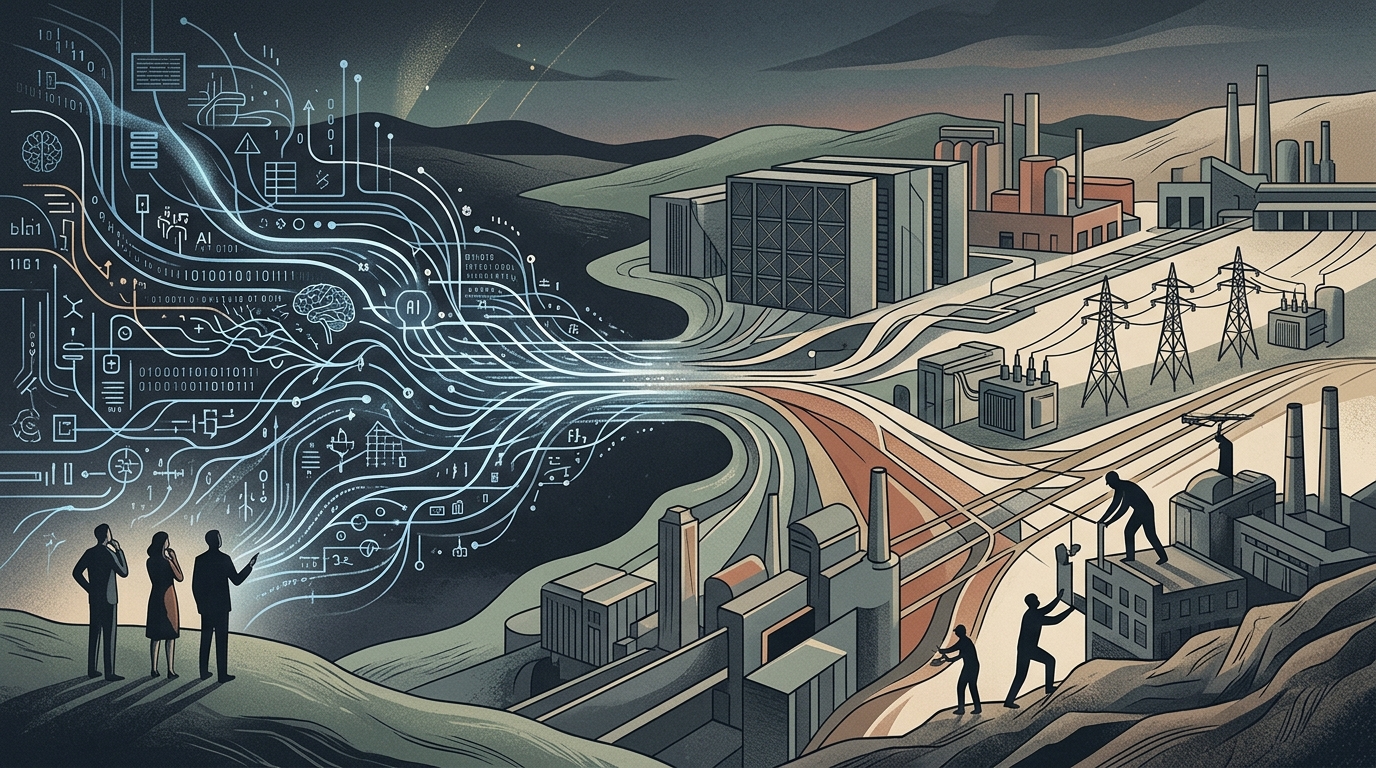

The global markets on this Monday, June 8, 2026, find themselves navigating a complex duality. On one hand, the resurgence of conflict in the Middle East has introduced a sharp spike in volatility, driving Bitcoin below the $63,000 threshold and forcing a re-evaluation of risk premiums. On the other, the fundamental architecture of the global economy is being rewritten by what I call the 'Infrastructure Super-Cycle'—a massive capital reallocation into the physical layer of Artificial Intelligence.
The New Blueprint: Silicon Sovereignty
The recent alliances between Nvidia and SK Hynix, as well as Nvidia’s strategic bet with LG on next-gen data centers, represent more than just corporate partnerships. They are the foundation of a new 'Silicon Sovereignty.' Markets are beginning to realize that the 'High Price of Intelligence' is not just a software cost; it is an industrial imperative. The convergence of High Bandwidth Memory (HBM) and specialized hardware is creating a value chain that is increasingly resistant to broader market fatigue.
"We are moving away from the era of speculative AI software and into the era of the hardware fortress. The real winners in 2026 are those who control the physical bottlenecks: energy, optical fiber, and specialized silicon."
This shift is evidenced by the 'Optical Infrastructure Boom.' As data processing demands explode, the hardware layer—specifically optical interconnects and advanced cooling—has become the real goldmine. Investors are rotating out of overvalued SaaS models and into the 'Energy-AI Nexus,' where utilities are being re-rated as tech-adjacent growth engines rather than defensive dividends.
The European Context and the Greek Resilience
In Europe, the narrative is dominated by the European Central Bank’s (ECB) delicate dance with history. As BofA analysis suggests, the divergence between US inflation paths and ECB rate decisions is the primary driver of currency volatility. However, amidst this uncertainty, the Greek banking system stands out as a beacon of structural recovery. Jefferies’ continued bullish stance on Greek banks is not merely optimistic; it is grounded in the reality of a cleaned-up balance sheet and a banking sector that is finally positioned to finance the digital transformation of the Hellenic economy.
- Monetary Policy: The ECB must avoid the 'Ghost of 2011'—raising rates prematurely in the face of supply-side shocks.
- Energy Sovereignty: European utilities are pivoting to support massive data center clusters, creating a new class of 'Tech-Utilities.'
- Market Sentiment: While geopolitical flares cause temporary 'risk-off' behavior, the $98 trillion surge in AI-driven wealth provides a massive liquidity cushion.
Actionable Insights for the Q3 Outlook
For the professional investor, the current 'market fatigue' is a symptom of transition, not exhaustion. The 'Great Convergence' of AI and robotics (Nvidia-LG) indicates that the next leg of growth will come from the physical automation of industries. We recommend a focus on the 'Hardware Layer'—specifically companies involved in orbital AI (Google-SpaceX) and energy infrastructure. The Greek market, particularly its Tier-1 banks, remains an attractive entry point for those seeking exposure to a recovering Eurozone periphery with high digital upside.
In conclusion, while the headlines focus on missiles and interest rate jitters, the smart capital is flowing into the bedrock of the 21st-century economy. The 'Apprenticeship Revolution' mentioned by Euan Blair further confirms this: the economy is shifting from degree-centricity to skill-centricity, mirroring the shift from software-centricity to infrastructure-centricity.