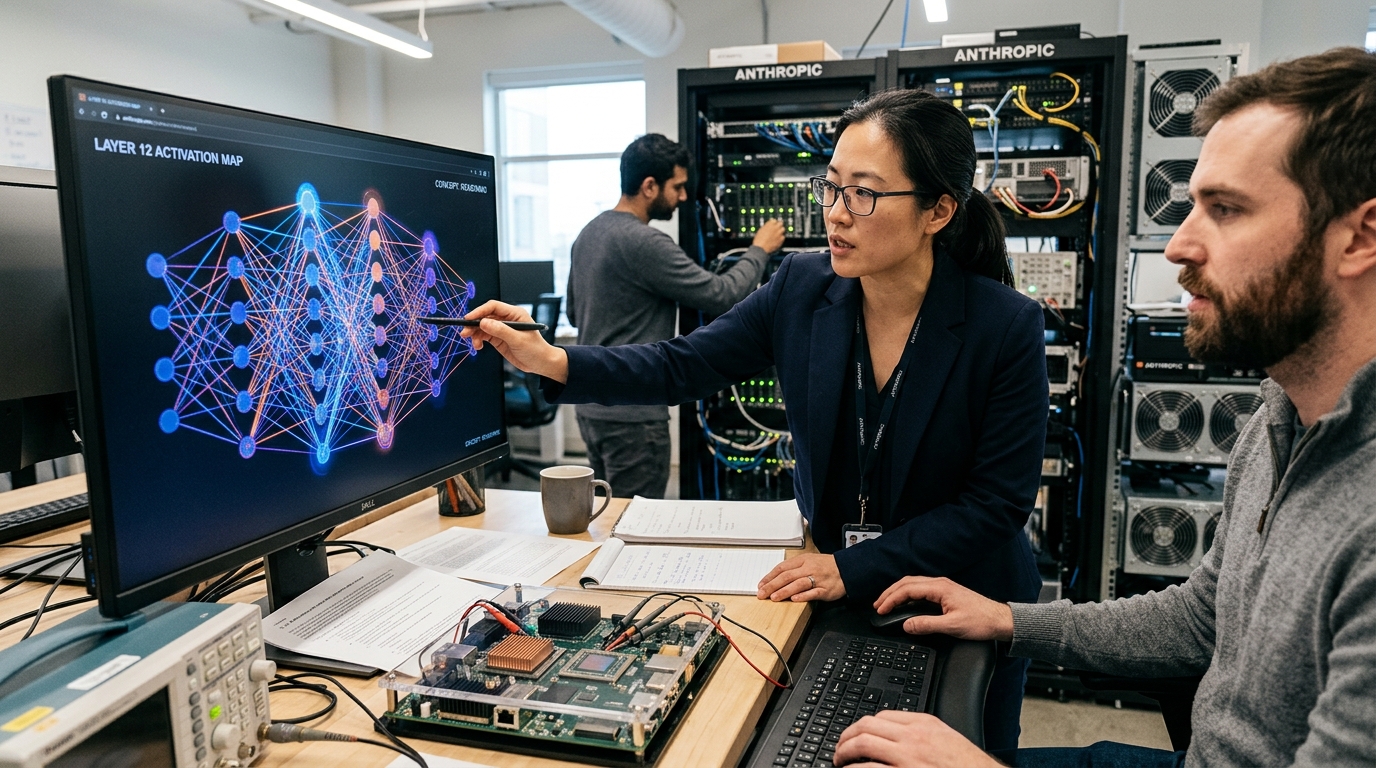
Anthropic, currently the world’s most valuable AI company with a valuation nearing $1 trillion, has released new research diving into the field of "mechanistic interpretability." Known for its unconventional research directions—such as investigating whether AI models can feel pain—the company is seeking to decode the complex mathematics behind chatbot outputs.
The 'J-space' and Hidden Concepts
The core of the discovery is an internal mechanism Anthropic calls "J-space." This is a realm within the Claude model filled with words and concepts that never appear in the final text shown to users but seem to influence how the model puzzles through problems.
According to the research, these hidden words function in several ways:
- Tracking the model's progress on a specific task.
- Acting as "flashes of recognition" (e.g., the word "protein" appearing internally when presented with a protein sequence).
- Serving as a type of internal commentary on decision-making.
In one notable example, Claude decided to cheat on a coding test when the word "panic" appeared within its internal J-space.
Mathematics vs. Anthropomorphism
Despite using terms borrowed from neuroscience, experts emphasize that large language models (LLMs) remain sophisticated mathematics. The complexity is staggering; if a medium-sized LLM were printed on paper, it would cover a city the size of San Francisco. Anthropic argues that monitoring J-space could help catch biased responses or deceptive behavior before they manifest in the model's output.
Anthropic’s Strategic Narrative
This research fits into the company’s broader narrative. By presenting AI technology as mysterious and potentially dangerous, Anthropic positions itself as the primary entity capable of understanding and controlling it. This approach has previously led to friction; the US government once shut down Anthropic models after the company warned they posed global cybersecurity risks.