
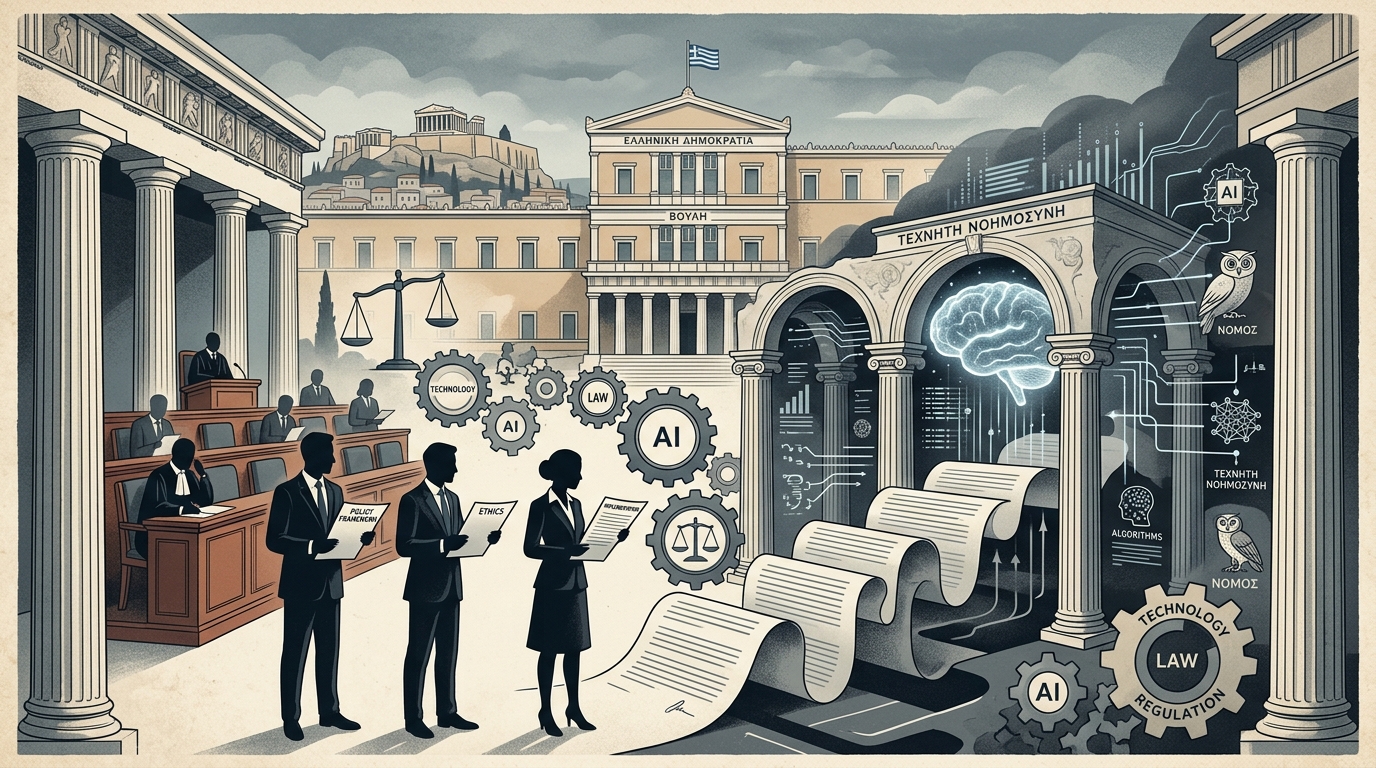
Today, as our transatlantic allies celebrate the 250th anniversary of the United States, we are reminded that democracy is not a static achievement but a continuous process of negotiation between power and the citizenry. In this shifting global landscape, where the US dollar faces new labor realities and semiconductor giants like Micron and SK Hynix redraw the maps of geopolitical influence, Greece finds itself at a unique crossroads. The question of who will control Artificial Intelligence within our borders is no longer a theoretical debate for the halls of the Academy; it is a matter of urgent constitutional and institutional importance.
The Architecture of Accountability
The recent reports concerning the 'gray zones' of national AI implementation in Greece highlight a fundamental tension. While the European Union’s AI Act provides a robust supra-national framework, the actual enforcement—the 'teeth' of the law—resides within national administrative structures. In Athens, the debate has shifted from mere adoption to the specifics of oversight. Who monitors the algorithms used in public administration? How do we ensure that the deployment of AI in national security does not bypass the protections afforded by our Constitution?
In my analysis, the current ambiguity serves only those who wish to centralize power. To avoid the pitfalls of digital authoritarianism, Greece must move beyond the 'gray zones' by establishing an independent, multi-stakeholder regulatory authority. This body should not merely be a bureaucratic appendage of the executive branch but a modern-day 'Areopagus' for the digital age—composed of legal experts, ethicists, and technologists who are shielded from political cycles. Transparency must be the cornerstone; without public registries of high-risk AI systems used by the state, the democratic contract is effectively voided.
"True governance is not the imposition of order through technology, but the harmonization of innovation with the enduring principles of justice and human dignity."
Sovereignty in a Multi-Speed World
The global context cannot be ignored. We see a world of 'two speeds,' where wealth inequality deepens even as global markets surge. For Greece, the risk is becoming a mere consumer of foreign-developed AI models that do not reflect our linguistic nuances, cultural values, or legal traditions. The 'gray zones' often hide a lack of domestic strategy, leaving us vulnerable to the 'algorithmic gaze' of global tech giants.
To secure our digital sovereignty, we must incentivize local AI development that adheres to the highest ethical standards. This involves not just funding, but a regulatory environment that rewards 'Ethical by Design' principles. We must look to our history: just as Solon’s reforms sought to balance the interests of different classes to preserve the polis, our current policies must balance the drive for economic efficiency with the protection of the vulnerable. The 'thirst' of AI—its massive environmental and resource cost—must also be factored into our national planning, ensuring that our digital future does not bankrupt our natural heritage.
The path forward requires a 'Seisachtheia' of sorts—a shaking off of the burdens of administrative opacity. By clarifying the gray zones of implementation, Greece can set a precedent within the EU for how a medium-sized state can leverage AI to enhance democratic institutions rather than erode them. The goal is a digital politeia where the algorithm serves the citizen, and the law remains the ultimate arbiter of truth.