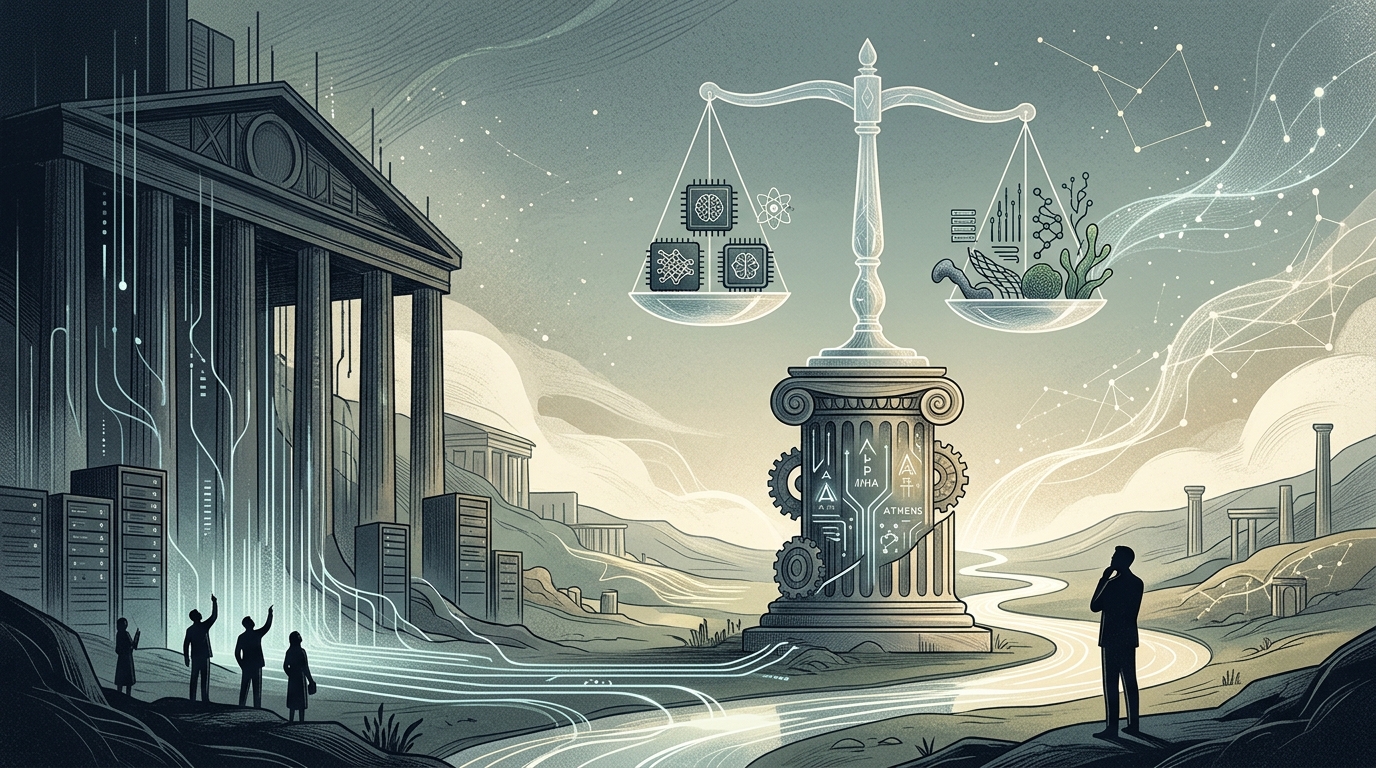

The Crisis of Institutional Oversight
In the age of Solon, the stability of the Athenian state rested upon the clarity of its laws and the visibility of its decision-making processes. Today, as we navigate the digital transformation of the 21st century, a new and silent challenge has emerged within the corridors of power: 'Shadow AI.' This phenomenon—the use of unauthorized, unvetted, and often personal artificial intelligence tools by public officials—represents more than a mere IT security risk. It is a fundamental challenge to the democratic principle of accountability.
Recent reports highlighting the 'invisible threat' of Shadow AI in public administration suggest that the gap between technological adoption and institutional regulation is widening. When a civil servant uses an external Large Language Model (LLM) to draft policy, summarize classified briefings, or manage citizen data without formal oversight, the chain of responsibility is broken. If a decision is made based on an algorithmic hallucination or a biased output, who is to be held responsible? In the absence of a clear framework, we risk returning to a state of 'stasis'—political fragmentation where the mechanisms of the state operate outside the reach of the law.
Geopolitical Efficiency vs. Democratic Auditability
The urgency of this issue is underscored by the shifting geopolitical landscape. While China has pivoted its AI strategy toward 'efficiency and resilience'—leveraging a top-down, highly integrated model to close the technological gap—Western democracies face a different struggle. Our strength lies in the 'rule of law' and the 'auditability' of our institutions. However, if our public administrations become dependent on 'Shadow AI' to maintain efficiency, we sacrifice the very transparency that distinguishes our system from authoritarian models.
The true measure of a state's resilience is not the speed of its bureaucracy, but the integrity of its processes.
We must look toward emerging research in 'Auditable Question Formation' and 'In-Process Retrieval' as potential technological allies. If scientific agents can be designed to be auditable from prompt to publication, as recent breakthroughs suggest, then our administrative AI must be held to the same standard. The goal is not to stifle innovation or to forbid the use of AI in the public sector—that would be a futile exercise in Luddism. Instead, we must integrate these tools into a formal 'Governance Framework' that ensures every algorithmic intervention is logged, vetted, and subject to human oversight.
Proposing a New Social Contract for the Digital State
To address the threat of digital chaos, I propose a three-tiered approach to AI governance in public administration. First, we must establish 'Institutional Sandboxes' where civil servants can experiment with approved AI tools under the supervision of data protection officers. This acknowledges the reality of the demand for AI without compromising security. Second, we must implement mandatory 'Algorithmic Impact Assessments' for any tool that touches public policy, mirroring the requirements of the EU AI Act but extending them to the micro-level of daily administration.
Finally, we must cultivate a culture of 'Technological Eunomia' (Good Order). This requires a significant investment in the digital literacy of our public workforce. A civil servant who understands the risks of data leakage and the mechanics of LLM memory is less likely to turn to 'shadow' solutions. As we watch the rise of agentic AI in specialized fields like bioinformatics, the state must not lag behind. We need a robust, sovereign AI infrastructure for the public sector—one that provides the efficiency of modern models while maintaining the sanctity of the public trust. Only then can we ensure that the 'Invisible Assembly' of AI tools serves the demos, rather than undermining it.