The history of Computer-Aided Design (CAD) has always been a story of translation: translating human intuition into rigorous mathematics and geometric constraints. For decades, this process required thousands of hours of specialized training and manual labor. However, a new research paper published on ArXiv (2607.05573) marks the beginning of a new era, where Foundation Models are taking on the role of the digital designer.
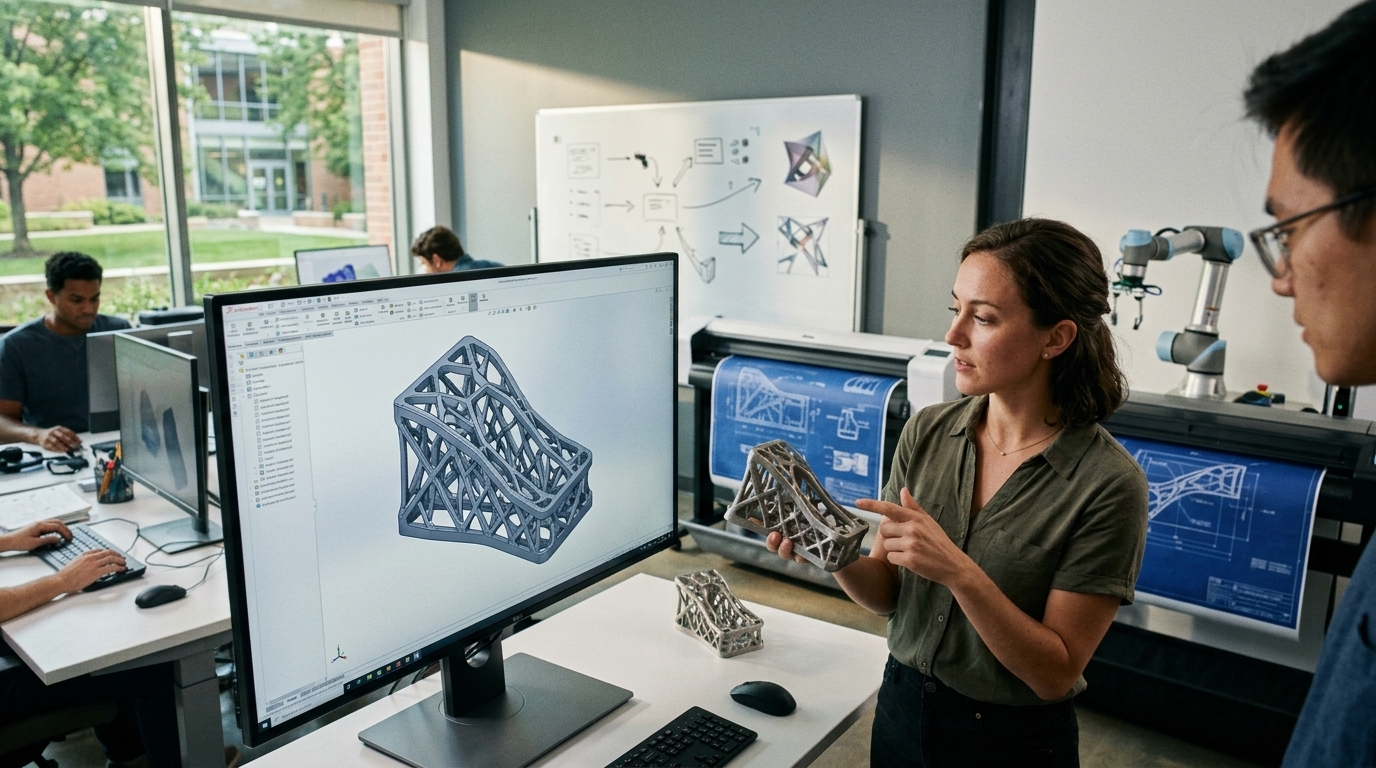
The study focuses on the use of Large Language Models (LLMs) and Vision-Language Models (VLMs) to automatically generate parametric 3D designs from natural language specifications. Unlike previous approaches that relied on pixels or voxels (which are difficult to edit or manufacture), the new generation of AI produces CAD code. This means the output is not just an "image" of an object, but a fully functional, editable, and parametric model that can be imported directly into industrial software like SolidWorks or AutoCAD.
The Convergence of Language and Geometry
The core innovation lies in treating geometric design as a form of programming. LLMs, having been trained on vast datasets of code, prove exceptionally capable of synthesizing scripts in languages like OpenSCAD or Python-based CAD APIs. When a user asks for "a clamp with a 50mm opening and reinforced corners," the model doesn't "draw" the object. Instead, it calculates the geometric relationships and writes the code that defines these parameters.
Adding Vision-Language Models (VLMs) to the mix acts as a quality control mechanism. The VLM can "see" the generated model and compare it with the user's original description. If the AI perceives that a screw hole is in the wrong place or that the structural integrity looks weak, it can provide feedback to the LLM to correct the code in a closed-loop of self-improvement. This "visual reasoning" capability is what makes 2026 models far superior to the early attempts of 2023.
Parametric Design: The Holy Grail of Engineering
Why is the parametric approach so important? In traditional 3D modeling for movies or games, a model is just a surface. In engineering, however, a model must have a design history and variables. If you change the diameter of a pipe, all connected components must adjust automatically. The foundation models described in the research understand these hierarchical relationships.
- Democratization of Design: Individuals without CAD knowledge can now create complex parts for 3D printing simply by describing them.
- Prototyping Speed: The time from idea to digital model is reduced from hours to seconds.
- Material Optimization: AI can suggest geometries that save material while maintaining strength, something humans would struggle to calculate manually.
However, the research also highlights significant challenges. AI "hallucination," which in a text might just be a wrong fact, in CAD design can mean a part that will fail under pressure, leading to catastrophic results. Micron-level precision remains the next great frontier for foundation models.
Ethical and Labor Implications
As these tools are integrated into production, questions arise about the future of the design profession. Will engineers become mere "prompt editors"? The study's answer is both reassuring and cautionary: AI takes over the repetitive labor, but strategic decision-making and understanding material physics remain a human prerogative. The need for human oversight is critical, especially in sectors like aerospace and medical technology.
"We are not just facing a new tool, but a new language for communicating with matter," the research team notes.
In conclusion, the arrival of Foundation Models in CAD is not just a technical upgrade. It is a fundamental paradigm shift that promises to accelerate innovation in the physical world at the same rate that information technology accelerated the digital world. 2026 will go down in history as the year code definitively became the engineer's new "pencil."