The evolution of language agents has reached a critical juncture. While these models can perform complex tasks by following the "observe-reason-act" loop, their memory has remained an external component until now. In traditional Retrieval-Augmented Generation (RAG) architectures, the agent queries a database, incorporates information into its context, and then proceeds. However, a groundbreaking study titled "Memory in the Loop," published on ArXiv (2607.05690), proposes a radical shift: integrating information retrieval directly into the reasoning process, creating what researchers call "In-Process Retrieval" (IPR).
Moving from External Storage to Internal Operation
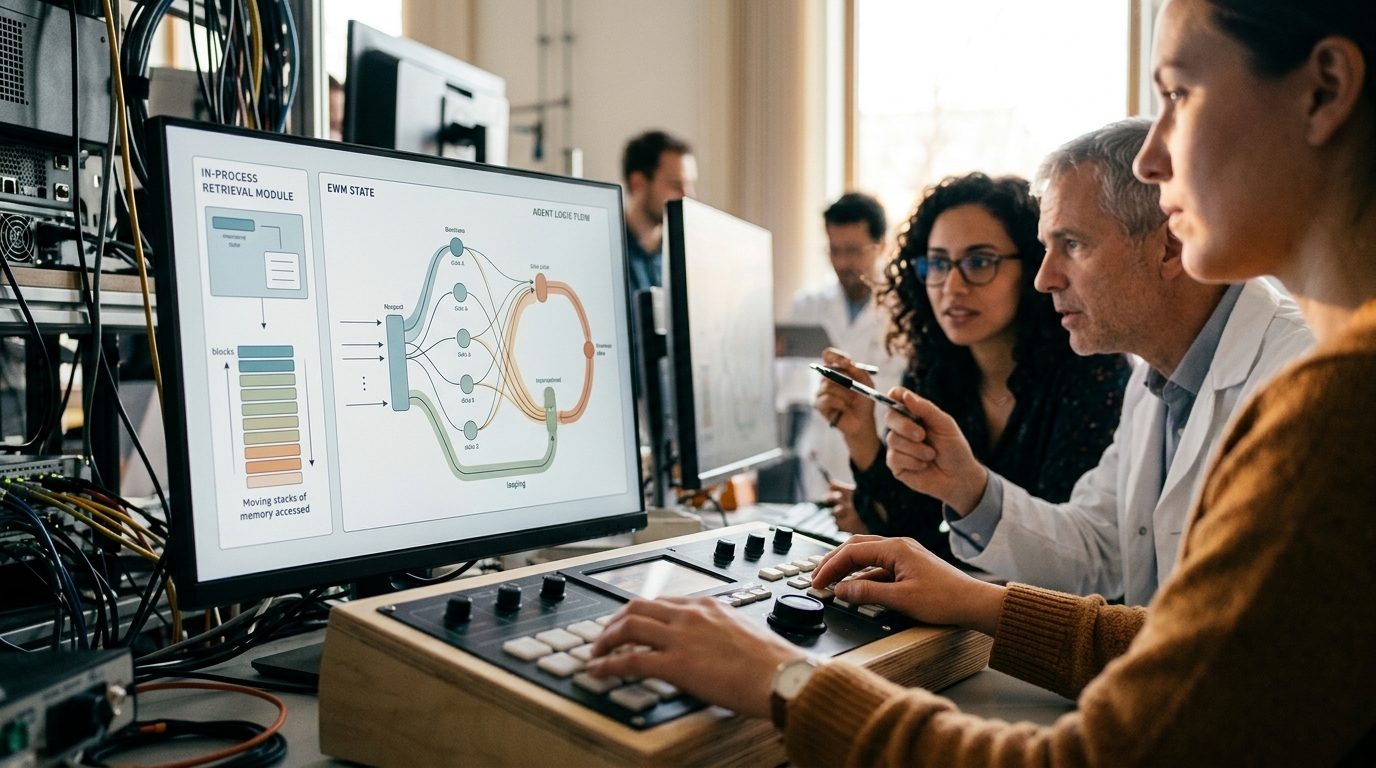
Until now, AI agents have treated their memory like a library—something to be consulted only when absolutely necessary, usually at the beginning of each turn. This creates a "cognitive disconnect," where the agent might forget crucial details during its own reasoning process. The IPR method changes this paradigm by allowing the model to read from and write to its memory at every sub-step of its internal dialogue.
Consider a human solving a complex mathematical problem. They don't just read a book and then try to solve it from memory; they use a scratchpad to note intermediate results, refer back to previous calculations, and revise their strategy in real-time. This is exactly what In-Process Retrieval aims to achieve: providing the agent with a "digital scratchpad" that is immediately accessible during the generation of every word or thought.
The Architecture of Extended Working Memory
The primary challenge faced by this research is managing noise and latency. Constant access to an external database at every step of text generation would make models frustratingly slow. The researchers propose an architecture where memory functions as an extension of the model's "working memory," akin to human cognitive function.
- Dynamic Updates: The agent can store intermediate thoughts that don't need to remain in the main context window, thereby saving computational resources.
- Targeted Recall: Instead of bulk document retrieval, the system retrieves specific "thought fragments" relevant to the current sub-problem.
- Hallucination Reduction: Because the agent has continuous access to verified data during reasoning, the likelihood of fabricating incorrect information is significantly reduced.
This approach allows agents to handle tasks with massive amounts of data, such as analyzing entire code repositories or synthesizing lengthy legal documents, without being "drowned" by the sheer volume of information.
Implications for the Future of Autonomous AI
Introducing memory into the reasoning loop is not just a technical improvement; it is a step toward achieving more human-like forms of artificial intelligence. Agents that can "think" over their own data in real-time are much more capable of self-correction and strategic planning. According to the researchers, experimental data shows that the IPR method outperforms traditional RAG methods in tasks requiring multi-hop reasoning.
"Memory should not be a warehouse where we look things up, but the very fabric upon which thought is woven," the study notes.
In the future, it is expected that major tech companies will integrate similar techniques into their next-generation models, transforming AI assistants from simple Q&A tools into true collaborators that "understand" the history and depth of their work in an organic and continuous manner.