
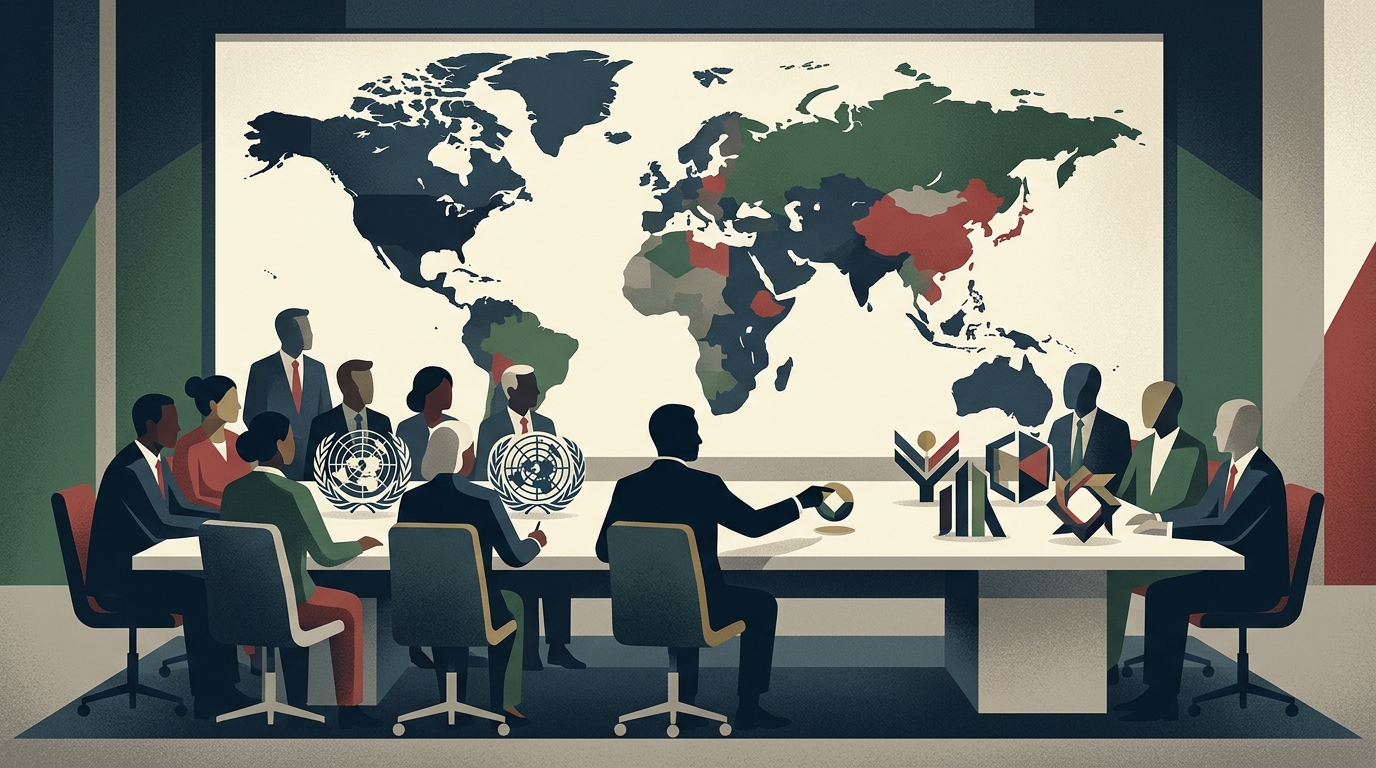
In the spring of 2026, the international community finds itself at a crossroads reminiscent of the ancient Hellenic city-states, where competing leagues sought to define the rules of engagement for an entire civilization. The recent announcement of Russia’s push for an 'Alternative Alliance' in Artificial Intelligence, coupled with the United Nations' urgent warnings regarding child safety and ethical standards, marks a definitive shift from the pursuit of a unified global consensus toward a multipolar, fragmented digital order.
The Fragmentation of the Digital Commons
For several years, the prevailing diplomatic ambition—championed largely by the European Union and the UN—was the creation of a 'CERN for AI' or a global regulatory body that would ensure safety and alignment across borders. However, the emergence of a Russian-led bloc suggests that AI has transitioned from a shared scientific frontier to the primary instrument of national sovereignty and geopolitical leverage. This 'alternative' framework is not merely a technical divergence; it is a rejection of the liberal-democratic values embedded in Western AI governance models, such as the EU AI Act.
"History teaches us that when laws are not universal, the vacuum is filled by power. A bifurcated AI landscape risks a 'race to the bottom' where safety is sacrificed for strategic dominance."
In my analysis, this fragmentation threatens the very 'digital commons' we have sought to protect. When a significant portion of the world’s computational power operates outside the consensus of the UN’s safety guidelines, the risks—ranging from automated disinformation to the erosion of child safety—become impossible to contain within national borders. We are witnessing the birth of a Westphalian order for silicon, where state interests override collective human security.
Sovereignty vs. Safety: The Regulatory Paradox
The UN’s recent focus on child safety serves as a poignant reminder of what is at stake. While sovereign nations have the right to develop their own industrial strategies, the algorithmic impact on human psychology and democratic integrity does not respect passports. Russia's strategy appears to prioritize 'technological sovereignty' as a means to bypass international sanctions and Western normative influence. This creates a regulatory paradox: the more the West tightens its ethical frameworks, the more attractive 'unregulated' alliances become for states seeking rapid, unconstrained deployment.
As we navigate this landscape in 2026, the role of middle powers—including Greece and our European partners—becomes critical. We must advocate for a 'minilateral' approach if multilateralism fails. This involves building robust, values-based coalitions that are economically and technologically superior, making the 'Alternative Alliance' less an ideological threat and more a peripheral isolation. We must ensure that the democratic model of AI remains the most prosperous and secure, thereby incentivizing global alignment through success rather than just treaty.
Toward a New Diplomatic Framework
To prevent a total breakdown of global AI safety, we propose a three-tier governance framework: first, a non-negotiable 'Human Safety Floor' mediated by the UN; second, regional 'Regulatory Zones' (like the EU) that reflect local values; and third, an 'Open Science Corridor' to ensure that basic AI research remains a public good. Without such a structure, the 'Alternative Alliance' will be but the first of many fractures in our global digital architecture. We must remember the wisdom of the past: a house divided against itself cannot stand, and a world with two conflicting intelligences risks losing its own collective reason.