
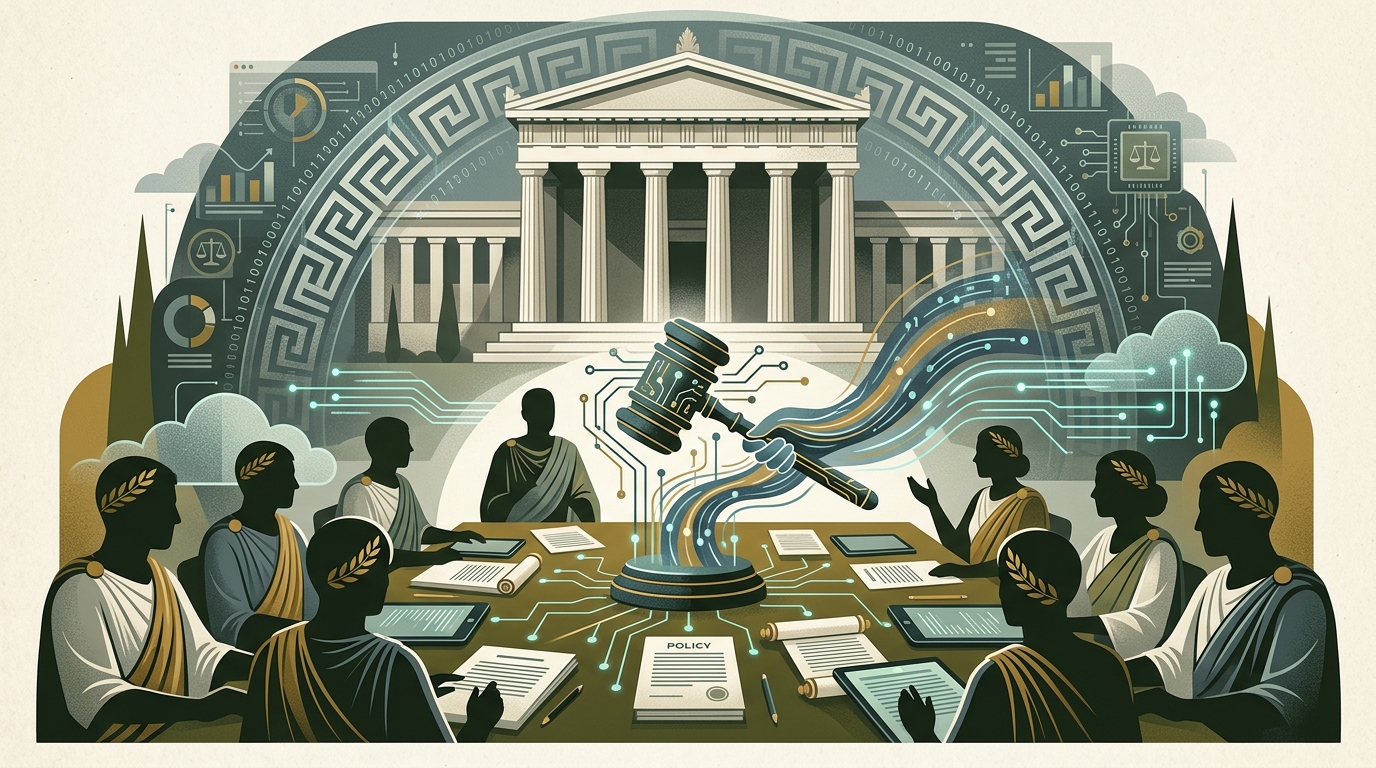
The Emergence of 'Digital Themis'
The recent milestone of 343 forensic reports processed with the assistance of artificial intelligence in Greece marks a significant pivot in the modernization of the Hellenic state. As someone who views governance through the lens of institutional stability, I see this not merely as a technological upgrade, but as a fundamental shift in the administration of justice. In ancient Athens, the clarity of evidence was the bedrock of the dikastēria; today, that evidence is increasingly filtered through algorithmic lenses. While efficiency is a commendable goal, the integration of AI into the service of Themis requires a rigorous policy framework that prevents the 'black box' problem from undermining the right to a fair trial.
High-Risk Classification and the EU AI Act
Under the European Union's AI Act, systems used in the administration of justice and democratic processes are explicitly categorized as 'high-risk.' This designation is not a deterrent but a safeguard. For the 343 reports already issued, and the thousands that will follow, we must ensure that the Greek Ministry of Justice adheres to strict transparency requirements. This includes detailed technical documentation, logging of system activity, and, most importantly, human oversight. We cannot allow the judicial process to become a delegated authority to proprietary algorithms. The principle of isonomia—equality before the law—demands that a defendant has the right to challenge not just the conclusion of a forensic report, but the logic of the AI that produced it.
"Justice is not a calculation, but a deliberation. AI must remain a tool for the deliberator, never the deliberator itself."
Institutional Proposals for Algorithmic Accountability
To ensure that Greece remains a leader in digital judicial reform without compromising democratic values, I propose three pillars of governance. First, the establishment of an Independent Judicial AI Oversight Committee, composed of both legal scholars and data scientists, to audit forensic models for bias. Second, a mandatory 'explainability' requirement for any AI-generated evidence presented in court. Third, specialized training for judges and legal professionals to interpret AI outputs critically. As we embrace the 'Greek Key' to economic growth mentioned by recent financial analyses, we must remember that sustainable growth is impossible without a predictable and transparent legal system. Our goal should be a judiciary that is faster, yes, but also more equitable through the disciplined application of technology.