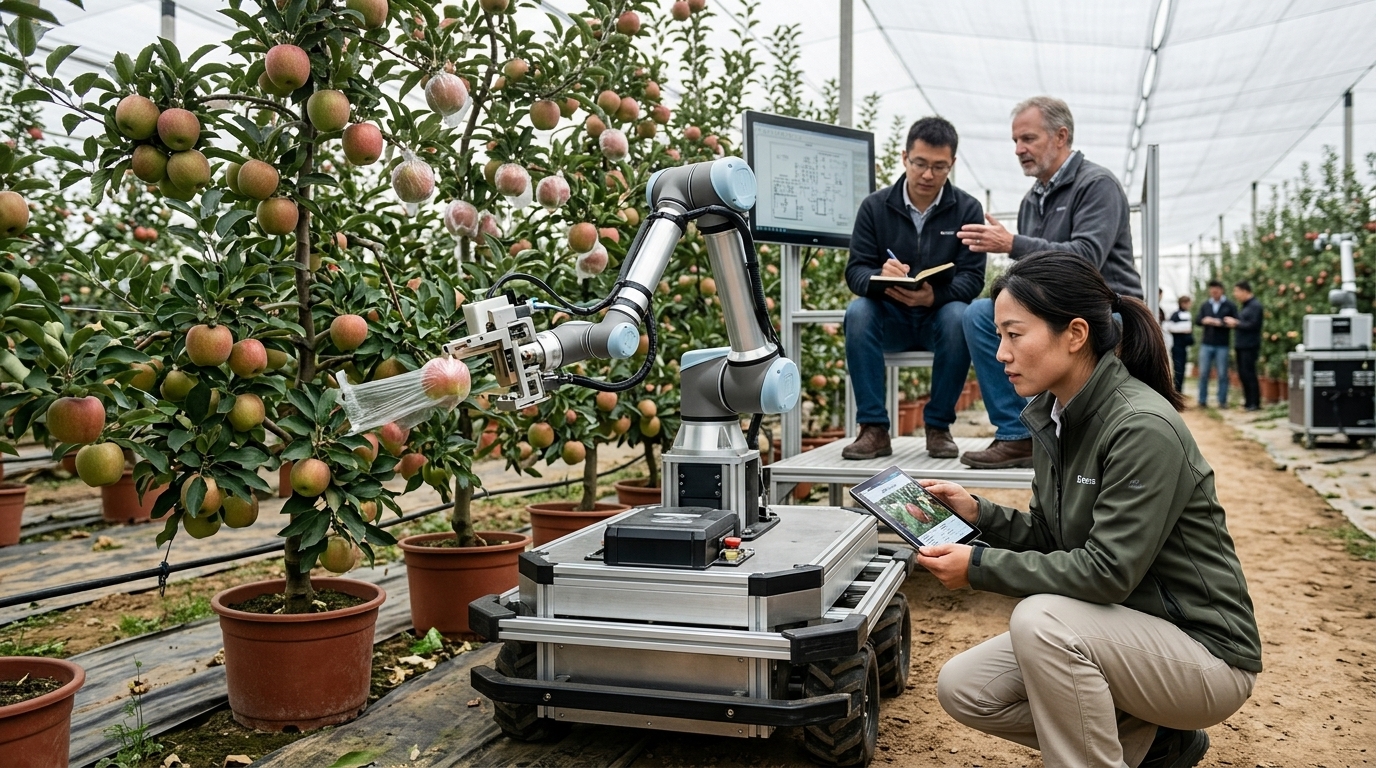
In the heart of Shandong province, in the city of Yantai—renowned for its apple production—a quiet revolution is unfolding. Where hundreds of workers once labored under the sun, a sleek, autonomous robot now glides between rows of trees. Its mission? One of the most arduous and time-consuming tasks in pomology: fruit bagging.
The Challenge of Manual Labor and the AI Solution
Wrapping apples in specialized paper or plastic bags is not a matter of aesthetics, but a necessity for fruit quality. These bags protect the apples from insects, birds, pesticides, and direct solar radiation, ensuring the skin remains smooth and the color uniform. However, in China, the world's largest apple producer, the rural population is aging, and young people are moving en masse to urban centers. Finding labor for such meticulous work has become a nightmare for growers.
The robot developed by Chinese researchers and tech startups aims to fill this gap. Equipped with advanced LiDAR sensors and high-definition cameras, the system utilizes Deep Learning algorithms to identify fruits amidst dense foliage. This is not a simple mechanical movement; the robot must calculate distance, angle, and apple size in fractions of a second, while simultaneously avoiding branches that could obstruct its arm.
Technical Superiority and Speed
The system's performance is striking: 600 apples per hour. To put this into perspective, an experienced worker can wrap approximately 100 to 200 apples per hour, depending on the tree's morphology and fatigue levels. The robot does not tire, requires no breaks, and maintains the same precision from sunrise to sunset. The mechanical arm is designed with 'soft robotics' at its tips to avoid bruising the delicate fruit during the bagging process.
- Use of LiDAR for real-time 3D mapping of the orchard.
- Neural networks trained on thousands of images to detect apples at various stages of maturity.
- Autonomous navigation allowing the robot to move without human intervention.
- Specialized bag-sealing mechanism built to withstand harsh weather conditions.
This technology is not limited to apples. Researchers are already adapting algorithms for use in pears, peaches, and grapes, where fruit protection is equally critical. The ability of AI to adapt to different shapes and environments is the key to the universal application of Agriculture 4.0.
Economic and Social Implications
While the initial investment for such a robotic system remains high, the return on investment (ROI) is expected to be swift due to rising labor costs. In China, the cost of manual fruit bagging has tripled over the last decade. Furthermore, the use of robots allows for large-scale data collection. Every apple 'dressed' is recorded in a database, allowing the farmer to know the exact expected yield months before harvest.
"We are not just automating a task. We are redefining our relationship with the land, using data to minimize waste and maximize quality," states one of the lead project engineers in Yantai.
However, this transition is not without hurdles. The need for 5G infrastructure in orchards for data transmission and the requirement for specialized personnel to maintain these machines pose challenges for smaller producers. The Chinese government, however, is actively subsidizing such initiatives, viewing robotics as the only solution for food security in a nation with a declining agricultural workforce.
The Future of Smart Farming
The Yantai example is just the beginning. The vision for the 'Smart Orchard' includes drones that spray with centimeter-level precision, soil sensors that regulate irrigation via AI, and harvesting robots that can distinguish ripe fruit. China appears to be taking the lead in this sector, transforming traditional agriculture into a high-tech industry. For the rest of the world, the message is clear: automation is no longer an option, but a necessity to remain competitive in the global food market.