In the heart of the digital revolution of 2026, the concept of the "influencer" is undergoing a radical transformation. It is no longer just about humans holding a camera, but about sophisticated computational systems possessing an "agentic" nature. Scott Steinberg, one of the world's most recognized futurists, is at the forefront of this shift, introducing the concept of Agentic AI Influencers. This development marks the transition from Generative AI, which merely produces content, to Agentic AI, which can make decisions, execute tasks, and interact autonomously with an audience.
From Creation to Autonomy: What are Agentic Influencers?
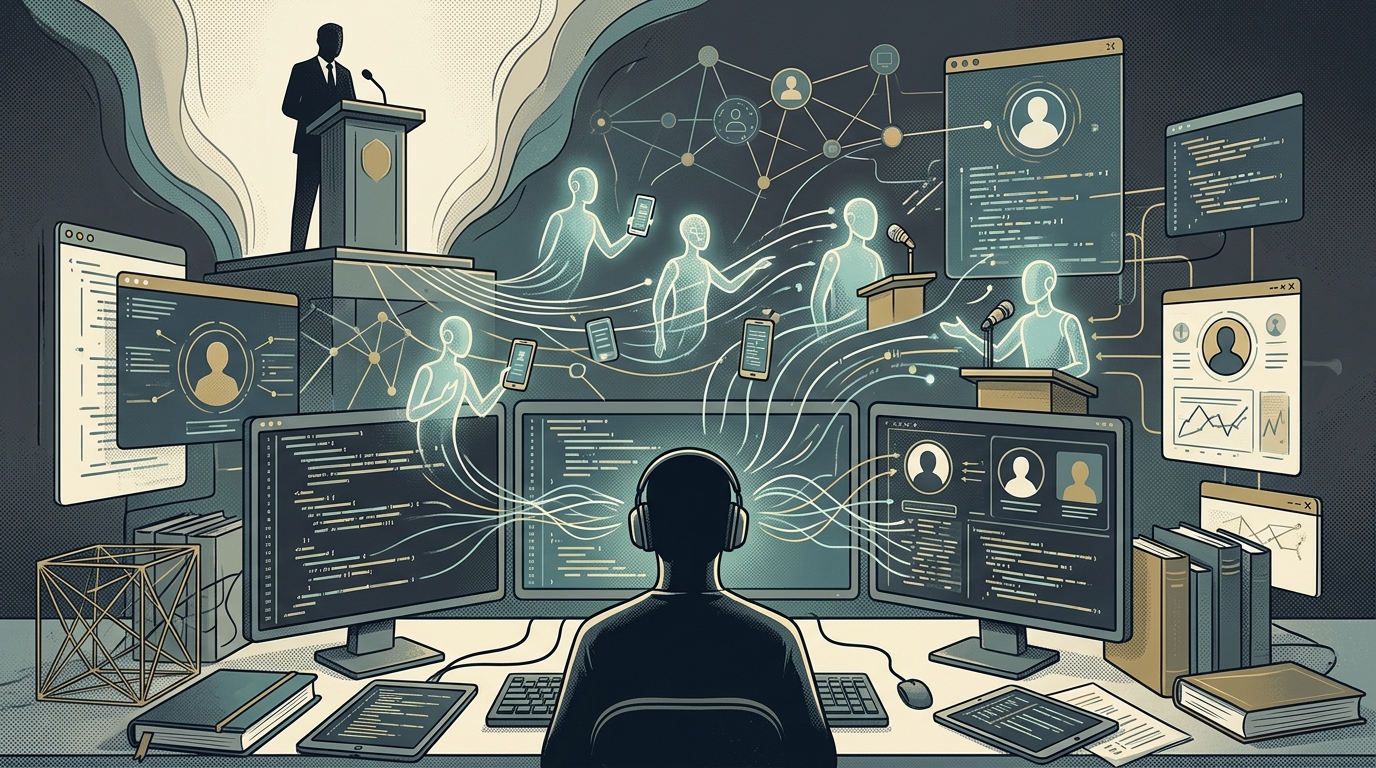
The fundamental difference between a traditional AI chatbot and an Agentic AI Influencer lies in the capacity for action. While past models waited for a prompt to respond, Steinberg's agents are designed to function based on goals. They can monitor market trends in real-time, participate in social media discussions without human intervention, and adjust their communication strategy based on audience reactions. This creates a continuous, 24-hour presence that is impossible for a human to achieve.
Steinberg argues that these digital ambassadors are not just marketing tools, but "living" extensions of a brand's or expert's intellectual property. For a keynote speaker, this means their expertise can scale infinitely. An Agentic AI Influencer can conduct thousands of personalized consulting sessions simultaneously, maintaining the creator's tone, knowledge, and personality.
The Attention Economy and the New Business Model
The advent of agentic entities is fundamentally changing the economics of the entertainment and conference industries. Companies are no longer looking for just a speaker for an hour on stage, but a constant source of knowledge and interaction. Steinberg capitalizes on this need, offering solutions where AI is not just an assistant, but an autonomous partner. This dramatically reduces content production costs while increasing targeting effectiveness.
- Automated community management based on brand personality.
- Creation of dynamic content that evolves according to user data.
- Reduction of operational costs for large-scale campaigns.
- Ability to provide specialized advice in real-time.
However, this economic efficiency is accompanied by questions regarding the value of human authenticity. If an AI Influencer can persuade an audience as effectively as a human, what is the future value of human communication skills? Steinberg suggests a hybrid approach, where AI handles the bulk of the work, allowing humans to focus on high-level strategy and emotional connection.
Ethical Challenges and the Question of Transparency
As Agentic AI Influencers become more convincing, the line between reality and simulation blurs. There is a risk of manipulation, as these systems are optimized to maximize engagement. The European Union, through the AI Act, is already setting strict rules for labeling AI-generated content. Steinberg emphasizes that transparency is key: the audience must know when they are interacting with an algorithm.
"The power of Agentic AI lies not in deception, but in the amplification of human reach," Steinberg noted in recent statements.
In conclusion, Scott Steinberg’s initiative to integrate Agentic AI into the world of influencers and speakers represents a bold experiment for the future of work. It is not just a new technology, but a new form of existence in the digital space, which will define how we consume information and build trust in the coming years. The challenge for us will be to maintain our critical thinking in a world where the most persuasive voices might not even have a heart.