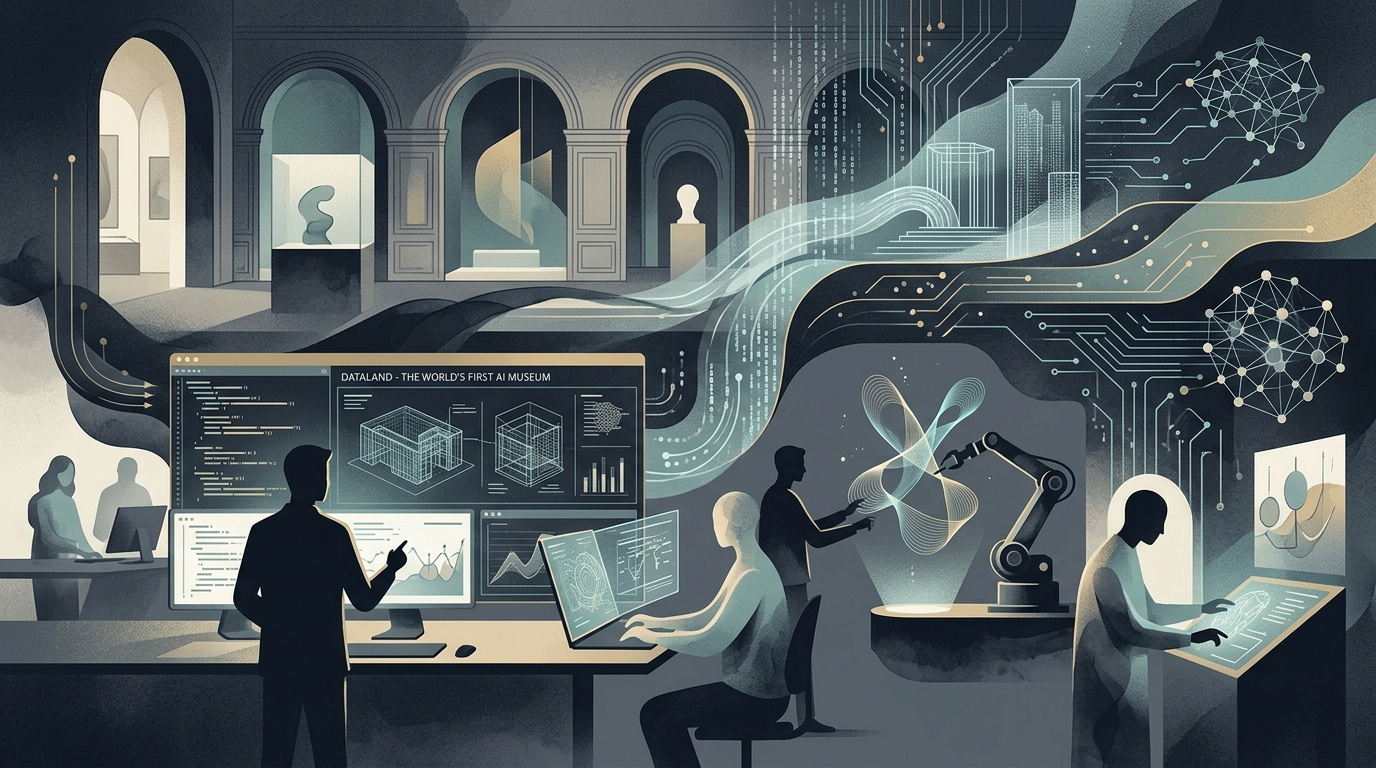
In the beating heart of Los Angeles, housed within Frank Gehry’s architectural masterpiece, 'The Grand LA,' a new species of cultural institution is being born. Dataland, the world’s first museum dedicated entirely to Artificial Intelligence (AI) arts, marks a pivotal shift from the static galleries of the past to the 'living' art of the future. It is not merely a space to display digital pixels; it is a breathing organism that leverages billions of data points to craft experiences that transcend sight, engaging scent, sound, and the very perception of reality.
Its founder, the globally acclaimed media artist Refik Anadol, has spent the last decade proving that data is not just numbers on a server, but the collective 'memories' of our civilization and planet. With Dataland, Anadol and his team at Refik Anadol Studio (RAS) aim to democratize access to high-end technology, transforming complex algorithms into tools for spiritual elevation and ecological awareness.
The Philosophy of the Large Nature Model (LNM)
At the core of Dataland’s operations lies the Large Nature Model (LNM), the world’s first open-source AI model trained exclusively on the data of the natural world. Unlike the LLMs of Silicon Valley, which are trained on scraped internet text, the LNM utilizes information from botanical gardens, oceanographic institutes, and national parks. The result is a 'digital nature' that doesn’t just mimic reality but dreams it.
Visitors to Dataland don't just look at images of forests or oceans. They walk through 'waves' of data that react to their presence, inhale scents synthesized by AI based on the chemical profiles of rare flora, and listen to soundscapes composed in real-time. This approach shatters the myth that AI is a cold, clinical force detached from our biological roots. Instead, Dataland proposes a symbiotic relationship where technology acts as a magnifying glass for the fragile beauty of our natural world.
Architectural and Technological Supremacy
The choice of Los Angeles, and specifically Gehry’s landmark building, is intentional. Dataland is part of a broader vision to revitalize downtown LA through culture and innovation. The space is engineered to support massive 16K resolution displays, spatial audio systems, and sensors that track everything from visitor movement to ambient temperature shifts. Yet, the technology remains invisible, serving the aesthetic experience rather than overshadowing it.
The museum also functions as a high-tech laboratory. Through partnerships with industry giants like Google, NVIDIA, and Epic Games, Dataland utilizes cutting-edge processing power (GPUs) to demonstrate that AI can be sustainable. Anadol has committed to using renewable energy sources to power the museum’s servers, addressing one of the primary criticisms of generative AI: its significant carbon footprint. By doing so, Dataland sets a precedent for 'green' digital art at scale.
Ethics, Data, and the Future of Creativity
As AI permeates every sector of human endeavor, the question 'what is art?' becomes more urgent than ever. Dataland offers a compelling answer: art is the ability to perceive the invisible. By utilizing data that we typically ignore—such as wind patterns or the electromagnetic activity of trees—Anadol creates a new visual language for the 21st century.
Furthermore, the museum addresses critical questions regarding data ownership. In an era where artists are fighting against the unauthorized use of their work to train AI models, Dataland takes a transparent path. By focusing on open-source data and collaborating with scientific institutions, it ensures that the 'raw material' of its art is not stolen property but shared knowledge. This ethical AI model could serve as a blueprint for future digital museums globally, fostering a culture of consent and collaboration.
Conclusion: A Window into 2026 and Beyond
Dataland is more than a destination for art or tech enthusiasts; it is a manifesto for the future of humanity. In a world overwhelmed by information, this museum teaches us how to transform noise into harmony. As we move through 2026, the success of Dataland will be measured not just by its attendance figures, but by its ability to inspire a new generation of creators to view AI not as a replacement for human talent, but as the most powerful collaborator in our quest to understand the universe and our place within it.