The haunting images of the plaster casts in Pompeii, frozen in time by the ash of Mount Vesuvius in 79 AD, stand as one of the most poignant monuments to human tragedy. Today, in 2026, Artificial Intelligence is breaking that eternal silence. Through sophisticated generative AI algorithms and Neural Radiance Fields (NeRFs), researchers and digital artists have managed to 'reanimate' a victim attempting to flee the eruption, imbuing the figure with motion, expression, and a terrifying sense of realism. This development is not merely a technological feat; it is a bridge between archaeological artifacts and living history, carrying with it profound ethical dilemmas.
The Technology Behind the Digital Rebirth
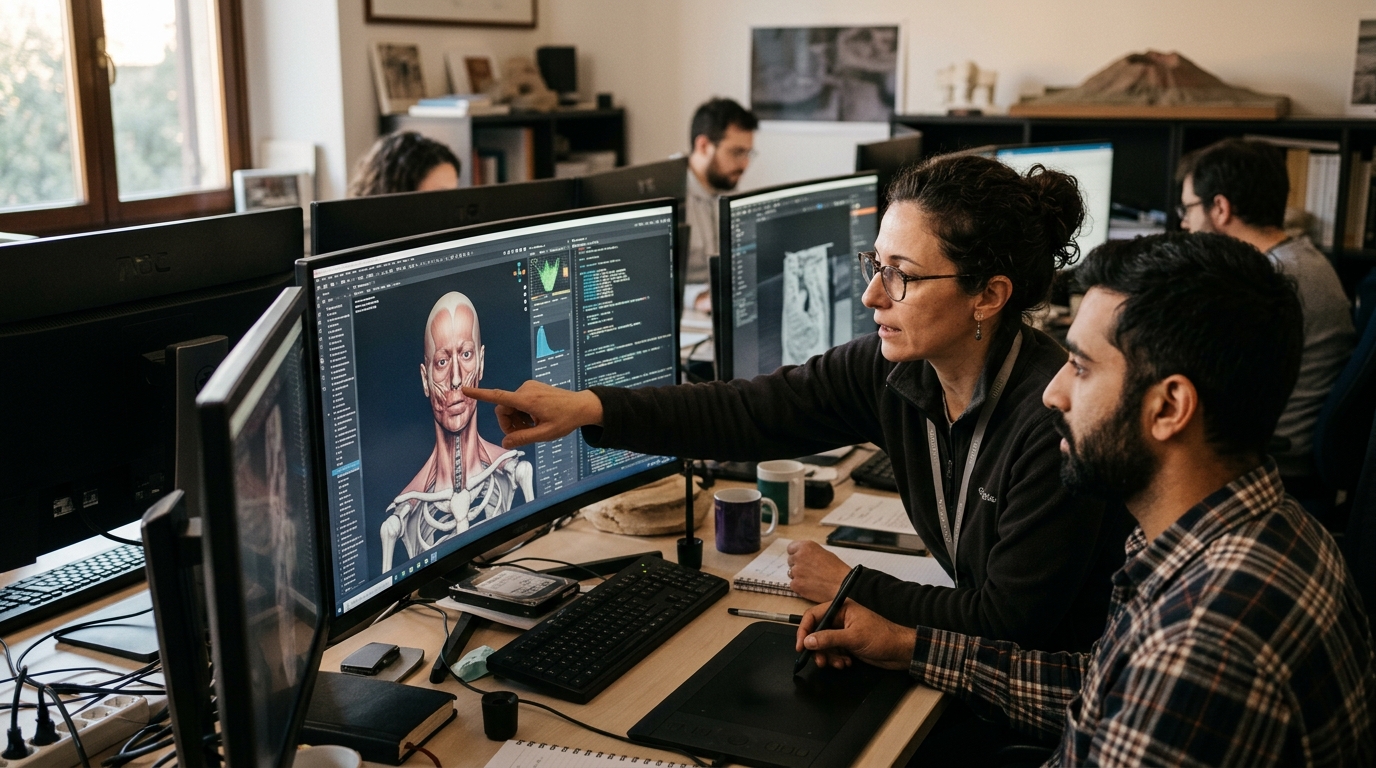
The process of 'digital resurrection' begins with the famous plaster casts created by Giuseppe Fiorelli in the 19th century. These casts, which capture the voids left by decomposed bodies within the hardened ash, serve as the foundation. AI then steps in to 'fill' these voids. Utilizing Deep Learning models trained on thousands of anatomical structures and human movements, the system reconstructs muscle mass, skin texture, and facial features based on the skeletal remains found within the casts.
The most striking element is the use of kinematic AI. Researchers feed the model data regarding the physics of the eruption—temperature, speed of pyroclastic flows, and the angle of falling ash—to ensure the victim's movements are historically and physically accurate. The result is a high-definition video where the victim appears to struggle for breath, covering their face and attempting to crawl away from the encroaching doom. This is not a simple animation; it is a simulation grounded in biometric and environmental data.
Ethics and Digital Conduct: The Right to Silence
Despite the technological awe, the community of archaeologists and ethicists remains divided. Is it ethical to transform a moment of absolute agony and death into a digital spectacle? Pompeii is not just an archaeological site; it is a vast cemetery. Converting a victim into a 'digital avatar' raises questions about respect for the deceased. Some argue that this technology strips the victim of their dignity, turning their final moments into 'content' for social media consumption.
"Archaeology should illuminate the truth, not dramatize it through the lens of Hollywood," critics of the method state.
On the other hand, proponents of AI in archaeology emphasize the power of empathy. Being able to see the victim not as a stone statue, but as a human being of flesh and blood, helps us grasp the magnitude of the disaster and connect with the past in a way no history book can achieve. Digital reconstruction can serve as a powerful educational tool, provided it is used with restraint and respect for historical accuracy.
The Future of Museums and Historical Memory
The case of Pompeii is just the beginning. Museums worldwide are already exploring how AI can revolutionize the visitor experience. Imagine walking through the streets of the Ancient Agora of Athens and, through Augmented Reality (AR) glasses, seeing citizens of the era conversing, moving, and interacting, all based on historical records and AI reconstructions. This technology shifts the experience from passive observation to active participation.
However, the risk of 'historical misinformation' remains real. If AI begins to 'guess' details not present in the archaeological data—such as facial expressions or clothing choices without documentation—the line between history and fiction blurs. The challenge for 2026 and beyond will be establishing an international framework for the use of AI in cultural heritage, ensuring that technology serves the truth rather than mere sensationalism. The 'resurrection' of the Pompeii victim reminds us that while AI has the power to defeat time, the responsibility for how we wield that power remains uniquely human.