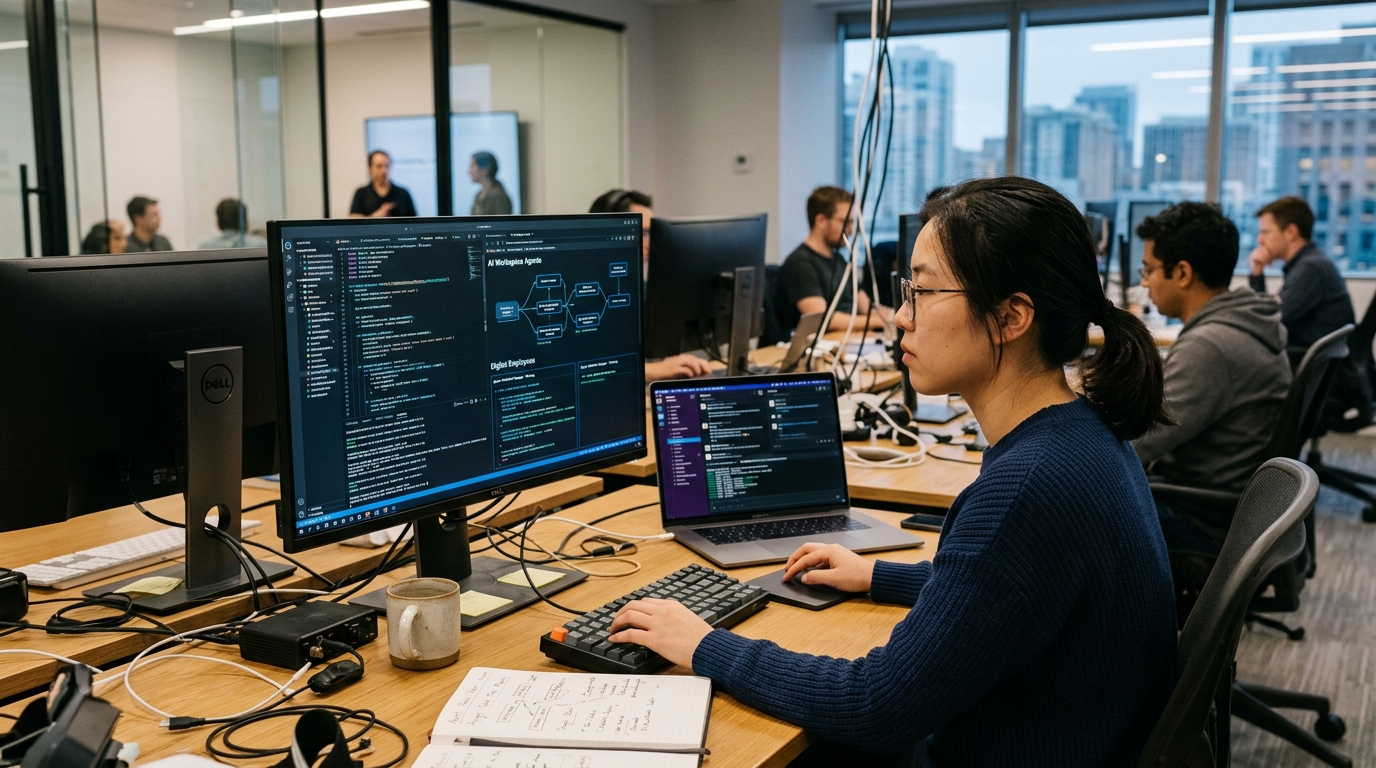
In a move that signals the end of the era of simple "conversational" AI and the dawn of agentic systems, OpenAI has unveiled Workspace Agents. This is the successor to Custom GPTs, specifically engineered for the enterprise sector, with capabilities that go far beyond merely answering questions. These new agents are not limited to chatting with the user; they can act, communicate with external platforms like Slack and Salesforce, and execute complex tasks autonomously within a company's digital ecosystem.
From Custom GPTs to Autonomous Action
When OpenAI introduced Custom GPTs in 2023, the promise was personalization. However, in practice, these tools remained trapped within the ChatGPT environment, requiring users to manually move data back and forth. Workspace Agents break these chains. The new architecture allows agents to "live" where people work. For example, a sales agent can now monitor Slack conversations, automatically update opportunities in Salesforce, and draft contracts in Google Docs, without any human intervention for data transfer.
This strategic move by OpenAI aims directly at the heart of corporate productivity. At a cost of $20 per user per month for the ChatGPT Business tier, the company is offering an infrastructure that promises to drastically reduce the time spent on repetitive administrative tasks. The difference lies in "orchestration": Workspace Agents can call APIs, search for information in corporate code repositories like GitHub, and coordinate actions across different departments.
Security and Governance: The Key to Adoption
One of the biggest hurdles for widespread AI adoption in large enterprises has always been data security and control. Workspace Agents address this issue with a new centralized management system. IT administrators now have the ability to define exactly what data each agent can access and what actions it is permitted to perform. It is no longer a "black box" of information, but a controlled environment where every AI movement is logged and can be audited.
Furthermore, OpenAI is introducing the concept of "Human-in-the-loop" for critical decisions. Although the agents are autonomous, businesses can set guardrails where human approval is required for finalizing an expense or sending a critical email. This hybrid collaboration model is essential for building trust in sectors such as banking and legal, where mistakes are costly.
Competition and the Future of Work
The introduction of Workspace Agents puts OpenAI on a direct collision course with giants like Microsoft and Salesforce. While Microsoft promotes Copilot and Salesforce pushes Agentforce, OpenAI is betting on the flexibility and widespread adoption of the GPT-4o model (and its successors). The ability of agents to function cross-platform—rather than just within one ecosystem—is their strongest competitive advantage.
- Autonomous Project Management: Agents that assign tasks in Jira based on meeting minutes.
- Personalized Customer Support: Accessing a customer's entire history from the CRM to provide solutions in seconds.
- Automated Data Analysis: Connecting to SQL databases to generate real-time reports and visualizations.
As we move into the second half of 2026, the conversation is shifting from "what AI can write" to "what AI can do." Workspace Agents are the harbinger of a new organizational structure, where teams will consist not just of humans, but of a combination of human talent and specialized digital agents. The challenge for businesses will no longer be access to technology, but the ability to redesign their processes to exploit this new form of digital labor.