For over a year, the term "AI PC" has echoed through the corridors of Silicon Valley and tech expos as the next big promise. Yet, for the average user, the experience has often been limited to simple chatbots and blurred backgrounds in video calls. The recent unveiling of Nvidia’s RTX Spark architecture seems poised to shift this narrative dramatically. This isn't just another graphics card refresh; it’s a fundamental re-evaluation of what a laptop can achieve without relying solely on the cloud.
The Spark Architecture: Beyond Pixels
Nvidia, already dominant in data centers with its H100 processors, is now bringing that expertise directly to consumer hardware. Laptops equipped with RTX Spark technology aren't just targeting gamers; they are aimed at a broad spectrum of professionals and creators. The key differentiator lies in the third-generation specialized Tensor cores, optimized specifically for running Large Language Models (LLMs) locally.
This means a user can run their own personal AI, which has access to their files and data, without that information ever leaving the local drive. The response time is instantaneous, as the latency caused by sending data to remote servers is eliminated. Furthermore, power management has been drastically improved, allowing these systems to deliver high AI performance without draining the battery in record time.
Competition and Nvidia's Strategy
Nvidia’s move comes at a time when Qualcomm, Intel, and AMD are fighting for dominance in the Windows Copilot+ category. While competitors focus on low-power Neural Processing Units (NPUs), Nvidia is betting on the raw power of its GPUs combined with a software ecosystem that no one else possesses. RTX Spark acts as a bridge, allowing applications to toggle between peak performance and energy efficiency as needed.
- Local AI processing with speeds exceeding 500 TOPS (Tera Operations Per Second).
- Integration of Nvidia Broadcast for advanced real-time audio and video processing.
- Support for RTX Remix, enabling AI-driven upgrades for classic game titles.
- Optimized power consumption reaching ARM-like efficiency during light tasks.
“We aren’t just building faster computers; we are redefining how humans interact with machines,” a company executive stated during the launch.
Impact on the Creative Industry
For video editors, graphic designers, and developers, RTX Spark represents a tool of liberation. The ability to perform tasks like 4K video rotoscoping or code generation via local AI models in seconds is a productivity game-changer. Nvidia is also investing in ChatRTX software, which allows users to "train" their AI on their own notes and documents, creating a truly contextual digital assistant.
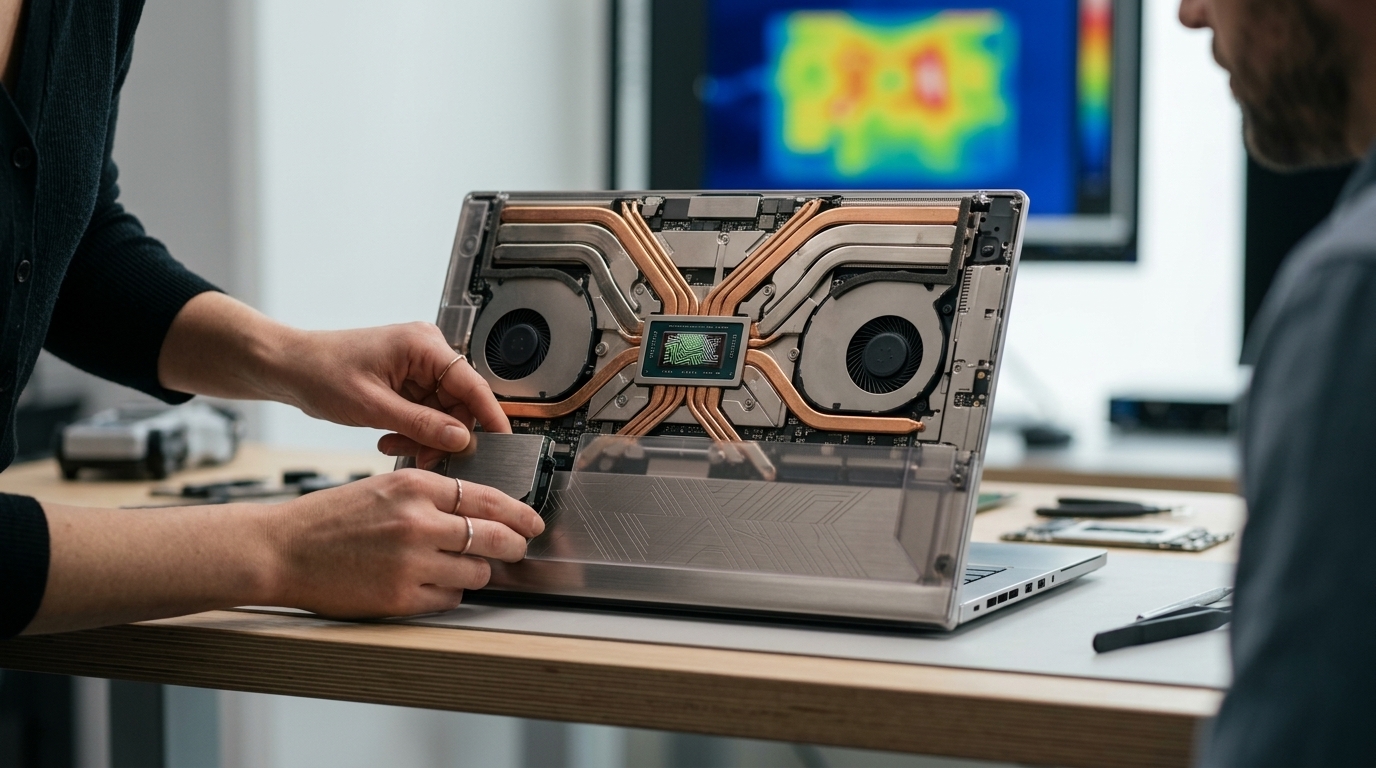
However, the challenge remains price and thermal management. Despite improvements, the power of RTX Spark requires sophisticated cooling systems, which keeps the weight and cost of these devices high. Nvidia seems to accept this trade-off, focusing for now on the premium segment of the market, where performance takes precedence over economy.
Conclusion: A New Era of Computing
RTX Spark is more than just a response to competition; it is Nvidia’s attempt to maintain control over the AI narrative. As software begins to demand more AI resources, owning a computer that can handle these loads locally will shift from a luxury to a necessity. The disruption Nvidia promises is here, and it appears the laptop of the future will be much smarter—and much more powerful—than we previously imagined.