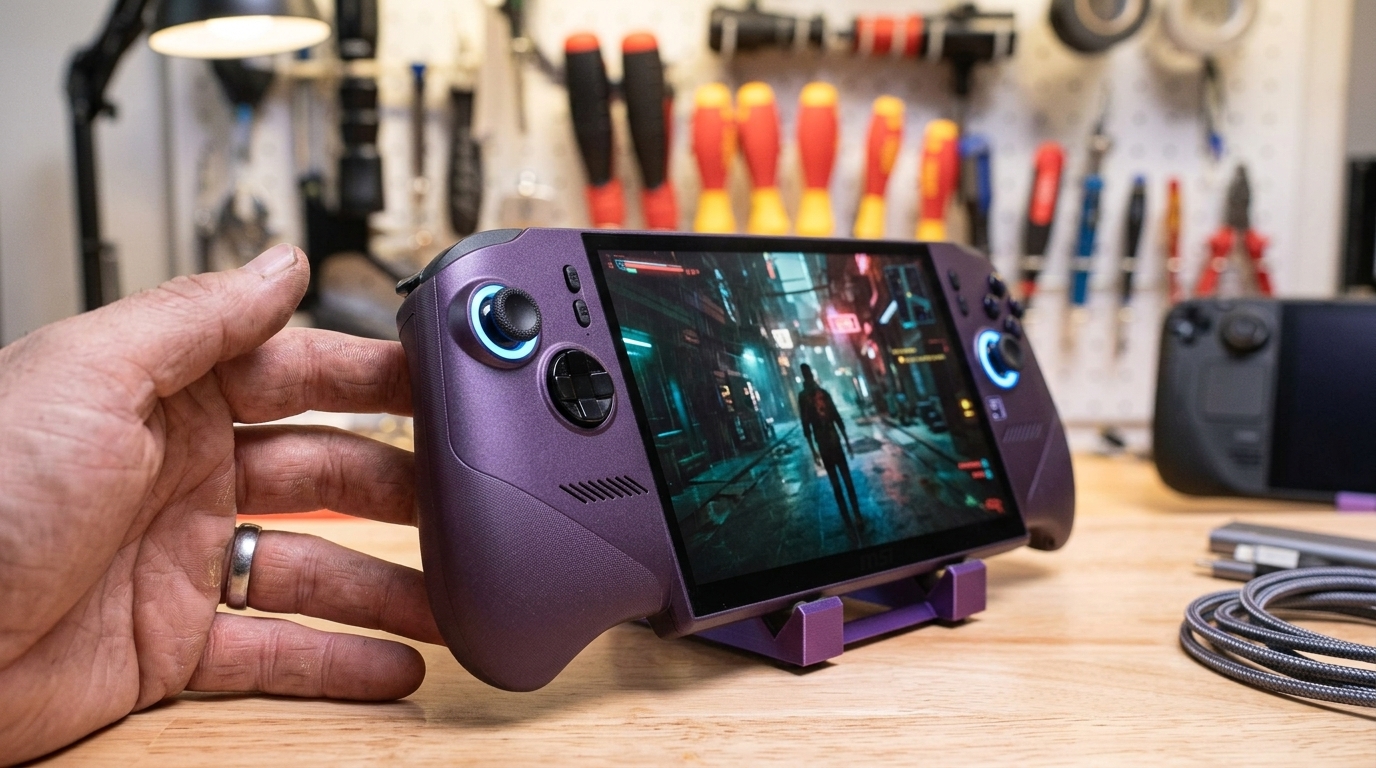
The handheld gaming PC market is experiencing an unprecedented boom, reminiscent of the 'console wars' of the 1990s. However, this time the battle is not just fought in megahertz, but in user experience, battery life, and software integration. The MSI Claw 8 AI+ (A2M) represents MSI's second attempt to enter this arena, armed with Intel's new Lunar Lake architecture. But as it turns out, raw hardware power isn't enough to shake Valve's dominance with the Steam Deck.
The Legacy of a Rough Start
To understand the Claw 8 AI+, one must look at the failure of its predecessor. The original MSI Claw was the first handheld to feature Intel Meteor Lake processors, a move that proved risky. Drivers were unstable, performance lagged behind the competition (specifically AMD's Z1 Extreme), and the price point was disproportionate to the experience. MSI seems to have learned its lesson, but the new device enters a market already shaped by the ROG Ally X and the peerless Steam Deck OLED.
The new model promises to rectify past mistakes with the Core Ultra Series 2 (Lunar Lake) processor. Intel promises massive leaps in efficiency per watt, which is the 'Holy Grail' for portable devices. With a massive 80Wh battery—matching the ROG Ally X—the Claw 8 AI+ aims to solve the biggest problem of Windows handhelds: abysmal battery life during intensive gaming sessions.
Hardware vs. Ecosystem
Valve's Steam Deck didn't win because it was the most powerful. On the contrary, it is now one of the 'weakest' hardware offerings in its category. It won because SteamOS offers a console-like experience: you press a button and you play. The suspend/resume functionality works flawlessly, something Windows 11 still struggles to achieve in a handheld form factor.
- 8-inch Display: Larger than the original, offering better visibility but increasing the overall footprint.
- Thunderbolt 4: A crucial addition that allows for external GPU (eGPU) connectivity, a feature the Steam Deck lacks.
- Redesigned Triggers: MSI has overhauled the buttons for a more tactile feel, nearing the quality of premium standalone controllers.
However, the weight of the MSI Claw 8 AI+ remains a concern. The combination of a massive battery and a larger screen makes it a heavy device for extended play. Unlike the Steam Deck, which is ergonomically balanced to minimize wrist strain, the Claw feels like a bulky tablet with controllers attached to the sides.
The Windows Barrier and the AI Hype
The addition of the "AI+" suffix is no coincidence. Intel is heavily promoting the NPU (Neural Processing Unit) of the Lunar Lake chip, which can handle AI tasks locally. In practice, for a gamer, this currently means very little. It might assist in image upscaling via Intel's XeSS, but the actual utility of AI in a gaming handheld remains largely theoretical at this stage.
"The problem isn't Intel's power; it's Microsoft's rigidity. Windows 11 on an 8-inch screen without trackpads is an exercise in patience, not entertainment."
The Steam Deck features dual trackpads that allow for playing strategy titles or navigating desktop mode with precision. The MSI Claw relies solely on analog sticks and the touchscreen. For many users, this omission is a dealbreaker. Furthermore, the MSI Center M software, while improved, remains an 'overlay' on top of Windows, which often crashes or requires manual tweaks that discourage the average player.
Conclusion: Who is the MSI Claw For?
The MSI Claw 8 AI+ is targeted at the 'power user' who wants a portable PC that can do everything: gaming, productivity (when docked), and AI experimentation. But if the goal is a pure gaming experience on the couch or a plane, the Steam Deck remains king. Valve proved that hardware is just the vehicle, but software is the driver. MSI has built an impressive vehicle, but the driver (Windows) seems to have lost its way.