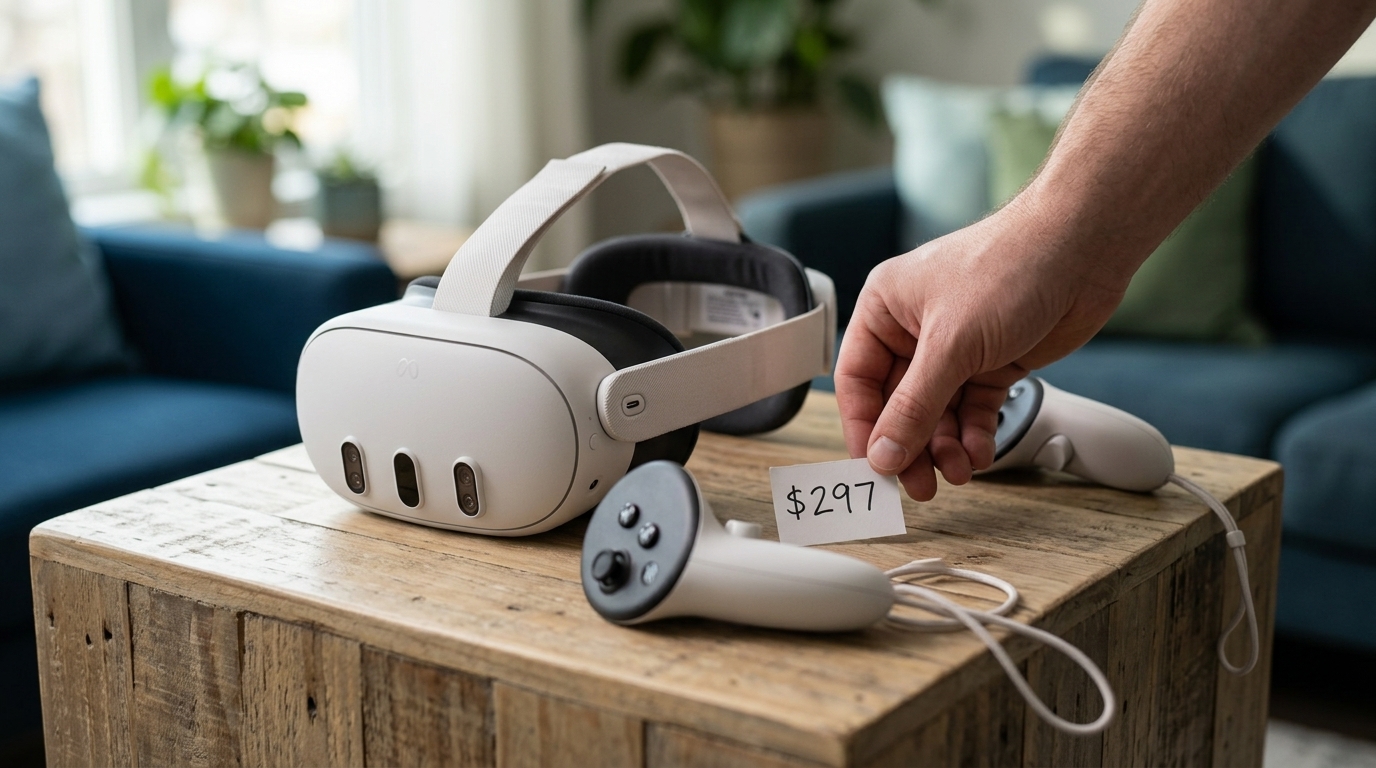
In the tech world, "sales" often function more as psychological triggers than actual opportunities for savings. The recent price drop of the Meta Quest 3S to $296.79 on Amazon is a textbook example of this tactic. While presented as a $53 discount, it effectively brings the device back to its late 2024 launch price of $299. The interim price hike to $349 now serves as the perfect psychological anchor to make the current deal look irresistible.
The Anatomy of a Pricing Strategy
The Meta Quest 3S was designed from the ground up to be the "accessible" entry point into Meta’s VR ecosystem. At launch, the goal was clear: replace the aging Quest 2 and offer the processing power of the Quest 3 at a price point the average consumer couldn't ignore. However, economic pressures and supply chain fluctuations led Meta to increase the price by $50 in early 2025. This move was viewed by many analysts as an attempt to mitigate the staggering losses of the Reality Labs division.
The current return to $297 isn't just a Prime Day whim; it's a strategic retreat. In a market where the Apple Vision Pro remains an unattainable luxury and other players struggle to find their footing, Meta knows its dominance relies on user volume. Every headset sold, even at razor-thin margins or a loss, represents another user locked into Horizon OS and another consumer purchasing software from the Meta Store.
Technical Compromises and User Experience
To hit this aggressive price point, Meta had to make difficult hardware choices. The Quest 3S utilizes the same Fresnel lenses found in the Quest 2, rather than the superior "pancake" optics of the standard Quest 3. This results in a smaller optical sweet spot and a slightly bulkier profile. However, under the hood, the Snapdragon XR2 Gen 2 processor does the heavy lifting, ensuring that users can run the same high-end games and applications as the more expensive model.
- Processor: Snapdragon XR2 Gen 2, identical to the Quest 3.
- Optics: Fresnel lenses used to keep costs down.
- Mixed Reality: Full color passthrough capabilities included.
- Ecosystem: Full access to the Meta Quest Store library.
This price reduction makes the Quest 3S the most logical choice for those wanting to experience Mixed Reality without breaking the bank. The device's ability to overlay digital objects onto the user's physical space with reasonable clarity is its standout feature, despite the compromises in display resolution compared to its premium sibling.
The Geopolitics of Virtual Reality
Beyond the specs, there is a broader conversation about how Meta uses predatory pricing to stifle competition. At $297, it is nearly impossible for any other manufacturer to build competitive hardware without sustaining massive financial losses. Meta can subsidize these losses through its advertising revenue, but this creates a monopolistic environment that may ultimately stifle long-term innovation in the sector.
"Virtual reality is no longer an experiment for the few; it is a battle for the data of the many," market analysts suggest.
In conclusion, while the $297 "sale" is technically a return to the status quo, it remains the most opportune moment for newcomers to enter the VR space. Meta is playing a long game of attrition, and with this move, it demonstrates a willingness to sacrifice immediate margins for total market dominance in the spatial computing era of 2026.