In the world of sports, few disciplines demand the speed and precision of fencing. With blades often moving faster than the human eye can track, judging matches has historically been a challenge, relying on subjective assessments and limited technical aids. However, in the heart of Tokyo, a technological revolution is underway, transforming this ancient sport into a digital spectacle. Japan, blending samurai tradition with its dominance in Artificial Intelligence (AI), is redefining what "fair play" and "athletic experience" mean.
The Challenge of Speed and the Computer Vision Solution
Fencing is a sport of milliseconds. In foil and épée, blade contact can last less than a tenth of a second. Traditionally, referees relied on electrical circuits connected to the athletes' uniforms, but this system had limitations, particularly in understanding the trajectory of movement and the "right of way" in attacks. The Japanese approach introduces computer vision systems that require no cables at all.
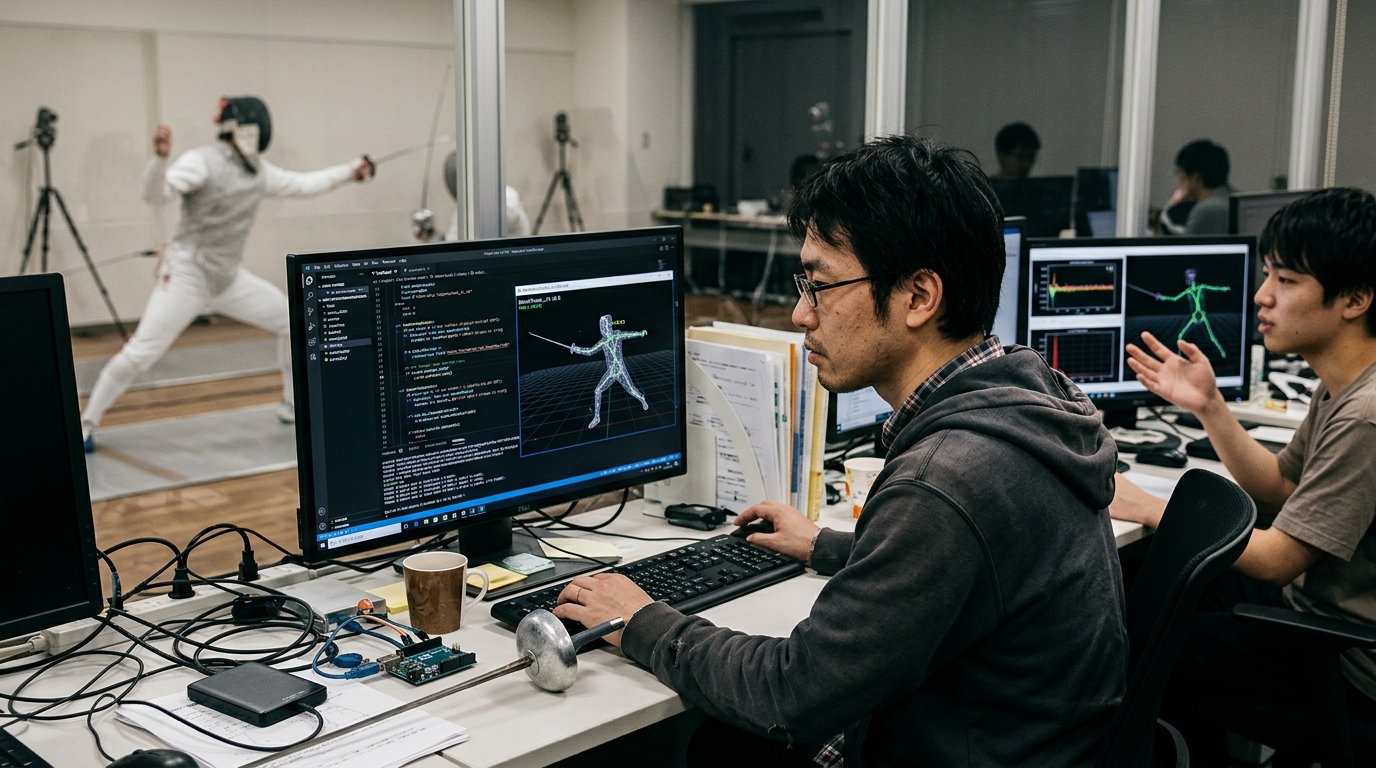
By utilizing high-speed cameras and deep learning algorithms, the system can track the tip of the blade in real-time. This allows judges to see not only if contact was made, but also the exact angle and velocity of the movement. This technology, developed in collaboration with giants like Fujitsu and creative organizations like Rhizomatiks, aims to eliminate human error, ensuring that victory is determined solely by skill rather than a referee's missed perspective.
Fencing Visualized: Transforming the Spectator Experience
One of the greatest challenges for fencing has always been the difficulty for the audience to follow the action. For the casual viewer, movements are often too fast to comprehend. This is where Japan has made a significant impact with the "Fencing Visualized" project. Through AI and Augmented Reality (AR), blade trajectories are rendered on-screen with glowing lines, reminiscent of sci-fi films or video games.
- Real-time Tracking: Spectators see the "tail" of the blade's movement, understanding each athlete's tactics.
- Heatmaps: AI analyzes which body areas an athlete targets most frequently, providing data for analysis during the broadcast.
- Predictive Analytics: In advanced stages, the system can predict the likelihood of an attack's success based on the fencer's body posture.
This approach is not merely aesthetic. It makes the sport marketable and accessible to a new generation of fans accustomed to dynamic digital environments. The Japan Fencing Federation, under the leadership of former Olympian Yuki Ota, has successfully filled stadiums, proving that technology can revitalize traditional sports.
AI as a Coach: The New Era of Preparation
Beyond judging and viewing, AI is also entering the training hall. Japanese athletes now use systems that analyze their biometric data and body mechanics. AI compares their movement with the patterns of top fencers worldwide, identifying minute deviations that could lead to injury or a lost point.
"Technology does not replace the coach; it gives them eyes they never had. We can now quantify instinct," says one of the national team's technical directors.
By analyzing thousands of hours of video from previous matches, AI can identify an opponent's "tells"—those small, unconscious movements that betray an upcoming attack. This turns fencing into a high-speed game of chess, where information is just as vital as physical prowess.
Ethical Dilemmas and the Future of Sport
Naturally, the integration of AI into fencing is not without its critics. There are voices concerned that over-reliance on data may strip the sport of its "romance" and spontaneity. Furthermore, the issue of access arises: Can countries with fewer resources compete with Japan's technological firepower?
However, the direction is clear. Japan is not just transforming fencing; it is creating a blueprint for how all sports will evolve in the 21st century. The convergence of physical and digital reality is now a fact, and the "digital blade" is the tool carving the path toward the future.