In a move that recalibrates the balance of power in generative AI, Elon Musk’s xAI has announced the release of Grok Build. This marks the company’s first autonomous "coding agent," designed with a singular objective: to challenge Anthropic’s Claude, which has long been considered the gold standard for AI-assisted software development.
The Shift from Chatbots to Autonomous Agents
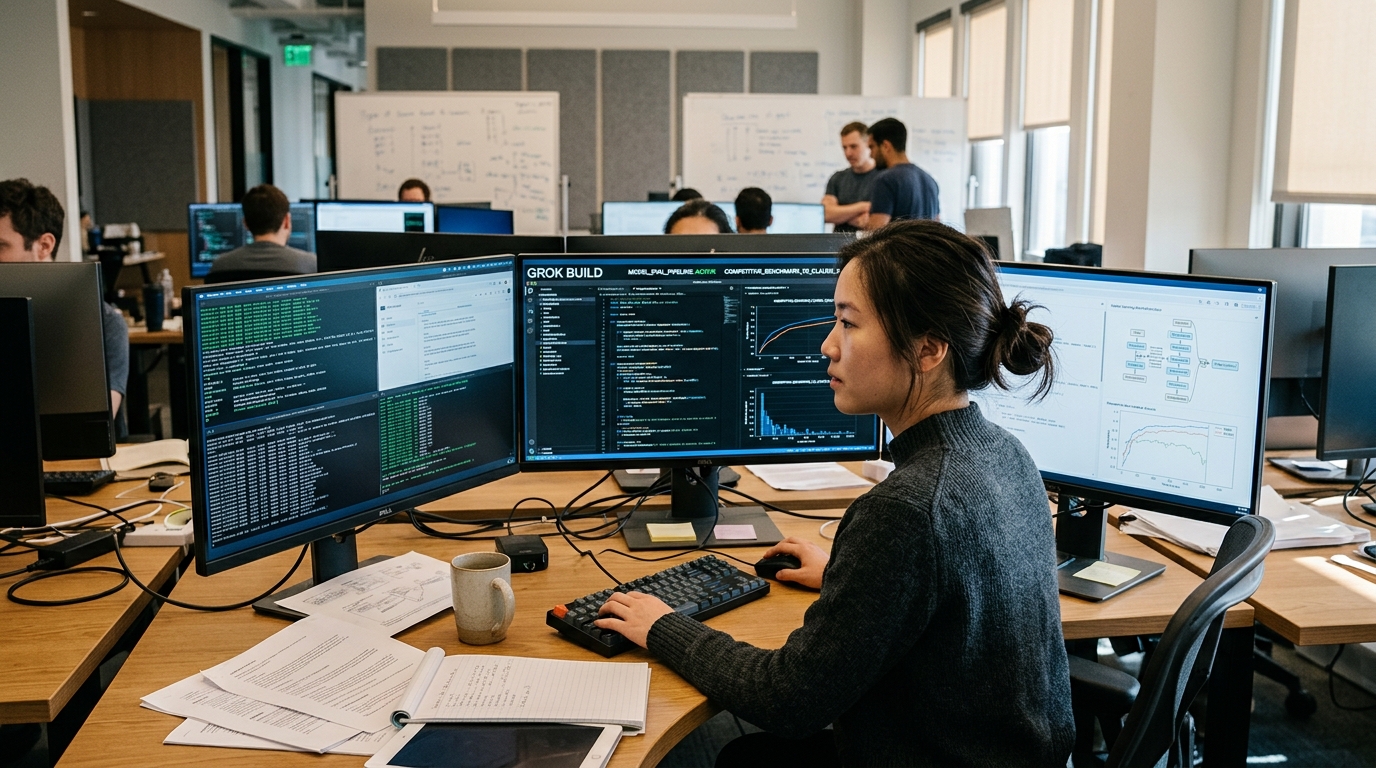
Until recently, the use of AI in programming was largely confined to sophisticated autocomplete features or solving isolated logic puzzles via chat interfaces. Grok Build represents a fundamental paradigm shift. It is not merely a tool that suggests the next line of code; it is an agent capable of comprehending entire repositories, designing architectural solutions, debugging complex errors, and executing tests autonomously.
The strategy behind xAI’s new tool relies on the raw power of the Grok-3 model, trained on the massive Colossus supercomputer cluster in Memphis. According to internal sources, Grok Build features a unique "reasoning engine" that allows it to plan before executing, utilizing advanced chain-of-thought techniques to mitigate the hallucinations that often plague its competitors.
The Rivalry with Anthropic and the Claude Dominance
The choice of Anthropic as the primary target is calculated. Claude 3.5 Sonnet has secured the loyalty of the global developer community due to its precision and its remarkably nuanced understanding of complex coding logic. Musk, however, is betting on speed and ecosystem integration. Grok Build is expected to be deeply integrated with the X platform, allowing developers to transition from a conceptual thread to a functional prototype in record time.
The market for coding agents is becoming increasingly crowded. OpenAI’s o1 model and Google’s Gemini Code Assist are also vying for dominance. However, xAI is carving out a niche by emphasizing a lack of "excessive safety guardrails" which Musk argues stifle productivity and creativity in rival models. This "unfiltered" approach to problem-solving is aimed squarely at power users who find existing AI tools too restrictive.
Implications for the Job Market and Software Engineering
The emergence of tools like Grok Build has reignited the debate over the future of the programming profession. If an AI agent can handle 80% of the tasks typically assigned to a junior developer, the organizational structure of tech companies will undergo a radical transformation. Analysts foresee a transition from the "code writer" to the "systems architect," where human expertise is focused on high-level oversight of AI-driven production pipelines.
- Automation of repetitive boilerplate code.
- Instant generation of comprehensive documentation.
- Real-time identification of security vulnerabilities.
- Significant reduction in development costs for early-stage startups.
However, significant risks remain. An over-reliance on AI-generated code could lead to massive "technical debt" if the underlying logic is flawed or if human developers lose the ability to troubleshoot the systems they oversee. Furthermore, the legal questions surrounding the training data used for these models—often scraped from public repositories—continue to pose a long-term threat to the industry's stability.
"We aren't just building a tool; we are building the partner that will allow a single individual to run a billion-dollar software enterprise," an xAI representative stated during the launch.
In conclusion, Grok Build is more than just a competitive response to Anthropic; it is the next step in Musk’s vision for an AI that moves beyond conversation into the realm of creation. The battle for the keyboard of the future has officially begun.