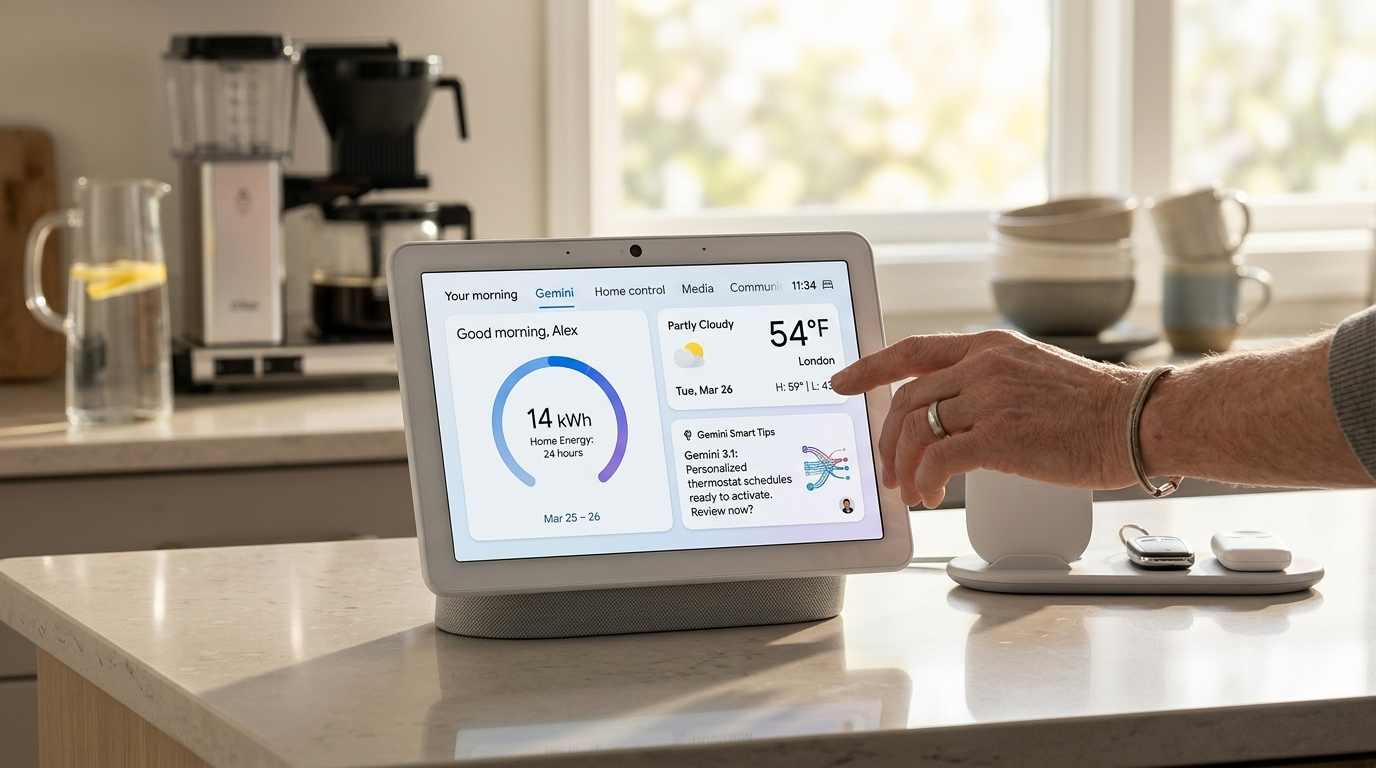
The era when the smart home was limited to simple voice commands for turning on lights or adjusting the thermostat is coming to an end. As of May 2026, Google has announced the integration of the Gemini 3.1 model into the Google Home ecosystem, a move that promises to transform the home assistant from a passive order-taker into a proactive digital manager. This upgrade is not merely an improvement in response speed, but a structural shift in how artificial intelligence perceives our private space.
Gemini 3.1: From Voice Recognition to Logical Reasoning
The headline feature of version 3.1 is its ability to handle complex, multi-step requests. Previously, a user had to issue separate commands for every action or rely on pre-set "routines" that required manual configuration via an app. Now, Gemini can understand sentences like: "If it starts raining and the living room window is open, close it and lower the AC temperature." This capability stems from the model's improved context window, allowing it to bridge data from different sensors and devices in real-time.
Google claims that the new architecture drastically reduces the comprehension failures that plagued the old Google Assistant. Gemini 3.1 no longer looks for keywords; instead, it attempts to interpret the user's intent. This means it can handle mid-sentence corrections or understand nuances. For instance, if you say, "Make the house ready for a movie," the system can automatically dim the lights, close the blinds, and activate the soundbar, based on your previous preferences and hardware capabilities.
Convergence with Matter and Interoperability
This upgrade arrives at a critical juncture for the smart home market. With the full adoption of the Matter standard, devices from different manufacturers now communicate more easily. Gemini 3.1 leverages this interoperability to offer a unified experience. It doesn't matter if your bulbs are Philips Hue and your motion sensors are from Aqara; Gemini acts as the central brain orchestrating the whole.
- Enhanced Memory: The system remembers previous interactions to suggest relevant automations.
- Edge Processing: Much of the "reasoning" now occurs locally on compatible devices (like the Nest Hub), significantly reducing latency.
- Natural Language: Communication feels more like a conversation with a human than commands to a machine.
Privacy Challenges and the Future of Living
However, increased "intelligence" brings serious questions regarding data privacy. For Gemini 3.1 to predict needs and combine actions, it requires access to a vast stream of data from inside the home. Google reassures that processing is done with security in mind, yet the idea of an LLM model "listening" and "thinking" about our daily habits causes concern for a segment of consumers.
The transition to Gemini 3.1 marks the end of the era of "dumb" assistants. The question is no longer whether the technology can execute a command, but how much we want to let it make decisions for us. As the home becomes increasingly autonomous, our relationship with our space is being redefined, turning our walls into a living, thinking network.
"AI in the home is no longer about gadgets; it's about creating an environment that senses the human condition," Google executives stated during the launch.
In conclusion, the upgrade of Google Home with Gemini 3.1 represents a milestone. While competition from Apple and Amazon remains fierce, Google seems to be taking the lead in integrating Generative AI into daily life. The success of this venture will be judged by the balance between the convenience it offers and the trust it manages to inspire in its users.